
Introduction: Free AI Tools for Marketing
Artificial intelligence is no longer something marketers encounter only in experimental projects or futuristic discussions. It has become part of the everyday marketing toolkit, quietly taking on tasks that once consumed hours of manual effort: brainstorming article ideas, researching unfamiliar subjects, refining copy, developing social media concepts, analyzing information, and preparing campaign materials.
And there is an important advantage for individuals and small businesses. You do not necessarily need to pay for an expensive software subscription before you can begin experimenting with AI. Many well-known platforms now provide free plans or free-access tools capable of handling genuinely useful marketing work. Of course, there is usually a trade-off. Free versions may impose limits on usage, restrict certain features, or reserve their most advanced capabilities for paying customers.
This guide examines 10 free AI tools for marketing in 2026, focusing specifically on what marketers can realistically accomplish without immediately committing to a paid subscription.
The objective is not to declare that one platform is universally superior to every other option. Marketing workflows differ too much for that to be particularly useful. Instead, the goal is to explain what each tool is designed to do, where its free offering may fall short, and how several specialized tools can be combined into a practical workflow.
Important: AI features, pricing, usage allowances, and availability can change. Before depending on a particular feature, always check the provider’s current pricing or help documentation.
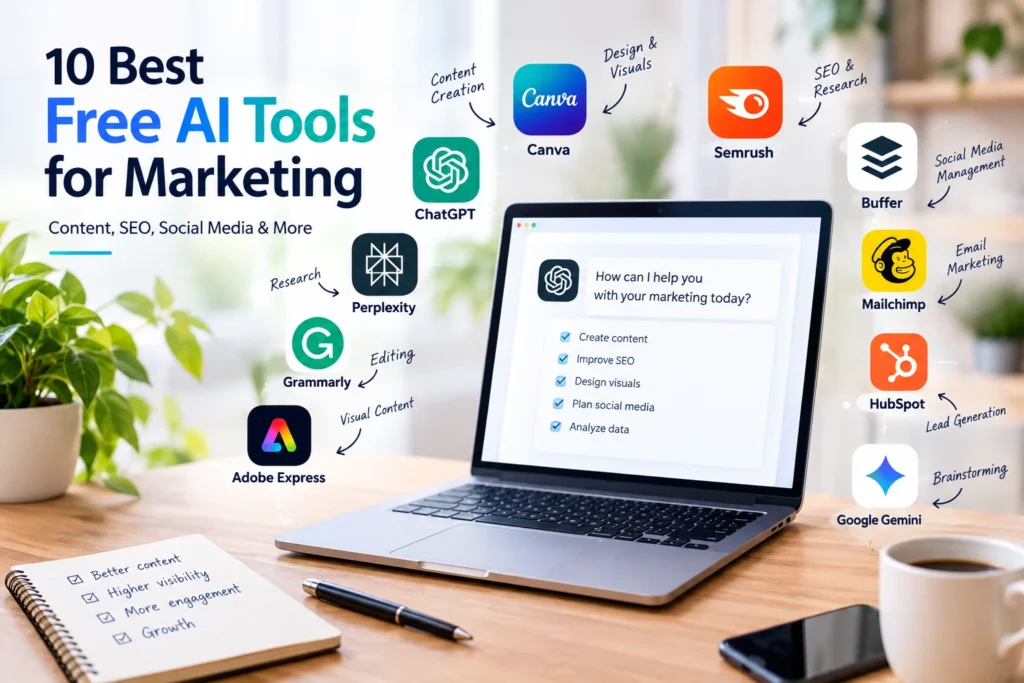
Table of Contents
What Are AI Marketing Tools?
AI marketing tools are software applications that use artificial intelligence to assist with activities connected to marketing. Their capabilities vary considerably. One platform may concentrate on writing, another on search-engine optimization, another on visual design, while others combine several functions under one interface.
Depending on the service, AI can generate or transform text, summarize large amounts of information, analyze data, produce images, suggest campaign ideas, improve existing copy, investigate topics, or help organize marketing activities.
Traditional marketing software has generally relied on predefined rules, templates, databases, and manually configured workflows. AI-powered software introduces another layer of interaction: instead of simply selecting a fixed option, users can often describe what they want in ordinary language and have the system interpret the instruction, generate something new, or transform material that already exists.
Common Marketing Tasks AI Can Assist With
AI can support a surprisingly broad range of marketing activities, including:
- Blog and article brainstorming
- Social media content creation
- Email copywriting
- Content editing
- Keyword and topic research
- SEO planning
- Competitor research
- Advertising copy ideas
- Image and graphic creation
- Campaign brainstorming
- Data analysis
- Content repurposing
Still, there is an important distinction to keep in mind.
AI works best as an assistant rather than as a substitute for marketing judgment. A marketer remains responsible for understanding the intended audience, checking important claims, protecting sensitive information, and deciding what is ultimately suitable for publication.
What Can Free AI Marketing Tools Do?
The exact capabilities of a free AI marketing tool depend on the provider, but several broad categories appear repeatedly across the market.
Content Creation
One of the most obvious uses is content production. AI can transform a rough concept into an article outline, generate several headline possibilities, develop social media drafts, summarize lengthy material, or offer alternative ways of explaining a product or service.
Consider the difference between a vague instruction such as:
“Write a blog post about email marketing.”
and a prompt that establishes the audience, objective, tone, length, and required information.
The second approach gives the AI considerably more context to work with. And context matters. The more precisely the marketer communicates the intended outcome, the easier it becomes to produce a useful first draft rather than generic filler.
SEO and Keyword Research
AI can also contribute to search-engine optimization by helping marketers brainstorm topics, organize keyword ideas, develop content briefs, and analyze existing material.
Dedicated SEO platforms can take the process much further, offering website audits, keyword information, competitor analysis, search-related metrics, and other forms of specialized research.
But AI-generated keyword suggestions should not be treated as unquestionable search data. They need to be checked against actual search information and, just as importantly, the intent behind the query. A keyword can look attractive on paper while being a poor fit for the audience or the content strategy.
Social Media Marketing
Social media is another area where AI can reduce repetitive work.
Marketers can use AI to generate post ideas, rewrite captions for different platforms, construct content calendars, adapt an existing message into several variations, or turn longer pieces of content into shorter social updates.
Some social publishing platforms go a step further by combining AI assistance with scheduling and analytics. This can create a smoother workflow: brainstorm the message, adapt it, schedule it, and then examine how the audience responds.
Email Marketing
AI can assist with nearly every early-stage part of an email campaign. It can suggest subject lines, produce draft messages, generate variations for different audiences, and help marketers rethink how an offer or announcement is presented.
Some email platforms now incorporate AI directly into campaign-building workflows, reducing the need to move between separate applications.
Yet customer-facing email deserves careful review. Every message should be checked for accuracy, clarity, brand voice, and compliance before it reaches a mailing list.
See our complete guide What is Email Marketing
Advertising and Campaign Ideas
Advertising is another area where AI can accelerate ideation.
A marketer can ask an AI system for advertisement concepts, calls to action, audience questions, creative directions, campaign themes, or different approaches to presenting an offer. What might otherwise require a long brainstorming session can become a collection of possible starting points within minutes.
That does not mean the generated ideas are ready for immediate deployment.
An advertising concept still needs to be evaluated in relation to the brand, audience, offer, budget, and applicable advertising requirements. AI can provide possibilities; testing and marketing judgment determine what deserves to move forward.
Data Analysis and Optimization
Some AI assistants can also work with marketing data. They may help summarize spreadsheets, identify apparent patterns, explain figures in simpler language, or help marketers formulate questions about campaign performance.
The quality of this analysis, however, depends heavily on the quality and context of the underlying data. A polished explanation cannot compensate for incomplete, misleading, or poorly structured information.
How to Choose the Best Free AI Marketing Tool
The word free deserves some scrutiny.
A free plan may cost nothing while still imposing meaningful restrictions. Before selecting a platform, marketers should look beyond the headline price and examine what the free version actually permits.
1. Free-Plan Limitations
Check whether the free version places limits on:
- AI prompts
- Image generations
- Monthly searches
- Contacts
- Email sends
- Scheduled posts
- File uploads
- Storage
- Advanced models or features
These restrictions can make a significant difference. A tool that appears generous during occasional use may become restrictive once it becomes part of a daily marketing workflow.
For example, Canva currently provides Free users with a limited monthly AI allowance, while Buffer’s free plan includes up to three connected channels and ten scheduled posts per channel.
2. Features
Start with the task, not the feature list.
A writing assistant may be excellent for editing and drafting while offering little value for serious SEO research. Conversely, a social media management platform may be extremely useful if you publish across several networks but unnecessary if you post only occasionally.
The right question is simple: What problem are you actually trying to solve?
3. Ease of Use
Power does not automatically translate into usefulness.
A sophisticated platform can become a burden if its interface is confusing or its workflow takes too long to learn. For beginners especially, a straightforward tool with a clear process may be more valuable than a platform packed with advanced capabilities that rarely get used.
4. Output Quality
AI-generated content can sound convincing while still being wrong.
It may contain factual errors, generic language, outdated information, or unsupported claims. Polished prose is not proof of accuracy.
Every important output should therefore be evaluated before publication, particularly when it contains factual claims that customers may rely upon.
5. Integrations
Consider the tools you already use.
If your marketing workflow depends on email software, social platforms, analytics systems, design applications, or CRM software, integrations can eliminate repetitive copying and manual transfers. A tool that fits naturally into your existing ecosystem may save more time than a theoretically more powerful application that operates in isolation.
6. Privacy and Data Considerations
AI tools often invite users to paste information directly into a prompt. That convenience comes with responsibility.
Think carefully before entering confidential business information, customer records, private documents, passwords, or other sensitive material into an AI service. Review the provider’s privacy documentation and business terms whenever the information requires additional protection.
10 Best Free AI Marketing Tools for 2026
The following tools are included because their free versions or free-access features can support meaningful marketing tasks. They are not interchangeable. Each occupies a somewhat different part of the marketing workflow, which means the most useful option depends heavily on what you are trying to accomplish.
1. ChatGPT — Best for General Marketing Assistance
ChatGPT can function as a broad, flexible marketing assistant. It can help with brainstorming, drafting, editing, summarizing, research, and the analysis of information, making it useful across several stages of the content-production process.
The current ChatGPT Free tier includes web search, file and image uploads, data analysis, image creation, and access to GPTs, although free-tier limits can change over time.
Useful Marketing Tasks
You can use ChatGPT to:
- Brainstorm content topics
- Create blog outlines
- Draft social media posts
- Rewrite marketing copy
- Develop customer personas
- Generate campaign ideas
- Analyze uploaded marketing data
- Summarize research
- Create content briefs
- Develop email variations
Example
A more useful prompt might look something like this:
“Create 10 blog topic ideas for a small accounting firm targeting local business owners. For each idea, identify the customer’s likely search intent and suggest a useful angle.”
Notice what makes the instruction effective: it establishes the business, the audience, the desired output, and the analytical element expected for each idea.
That context gives the model something concrete to work with.
Limitation
ChatGPT can produce information that sounds plausible even when it requires verification. Free usage also comes with limits, and those limits may change.
2. Canva — Best for AI-Assisted Marketing Design
Canva combines familiar graphic-design functionality with AI-assisted features, making it particularly useful for marketers who need to produce visual material without moving between a large collection of specialized applications.
From social media graphics and presentations to promotional images, documents, and other branded materials, much of the process can happen within one platform.
Canva’s current Free plan includes templates, stock assets, design tools, and limited AI usage. Canva says Free users can receive up to 20 uses of Standard or Premium AI tools under the current allowance structure, while more advanced capabilities are available through paid plans.
Useful Marketing Tasks
- Social media graphics
- Presentation designs
- Promotional images
- Simple advertisements
- Visual content ideas
- AI-assisted copy and design
- Branded marketing materials
Why Marketers May Find It Useful
The appeal is largely practical.
Instead of generating an idea in one application, searching for a separate design tool, adding branding elsewhere, and then exporting the finished asset, a marketer can move through much of that process in the same environment.
Imagine a small business preparing a promotional social post. The marketer can develop the wording, choose a visual template, incorporate brand elements, refine the design, and export the finished graphic without constantly switching applications.
Limitation
The free plan does not provide unlimited access to every AI feature or premium asset. Canva’s AI allowance and feature availability may also change over time.
3. HubSpot — Best for Small-Business Marketing Workflows
HubSpot takes a broader approach than a tool designed solely for content creation.
Its free marketing offering includes tools connected with forms, landing pages, email marketing, contact management, and reporting, while the wider platform also provides AI-focused marketing resources and tools.
Useful Marketing Tasks
- Lead generation
- Forms
- Landing pages
- Email marketing
- Contact organization
- Campaign reporting
- Marketing planning
- AI-assisted content workflows
Why It Stands Out
HubSpot becomes particularly relevant when marketing involves more than producing content.
A business may need to capture leads, organize contacts, create landing pages, send emails, and examine campaign performance. Having these functions connected can make the overall workflow more coherent than managing each activity through an unrelated service.
Limitation
Some advanced marketing automation, AI capabilities, and enterprise-level functionality require paid plans.
There is also a question of scale. For a very small operation with only a handful of straightforward marketing needs, HubSpot’s broader ecosystem may provide considerably more functionality than necessary.
Explore our HubSpot Review guide
4. Semrush — Best for SEO Research
For marketers whose strategy depends heavily on organic search, Semrush provides a more specialized set of capabilities.
Its current collection of free tools includes resources for SEO checking, website authority, competitor discovery, SERP simulation, sitemap generation, keyword and topic research, and other search-related tasks.
Useful Marketing Tasks
- SEO audits
- Keyword research
- Competitor research
- Search-result analysis
- Topic research
- Website visibility checks
- SERP previewing
Example Workflow
A content marketer might approach a new topic in several stages:
- Identify a broad subject.
- Research related search terms.
- Examine competing pages.
- Identify the questions the article should answer.
- Build a content outline.
- Write and edit the article.
- Review the page’s SEO elements before publishing.
The important point is that SEO should be treated as a process rather than a single keyword-search exercise.
Limitation
Semrush’s more comprehensive research and monitoring capabilities are part of its paid plans. Its free tools can be valuable for individual tasks, but larger campaigns may require a more complete SEO platform.
5. Buffer — Best for AI-Assisted Social Media
Buffer combines social media publishing with AI assistance, giving marketers a way to move from content creation toward actual distribution.
Its current Free plan supports up to three social channels and up to ten scheduled posts per channel, while also including AI Assistant and other basic features.
Useful Marketing Tasks
- Social post ideas
- Caption creation
- Content scheduling
- Managing multiple social channels
- Repurposing content
- Basic social insights
Example
Suppose you have written one educational blog post.
Instead of publishing the same paragraph everywhere, you could transform that single source into:
- A LinkedIn post
- Several short social updates
- A question designed to encourage audience engagement
- A promotional post
- A concise summary
The advantage is not simply producing more content. It is adapting the same underlying idea to the expectations and format of each platform.
Limitation
The free plan has publishing limits. Businesses running high-volume social strategies may eventually require a paid plan.
6. Adobe Express — Best for Quick Visual Content
Adobe Express provides a free environment for creating and editing visual material, making it another practical option for marketers who need promotional graphics without a highly specialized design workflow.
Its current Free plan includes templates, fonts, standard photo, video, and document editing, social scheduling for one account per social network, stock assets, and cloud storage. Adobe also provides AI-powered features such as image generation and other AI-assisted creation tools, with usage depending on the specific plan and feature.
Useful Marketing Tasks
- Social graphics
- Short promotional videos
- Visual advertisements
- Presentations
- Social scheduling
- Basic image editing
- AI-assisted visual creation
Limitation
Some premium assets and advanced capabilities require payment. Adobe also notes that stock assets can move between free and paid availability, so marketers should verify the licensing status of assets before publishing them.
7. Grammarly — Best for Marketing Copy Editing
Grammarly occupies a different position in the marketing workflow. Rather than being primarily concerned with generating an entire campaign from scratch, it is useful for polishing language that already exists.
Its current Free plan includes spelling and grammar assistance, tone detection, and 100 AI prompts per month.
Useful Marketing Tasks
- Website copy editing
- Email proofreading
- Social captions
- Blog editing
- Improving clarity
- Checking tone
- Refining business communication
Example
After drafting an email campaign, a marketer could use Grammarly to identify grammatical problems, improve awkward phrasing, and review whether the tone matches the intended audience.
That final editing pass can be valuable, particularly when the first draft was created quickly or assembled from several sources.
Limitation
The Free plan provides fewer rewriting and AI capabilities than Pro. Its AI assistance should also be treated as an editing aid, not as the final stage of quality control.
8. Perplexity — Best for Marketing Research
Perplexity can be useful during the research stage, particularly when a marketer needs to investigate a topic before turning that information into content.
Its current free Standard plan provides practically unlimited basic searches, while advanced searches and certain other capabilities have more restrictive limits.
Useful Marketing Tasks
- Initial market research
- Topic research
- Finding sources
- Competitor research
- Summarizing information
- Exploring customer questions
- Building research notes
Good Practice
Research-oriented AI can be an efficient discovery mechanism, but discovery is not the same thing as verification.
Use the tool to identify potentially useful information and sources, then open and evaluate important sources yourself. When a claim could affect customers, business decisions, regulations, pricing, or other consequential matters, verify it against authoritative material.
Limitation
Free access has restrictions, and AI research systems can still misunderstand sources, omit important context, or present incomplete conclusions.
9. Mailchimp — Best for Beginner Email Marketing
Mailchimp is an established email marketing platform with a Free plan designed for smaller audiences.
According to Mailchimp’s current pricing information, its Free plan supports up to 250 contacts and 500 sends per month, with a daily sending limit of 250.
Mailchimp also offers generative AI and other advanced marketing capabilities, although the availability of particular features depends on the plan.
Useful Marketing Tasks
- Email newsletters
- Basic audience management
- Email campaign creation
- Marketing messages
- Audience growth
- Testing email content
Limitation
The free audience and sending limits make the plan more suitable for smaller lists and early-stage email marketing.
As the audience grows, marketers should compare available plans and costs rather than assuming that the initial free option will remain sufficient indefinitely.
Discover more complete Mailchimp Reveiw
10. Google Gemini — Best for Google-Centric Workflows and Brainstorming
Google Gemini can assist with brainstorming, drafting, summarization, research, and working with information. For marketers already operating within Google’s wider ecosystem, that can make it a natural addition to an existing workflow.
Google’s current documentation states that users without a Google AI plan receive standard usage limits in Gemini Apps, while paid Google AI plans provide higher limits. Exact limits can change depending on usage, model, features, and system capacity.
Useful Marketing Tasks
- Brainstorming
- Content outlines
- Summarization
- Research assistance
- Drafting marketing copy
- Reviewing ideas
- Working with documents and other information
Limitation
Some advanced features have separate requirements or higher limits on paid plans. Google also notes that limits can change and that feature availability may vary.
Best Free AI Marketing Tools by Use Case
There is no single platform designed to handle every marketing problem equally well. The practical choice depends on the work in front of you.
| Marketing Task | Tools Worth Considering | What They Can Help With |
|---|---|---|
| Content creation | ChatGPT, Gemini | Ideas, outlines, drafts, rewriting |
| SEO | Semrush, ChatGPT | SEO research, content planning, analysis |
| Social media | Buffer, Canva, Adobe Express | Posts, visuals, scheduling |
| Email marketing | Mailchimp, ChatGPT, Grammarly | Campaigns, copy, editing |
| Marketing design | Canva, Adobe Express | Graphics, visual content, templates |
| Research & brainstorming | Perplexity, ChatGPT, Gemini | Research, summaries, ideas |
| Copy editing | Grammarly, ChatGPT | Grammar, clarity, tone |
| Lead generation | HubSpot | Forms, landing pages, contacts |
This table is best understood as a starting point, not a ranking. Different marketers operate under different constraints, use different channels, and need different combinations of capabilities.
Free vs. Paid AI Marketing Tools
Free AI marketing tools can be remarkably capable. For an individual marketer or a small business, they may provide enough functionality to handle a substantial portion of everyday marketing work without creating another monthly expense.
But there is an important distinction between free access and unlimited access.
In most cases, the free version is designed to let users experience the platform, accomplish useful tasks, and determine whether the product fits their workflow. As your demands increase, however, restrictions that seemed insignificant at first can become increasingly noticeable.
What You Can Realistically Do With Free Plans
A small business or individual marketer can often accomplish quite a lot with free AI tools, including:
- Content brainstorming
- Basic copywriting
- Social media ideas
- Simple graphics
- Email drafts
- Basic SEO research
- Research assistance
- Editing
- Small-scale campaign planning
For a small marketing operation, this combination can be enough to establish a functional AI-assisted workflow.
You might research a topic with one tool, develop an outline with another, refine the resulting copy with an editing assistant, create a visual asset in a design platform, and then schedule the finished content through a social media service.
No single application has to do everything.
That is often the more practical way to think about free AI software: not as a complete replacement for every professional marketing platform, but as a collection of accessible tools that can handle specific pieces of the workflow.
Common Free-Plan Limitations
The word “free” often comes with conditions.
Depending on the provider, free versions may limit:
- Number of prompts
- AI generations
- Searches
- Contacts
- Email sends
- Scheduled posts
- Storage
- Advanced models
- Automation
- Analytics
- Team features
The size and nature of these restrictions vary substantially from one provider to another. Some services may offer generous access to their basic functionality while reserving sophisticated capabilities for paid customers. Others may impose relatively modest quotas that become noticeable only when usage increases.
For that reason, marketers should examine the actual limits of a free plan rather than assuming that two products labeled “free” offer comparable value.
When Upgrading May Make Sense
A paid subscription can become useful when the free version repeatedly gets in the way of the work you are trying to accomplish.
For example, upgrading may make sense when:
- You regularly reach the free usage limit.
- You need advanced analytics.
- You require automation.
- Your team needs collaboration features.
- You manage a larger customer database.
- You need greater social scheduling capacity.
- You require more advanced SEO research.
- You need stronger brand-management features.
The important thing is to base the decision on an actual workflow requirement.
A long feature list can look impressive, but unused functionality does not necessarily create value. If a free tool handles the tasks you genuinely need, there may be little reason to upgrade simply because a paid version exists.
How to Use AI Marketing Tools Effectively
Having access to AI is only the beginning.
The real difference comes from how the technology is incorporated into the marketing process. A poorly designed workflow can turn a powerful AI tool into a generator of generic content, while a thoughtful process can make even a free tool considerably more useful.
1. Give AI Clear Prompts
The quality of an AI response is heavily influenced by the quality of the instruction.
A vague request such as:
“Write social media posts.”
leaves too many important questions unanswered.
Who is the audience? What industry is involved? Which platform are the posts intended for? What tone should they use? What should each post accomplish?
A more precise instruction would be:
“Create five LinkedIn posts for a small B2B accounting software company. Target small-business owners. Use a practical, educational tone. Each post should focus on one common bookkeeping problem and end with a useful question.”
The difference is substantial.
The second prompt establishes the business context, audience, platform, tone, subject matter, quantity, and desired structure. Instead of forcing the AI to guess, it gives the system a clearer framework within which to generate the response.
Specific instructions generally produce more useful starting material.
2. Review and Fact-Check AI-Generated Content
AI can make factual mistakes.
Sometimes the problem is obvious. More concerning are the errors that look perfectly reasonable at first glance.
Before publishing important marketing material, check details such as:
- Prices
- Product features
- Dates
- Statistics
- Names
- Regulations
- Technical information
- Links
- Claims about competitors
This becomes especially important when content could influence a customer’s purchasing decision.
A polished sentence can still contain an inaccurate claim. Good marketing therefore requires a second step after generation: verification.
3. Add Human Expertise
AI can produce a draft quickly, but human expertise gives that draft context and substance.
Human input can contribute:
- Original experience
- Industry context
- Brand personality
- Specific examples
- Better judgment
- Customer understanding
These elements matter because effective marketing is not simply a matter of producing grammatically correct sentences.
A business understands its customers in ways a generic AI model cannot automatically reproduce. It knows the objections customers raise, the questions they repeatedly ask, the terminology they actually use, and the practical problems they encounter.
That knowledge should find its way into the final content.
4. Avoid Publishing Generic AI Content
One of the easiest mistakes is treating the first AI-generated draft as the finished product.
AI makes content production faster, but speed is not the same thing as usefulness.
Before publishing, improve the material by adding:
- Original examples
- Clear explanations
- First-hand business knowledge where appropriate
- Relevant data from trustworthy sources
- Useful screenshots or illustrations
- Practical steps
- Specific answers to customer questions
The objective should not be to produce the largest possible amount of text.
It should be to produce something that genuinely helps the reader.
That distinction is important. More content is not automatically better content.
5. Combine Multiple Tools Strategically
You do not need ten subscriptions simply because ten tools appear on a list.
In fact, constantly switching between applications can create its own kind of inefficiency. A better approach is to give each tool a clear role.
A simple workflow might look like this:
Research: Perplexity or Semrush
↓
Planning: ChatGPT or Gemini
↓
Writing: ChatGPT or another writing tool
↓
Editing: Grammarly
↓
Design: Canva or Adobe Express
↓
Publishing: Buffer, Mailchimp, or HubSpot
↓
Review: Human marketer
This division of labor makes the workflow easier to understand. Research happens first. Planning follows. Writing and editing come next, followed by visual production and distribution.
The final review remains human.
The advantage is not that every tool is individually exceptional at everything. Quite the opposite. Each application is given a narrower, more appropriate responsibility.
Pros and Cons of Free AI Marketing Tools
Free AI marketing tools can remove significant barriers for individuals and smaller organizations, but their advantages come with limitations that should not be overlooked.
Advantages
Lower Cost
Free plans allow individuals and small businesses to experiment without immediately committing to recurring software expenses.
That matters when a marketer is still determining whether an AI-assisted workflow is genuinely useful.
Faster Brainstorming
AI can generate multiple starting points quickly.
For marketers facing the familiar blank-page problem, that can be valuable. Instead of staring at an empty document waiting for the perfect idea, they can begin with several possibilities and develop the strongest one.
More Accessible Marketing Capabilities
Tasks that once required specialized software—or considerable manual effort—are becoming increasingly accessible to smaller teams.
Basic design, writing assistance, research, and social scheduling can now be approached with relatively inexpensive or free tools.
Useful for Experimentation
Free tools make it easier to test an AI-assisted workflow before deciding whether advanced features justify a paid subscription.
That creates a low-risk opportunity to experiment.
Try the workflow. Measure whether it actually saves time. Identify where the limitations appear. Only then decide whether paying for additional functionality is worthwhile.
Limitations
Usage Restrictions
Free plans frequently come with quotas, reduced functionality, or limits on particular features.
A workflow that works perfectly for occasional use may become inconvenient when the same tool is needed every day.
Quality Still Varies
AI-generated material can be inaccurate, repetitive, generic, or poorly aligned with a particular audience.
Even when the writing sounds polished, the underlying information may require verification.
Privacy Concerns
Businesses should understand how information is handled before uploading confidential or sensitive material.
The convenience of an AI prompt box should not override sensible data-protection practices.
Too Many Tools Can Create Complexity
There is also a less obvious problem: tool overload.
Using a different application for every small marketing task can produce unnecessary account management, duplicated work, inconsistent processes, and constant switching between interfaces.
More tools do not automatically create a better workflow.
Common Mistakes to Avoid
When incorporating free AI tools into marketing, avoid these habits:
- Publishing AI output without reviewing it
- Treating AI-generated facts as automatically accurate
- Using generic prompts for important campaigns
- Uploading confidential information without checking privacy terms
- Choosing tools solely because they advertise many AI features
- Ignoring actual marketing data
- Creating content simply because AI makes production easier
The last mistake is particularly easy to make.
When content becomes cheap and fast to produce, the temptation is to produce more of it simply because production is easy. But marketing should begin with a purpose, not with the availability of a text generator.
Frequently Asked Questions
1. What Are the Best Free AI Tools for Marketing?
The right tool depends on the marketing task.
ChatGPT and Gemini can support general brainstorming and content work. Semrush is useful for SEO-related tasks, while Canva and Adobe Express can help with visual content. Buffer focuses on social publishing, Mailchimp supports smaller email campaigns, and HubSpot provides free marketing and lead-generation tools.
Because free-plan limits can change, marketers should check each provider’s current documentation before building a long-term workflow around a particular service.
2. Are Free AI Marketing Tools Really Free?
Many platforms offer genuine free tiers, but “free” generally does not mean unlimited.
Providers may restrict AI usage, contacts, searches, storage, scheduled posts, or access to advanced features.
For example, Canva currently limits AI usage on its Free plan, Buffer limits connected channels and scheduled posts, and Mailchimp’s Free plan places limits on audience size and email sending.
The practical question is therefore not simply whether a tool is free, but whether its free allowance is sufficient for your actual workload.
3. Which AI Tool Is Best for Marketing Beginners?
Beginners may find it useful to start with a general-purpose assistant such as ChatGPT or Gemini and then introduce specialized tools as specific needs emerge.
For instance, a beginner might use an AI assistant for planning and writing, Canva for graphics, and Buffer for social scheduling.
That approach avoids building an unnecessarily complicated technology stack at the beginning.
4. Can AI Tools Help With SEO?
Yes.
AI can assist with topic brainstorming, content outlines, search-intent analysis, editing, and SEO-related research.
Dedicated SEO platforms such as Semrush can provide additional capabilities for website audits, keyword research, competitor analysis, and search visibility.
However, AI-generated SEO suggestions should still be compared with actual search results and reliable SEO data. Search strategy requires evidence, not merely plausible-sounding recommendations.
5. Can I Use AI-Generated Content for Marketing?
AI-generated material can certainly form part of a marketing workflow, but it should be reviewed and improved before publication.
Marketers should consider accuracy, originality, brand suitability, licensing issues, privacy considerations, and any applicable platform or advertising requirements.
The AI-generated draft is the starting point—not necessarily the final product.
6. What Is the Best Free AI Tool for Social Media Marketing?
The answer depends on which part of social media marketing requires the most attention.
Buffer is useful when scheduling and managing posts is the priority. Canva and Adobe Express are useful for visual content. A general-purpose AI assistant can help with captions, brainstorming, campaign concepts, and content variations.
In many cases, using two complementary tools may be more practical than expecting one platform to handle every stage of social media marketing.
Conclusion
Free AI marketing tools have changed what individuals and small businesses can accomplish with relatively limited resources.
Tasks that once required separate applications, extensive manual work, or specialized expertise—from brainstorming and writing to SEO research, visual design, social scheduling, email campaigns, and marketing research—can now be supported by accessible AI-powered platforms.
But the smartest approach is not necessarily to collect the largest possible number of tools.
Start with the work.
Identify what you actually need to accomplish, then choose the technology that supports that process. A content-focused marketer, for example, might combine an AI writing assistant with Semrush and Grammarly. Someone concentrating on social media could pair Canva or Adobe Express with Buffer. A small business establishing its first structured marketing system might explore HubSpot, Mailchimp, and a general-purpose AI assistant.
The combination matters more than the sheer number of applications.
There is another point worth remembering: free plans change. Features disappear, limits move, usage allowances are revised, and capabilities that are available today may be structured differently later. Before building an important workflow around a particular feature, check the provider’s current pricing, usage limits, privacy documentation, and terms.
Used thoughtfully, AI does not have to replace the marketer.
It can instead remove some of the repetitive work—the first draft, the initial brainstorm, the formatting, the research starting point—leaving more time for the parts that require genuine human involvement: strategy, creativity, customer understanding, judgment, and quality.
That is where the real value lies.
Visit here AmiinMarketer.com