
Klaviyo is a customer-focused marketing platform built for businesses that want to turn customer data into more relevant, timely communication. Rather than functioning as a straightforward newsletter service, it brings together email marketing, automation, segmentation, customer profiles, analytics, forms, SMS, mobile push, integrations, and other capabilities within a broader B2C marketing ecosystem.
That breadth is both its appeal and, in some cases, its complication. A platform can offer an impressive collection of features without necessarily being the right tool for every business.
So, is Klaviyo worth using in 2026?
This Klaviyo review examines its core features, pricing structure, strengths and weaknesses, ideal use cases, ease of use, alternatives, and the practical questions businesses should consider before investing in the platform.
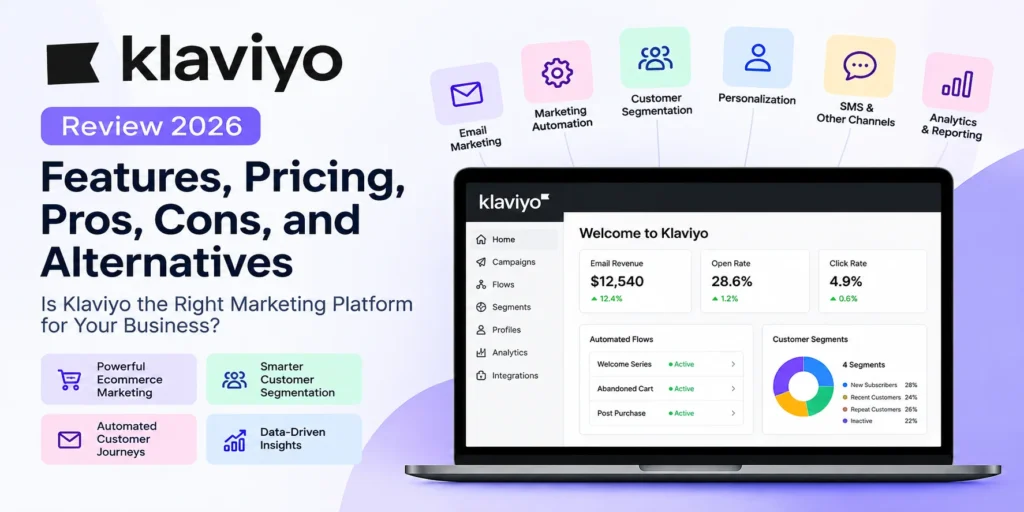
Table of Contents
What Is Klaviyo?
Klaviyo is a marketing and customer data platform centered on B2C relationships. Its fundamental idea is relatively simple: collect meaningful customer information, understand behavior, and use that information to deliver more relevant marketing at the right moment.
The difference becomes obvious when you compare a conventional newsletter campaign with a behavior-driven customer journey.
An online store, for example, could welcome a new subscriber, remind a shopper about an abandoned cart, recommend products after a purchase, and attempt to re-engage an inactive customer. Each interaction can be connected to customer data rather than treated as an isolated broadcast.
Klaviyo also supports connections with other systems. The company says its platform offers more than 350 integrations and APIs, enabling businesses to bring customer and marketing information together from multiple sources.
That makes the platform particularly relevant to ecommerce companies and consumer brands where purchasing behavior, browsing activity, and customer attributes can meaningfully influence marketing decisions.
Who Is Klaviyo Best For?
Klaviyo is primarily designed for B2C businesses that have useful customer data and want to build personalized, automated marketing experiences.
It can be especially suitable for:
- Ecommerce businesses
- Direct-to-consumer brands
- Retail companies
- Subscription businesses
- Consumer product companies
- Marketing teams managing substantial customer databases
- Businesses that need advanced email automation
- Brands coordinating communication across several channels
However, more functionality does not automatically mean more value.
A small business that sends a newsletter once or twice a month may find Klaviyo unnecessarily sophisticated. If most of its available features will sit untouched, paying for a larger platform can introduce cost and operational complexity without producing a meaningful return.
The more useful question, therefore, is not “Does Klaviyo have enough features?”
It certainly does.
The better question is “Will my business actually use those capabilities?”
Klaviyo Features
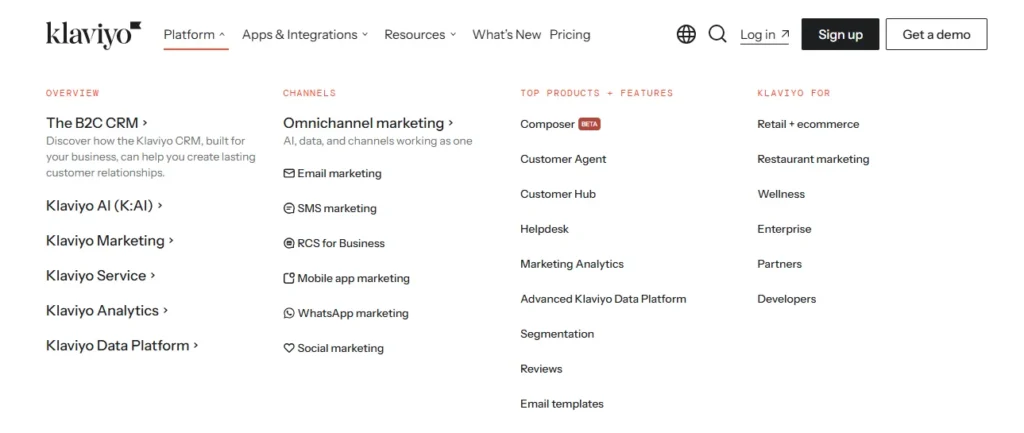
Klaviyo extends well beyond conventional newsletter functionality. Its platform combines customer profiles, campaigns, automated flows, segmentation, forms, analytics, integrations, and multiple communication channels.
Email Marketing
Email remains one of Klaviyo’s central functions.
The platform provides tools such as a drag-and-drop email editor, customizable templates, customer profiles, forms, campaigns, and automated flows. Klaviyo currently lists more than 160 customizable email templates, giving marketers a substantial starting point for different campaign types.
Businesses can use the platform for:
- Newsletters
- Promotional campaigns
- Product announcements
- Seasonal promotions
- Customer education
- Re-engagement campaigns
- Post-purchase communication
The real advantage is not merely the ability to create attractive emails. It is the ability to connect those messages with customer information.
Instead of sending one identical promotion to an entire database, marketers can use customer behavior and attributes to determine which message should reach which audience.
That distinction becomes increasingly valuable as a customer database grows.
Marketing Automation
Automation is one of Klaviyo’s defining strengths.
Klaviyo refers to its automated workflows as flows. These workflows can react to events such as a new subscriber joining a list, a customer completing a purchase, or a shopper leaving an item in their cart.
Common examples include:
Welcome flow: Introduces new subscribers to the brand and establishes the first stage of the relationship.
Abandoned-cart flow: Reminds shoppers about products they considered but did not purchase.
Post-purchase flow: Communicates useful information after an order and can support the next stage of the customer journey.
Win-back flow: Attempts to reconnect with customers who have become inactive.
Product-interest flow: Uses browsing or purchasing behavior to deliver messages related to products or categories that interest the customer.
These workflows can reduce repetitive manual tasks, but their bigger value lies elsewhere. They allow communication to respond to what customers actually do rather than relying exclusively on a fixed broadcast schedule.
That shift—from scheduled messaging to behavioral automation—is a major reason businesses consider Klaviyo in the first place.
Customer Segmentation
Klaviyo provides detailed segmentation tools for grouping customers according to different types of information.
Segments can incorporate data such as:
- Purchase history
- Website behavior
- Email engagement
- Customer attributes
- Location
- Product interactions
- Customer lifetime value
- Predicted behavior
Klaviyo says segments can update in real time and can draw on information from multiple sources. Its segmentation capabilities can also incorporate predictive information, including customer lifetime value and churn-related signals.
Imagine an ecommerce company preparing a promotion.
Instead of sending the same offer to everyone, the marketing team could create distinct groups for recent purchasers, frequent buyers, inactive subscribers, and customers who have demonstrated interest in a particular product category.
That level of targeting is one of Klaviyo’s clearest advantages.
Personalization
Segmentation answers one important question:
Who should receive the message?
Personalization asks another:
What should that person actually see?
Klaviyo can use customer and behavioral information to tailor marketing content. Depending on the available data, marketers can incorporate previous purchases, browsing activity, profile attributes, and other customer information into their communication.
For instance, a clothing retailer could recommend products based on items a customer has previously purchased or viewed rather than presenting identical recommendations to its entire audience.
Still, personalization is not magic.
More data does not automatically create better marketing. If the underlying information is inaccurate, outdated, or poorly interpreted, sophisticated personalization can become irrelevant—or simply annoying.
SMS and Other Channels
Klaviyo has expanded beyond email into a broader multi-channel marketing environment. Depending on the products, region, and plans involved, the platform supports channels such as email, SMS, mobile push, WhatsApp, RCS, social marketing, and reviews.
For businesses attempting to coordinate customer communication from a single platform, that can be useful.
A customer journey might begin with an email, continue with an SMS message, and later involve another channel based on the person’s behavior.
The advantage is coordination.
The drawback is complexity.
Using multiple channels effectively requires clear communication rules, appropriate consent practices, sensible frequency limits, and a deliberate understanding of which channel makes sense for each interaction.
Simply having more channels does not mean a brand should use all of them for every customer.
Forms and Lead Capture
Klaviyo also provides tools for collecting subscriber information through website forms. Businesses can create pop-ups, embedded forms, fly-outs, and other signup experiences designed to grow their marketing audiences.
This connects lead acquisition with automation.
For example, when someone subscribes through a website form, that person can immediately enter a welcome flow instead of merely being stored in a database and forgotten until the next newsletter is scheduled.
The journey becomes continuous: acquisition can lead directly into engagement.
Analytics and Reporting
Klaviyo provides reporting for campaigns and automated flows, while its broader analytics offerings can provide more detailed analysis. Marketers can review areas such as campaign performance, engagement, conversions, and revenue attribution. Additional Marketing Analytics functionality includes tools such as funnel analysis, cohort analysis, RFM analysis, and customer lifetime value reporting.
There is an important qualification here.
Not every advanced analytics capability necessarily comes with the basic marketing functionality. Some features are associated with additional products or depend on the plan a customer chooses.
That matters when comparing pricing.
A feature appearing in the wider Klaviyo ecosystem does not necessarily mean it is included in the specific package you intend to purchase.
Integrations
Klaviyo is designed to work alongside other business systems rather than exist as a completely isolated marketing application.
The company says its platform supports more than 350 integrations and APIs, enabling connections with ecommerce platforms, payment systems, CRM tools, analytics applications, and other services.
For ecommerce businesses, this can be particularly important.
Purchase events, product activity, customer interactions, and other signals can flow into Klaviyo and subsequently influence segmentation or automation.
Before subscribing, though, check the exact integrations your business requires. “Supports integrations” is not enough; the real question is whether the specific tools in your technology stack connect in the way you need.
Klaviyo Pricing
Klaviyo’s pricing structure can be more involved than the pricing of a basic newsletter service.
The company offers a free option, while paid plans can scale according to factors such as active profiles and channel usage. Klaviyo also provides additional products and enterprise-oriented options.
Its billing documentation indicates that different platform components can involve separate considerations, including profiles and email, mobile messaging, reviews, Marketing Analytics, Customer Hub, Helpdesk, and other products.
The free option currently includes up to 250 active profiles and 500 email sends per month, alongside a limited amount of mobile messaging credit.
Because pricing can change as your database grows and your channel requirements become more demanding, relying on an old pricing table can be misleading.
For current figures, businesses should consult Klaviyo’s official pricing information before making a purchasing decision.
Is Klaviyo Expensive?
There is no universal answer.
It depends on what you need the platform to do.
For a very small business that sends occasional newsletters, Klaviyo may offer considerably more functionality than necessary. In that situation, a simpler platform could provide a more sensible balance between features, effort, and cost.
For a growing ecommerce company that relies on segmentation, behavioral automation, customer data, personalization, and multiple channels, the additional capabilities may justify the investment.
One distinction is particularly important:
Access to a feature is not the same as value from a feature.
A business can pay for sophisticated automation, analytics, and segmentation, yet gain little from them if it lacks sufficient customer data, website traffic, marketing resources, or a strategy for using those capabilities.
Pros and Cons of Klaviyo
Klaviyo Pros
Advanced segmentation: Marketers can create detailed audiences using customer information and behavioral signals.
Powerful automation: Flows can react to customer actions and events rather than relying solely on scheduled campaigns.
Strong ecommerce focus: Klaviyo is particularly relevant to businesses that need purchase and behavioral data inside their marketing workflows.
Personalization: Customer information can be used to make marketing messages more relevant to individual audiences.
Multi-channel capabilities: Email can be coordinated with channels such as SMS and mobile push.
Large integration ecosystem: Klaviyo supports a broad collection of integrations and APIs.
Analytics: Campaign reporting is available, while additional analytics products provide deeper analytical capabilities.
Klaviyo Cons
Can become complex: Its broad feature set creates a steeper learning curve than a basic newsletter platform.
Costs can increase: Pricing can scale as the number of active profiles and messaging requirements grow.
Some advanced capabilities require additional products: Certain analytics and broader platform features may be sold separately.
May be excessive for simple needs: A business that only requires occasional newsletters may not benefit from the platform’s full complexity.
Data quality matters: Sophisticated personalization and automation depend heavily on accurate, well-organized customer data.
Klaviyo vs Traditional Email Marketing Software
A conventional email marketing service often revolves around a relatively straightforward process: create a newsletter, manage subscribers, send the campaign, and review the results.
Klaviyo takes a broader approach.
Its architecture is centered more heavily around customer data, segmentation, automated experiences, and behavioral marketing.
A basic workflow might look like this:
Create email → select list → send → review results
A more sophisticated Klaviyo workflow could look like:
Collect customer data → segment audience → trigger flow → personalize message → measure conversion → refine audience → automate the next interaction
Neither model is inherently superior.
Simplicity has value.
If a business only needs newsletters and occasional promotional messages, a lightweight platform may actually be the smarter choice. But when customer behavior needs to influence communication at scale, Klaviyo’s additional capabilities become much more relevant.
Klaviyo vs Other Marketing Platforms
Klaviyo operates in a crowded marketing technology landscape. Depending on a company’s requirements, potential alternatives can include:
- Mailchimp
- HubSpot
- ActiveCampaign
- Omnisend
- Brevo
- Campaign Monitor
The best choice depends on several variables, including business model, audience size, ecommerce infrastructure, automation requirements, budget, and technical resources.
Klaviyo vs Mailchimp
Mailchimp is widely recognized as an accessible email marketing platform and has historically appealed to businesses looking for relatively straightforward campaign management.
Klaviyo places greater emphasis on customer data, behavioral segmentation, ecommerce marketing, and advanced automation.
A small organization primarily interested in newsletters may appreciate Mailchimp’s simplicity.
A data-driven ecommerce business with complex customer journeys may prefer Klaviyo’s deeper segmentation and behavioral capabilities.
The better option depends on what the business is actually trying to accomplish.
See our complete Mailchimp Review
Klaviyo vs HubSpot
HubSpot is a broader customer platform covering areas including marketing, sales, service, and CRM functionality.
Klaviyo is more specifically oriented toward B2C customer relationships and marketing across channels.
Consequently, the comparison should extend beyond email features.
A company seeking a broader sales and service ecosystem may evaluate HubSpot differently from an ecommerce brand primarily looking to build behavior-driven customer marketing.
See our complete HubSpot Review
Klaviyo vs ActiveCampaign
ActiveCampaign is known for email marketing, automation, and CRM-related functionality.
Klaviyo tends to be particularly compelling when ecommerce customer data, purchasing activity, product interactions, and B2C personalization sit at the center of the marketing strategy.
Again, there is no universal winner. The useful comparison is the one that reflects your actual workflow.
See our complete ActiveCampaign Review
How to Get Started With Klaviyo
If you decide to test Klaviyo, resist the temptation to build dozens of complicated automations on day one.
Start with the foundations.
Connect Your Data
Begin by connecting your ecommerce store, website, or other relevant data sources.
Before creating sophisticated campaigns, verify that the important customer events are being captured correctly. A beautifully designed automation is worthless if the data triggering it is incomplete or inaccurate.
Build Your Core Segments
Start with useful, understandable audiences such as:
- New subscribers
- Recent customers
- Repeat customers
- Highly engaged subscribers
- Inactive customers
- Customers interested in specific products
There is no need to create dozens of microscopic segments immediately.
Build complexity only when it solves a real marketing problem.
Create Essential Flows
Next, build the automations associated with your most important customer journeys.
For many ecommerce businesses, that could mean:
- Welcome flow
- Abandoned-cart flow
- Post-purchase flow
- Customer win-back flow
The exact sequence will vary according to the business, product, sales cycle, and customer behavior.
Create Your First Campaigns
Once your data and core flows are functioning correctly, begin creating targeted campaigns.
Avoid the familiar trap of sending every promotion to every subscriber.
Instead, use customer information to make each communication more relevant. A smaller, better-targeted audience can sometimes be more valuable than a massive list receiving the same generic promotion.
Measure Results
Review campaign and flow performance regularly.
Open and click rates can provide useful signals, but they should not be the only measurements that matter. Depending on the business objective, marketers may also need to examine conversions, revenue, unsubscribe activity, retention, and performance across individual customer segments.
Measurement should ultimately answer a practical question:
Is the marketing producing better business outcomes?
Tips for Using Klaviyo Effectively
Keep Your Data Clean
Advanced personalization is only as reliable as the information behind it.
Regularly review duplicate profiles, outdated customer information, incorrect events, and unnecessary segments. Poor data can quietly undermine otherwise sophisticated marketing systems.
Start With High-Value Automations
Do not automate something merely because the platform allows you to.
Begin with customer journeys that have a clear purpose and a measurable outcome. Once those workflows are performing reliably, expand gradually.
Automation should remove friction, not create another layer of work.
Avoid Over-Messaging
Multiple communication channels can be useful, but that does not mean every customer should receive every message everywhere.
Establish sensible frequency rules, respect customer preferences, and follow applicable consent requirements.
A coordinated marketing strategy should feel relevant—not relentless.
Test Your Assumptions
Do not assume personalization will automatically outperform simpler messaging.
Test subject lines, content, offers, timing, audiences, and other relevant variables where appropriate. Data should challenge assumptions rather than merely confirm them.
Monitor Costs as You Grow
Keep an eye on subscription costs as your active profiles and messaging volume increase.
A platform that makes perfect financial sense for a database of 500 customers may have a very different cost profile once that database becomes substantially larger.
Growth is good. Unexpected software costs are not.
Is Klaviyo Easy to Use?
Klaviyo is reasonably approachable for marketers who already understand email campaigns and automation. However, its breadth means that it can feel considerably more involved than a basic newsletter service.
Drag-and-drop tools reduce the need for coding in many common tasks, while templates and pre-built flows provide useful starting points.
The advanced side of the platform is another story.
To use Klaviyo effectively at a sophisticated level, marketers need to understand customer data, segmentation logic, automation conditions, analytics, integrations, and the relationships between those components.
In other words:
Klaviyo can be easy to start with but sophisticated to master.
That is not necessarily a weakness. A platform with substantial depth will naturally require more learning than a tool designed only for simple newsletters.
For teams willing to understand how its data and automation systems work, that complexity can become an advantage.
Is Klaviyo Good for Small Businesses?
Klaviyo can be suitable for small businesses, particularly ecommerce companies that expect their marketing needs to become more sophisticated over time.
Its free option also gives smaller businesses an opportunity to explore core functionality before committing to a paid plan.
Still, small businesses should ask themselves whether they genuinely need advanced segmentation, behavioral automation, personalization, and multi-channel communication.
If the answer is no, a simpler platform may be easier to operate and more economical.
If the business already has meaningful customer data and wants to build automated customer journeys around that information, Klaviyo becomes considerably more attractive.
Is Klaviyo Worth It in 2026?
For the right business, Klaviyo can be a powerful marketing platform.
Its primary advantage is not simply email design. The real value lies in the combination of customer data, segmentation, personalization, automation, analytics, integrations, and multiple communication channels.
That combination is particularly useful for ecommerce and other B2C businesses where customer behavior can directly inform marketing decisions.
But Klaviyo is not automatically the best platform for everyone.
A business with a small subscriber base and straightforward newsletter requirements may gain more from a simpler and potentially less expensive service. Likewise, a company searching for a broad B2B sales CRM may be better served by software designed around longer sales cycles and account-based relationships.
The smartest decision is therefore not to ask which platform has the longest feature list.
Ask which platform best matches the way your business actually works.
Frequently Asked Questions About Klaviyo
What is Klaviyo mainly used for?
Klaviyo is primarily used by B2C businesses for customer data management, email marketing, segmentation, personalization, automation, analytics, and communication across channels such as email and SMS.
Does Klaviyo have a free plan?
Yes. Klaviyo currently provides a free option with limited usage. Its current pricing information lists up to 250 active profiles and 500 email sends per month for the free plan.
Is Klaviyo good for ecommerce?
Yes. Ecommerce is one of Klaviyo’s strongest use cases because the platform can connect customer profiles, purchasing information, website behavior, segmentation, and automated flows to create more personalized marketing journeys.
Does Klaviyo support SMS marketing?
Yes. Klaviyo supports SMS alongside email and other communication channels. Availability and pricing can vary according to the products, region, and plan being used.
Is Klaviyo better than Mailchimp?
There is no universal winner.
Klaviyo is particularly strong for data-driven B2C and ecommerce marketing, advanced segmentation, behavioral automation, and personalized customer journeys. Mailchimp may be more appropriate for businesses that prefer a simpler email marketing experience. The right choice depends on requirements, budget, technical needs, and the complexity of the marketing strategy.
Conclusion
Klaviyo is far more than a conventional email newsletter platform. By combining customer data, segmentation, personalization, automation, analytics, integrations, and multi-channel communication, it gives B2C businesses—particularly ecommerce brands—the infrastructure to build more sophisticated customer journeys.
Yet the same depth that makes Klaviyo powerful can also make it demanding.
Businesses need reliable customer data. They need sensible automation logic. They need to control communication frequency, understand their audiences, measure meaningful outcomes, and keep an eye on costs as their database expands.
For an ecommerce brand that wants to move beyond generic broadcast emails and create behavior-driven customer experiences, Klaviyo deserves serious consideration.
For a small business that only needs occasional newsletters, however, its extensive capabilities may be unnecessary. Simpler software could provide a more efficient solution.
Ultimately, the best choice comes down to fit.
Compare your actual marketing requirements with Klaviyo’s current plans, capabilities, integrations, and costs before subscribing. Pricing, features, product availability, and plan structures can change, so current official documentation should always take precedence over outdated comparisons.
Looking for the right marketing tools? Explore expert reviews, comparisons, and guides at AmiinMarketer.com.