
How Does AI Marketing Work? AI marketing works by combining artificial intelligence, machine learning, automation, predictive analytics, and large-scale data processing to help businesses understand customers, personalize experiences, create content, optimize campaigns, and make more informed marketing decisions.
Traditional marketing often depends on people manually gathering data, interpreting reports, building audience segments, creating campaigns, and monitoring results. AI changes the equation by allowing software to process enormous quantities of information, detect patterns that may be difficult to spot manually, estimate likely customer behavior, and automate selected marketing activities.
But there is an important distinction.
AI marketing is not simply a matter of opening an AI tool, entering a prompt, and publishing whatever comes back. Effective AI-powered marketing still requires strategy, accurate information, creative thinking, brand knowledge, human judgment, and responsible oversight.
This guide explains how AI marketing works, how businesses use it across different channels, what benefits it can provide, where the risks lie, and how marketing teams can introduce AI without sacrificing quality or customer trust.
Quick answer: AI marketing works by collecting and processing relevant marketing data, recognizing patterns, generating predictions or recommendations, assisting with content and decisions, automating selected actions, and using performance results to improve future marketing activities.
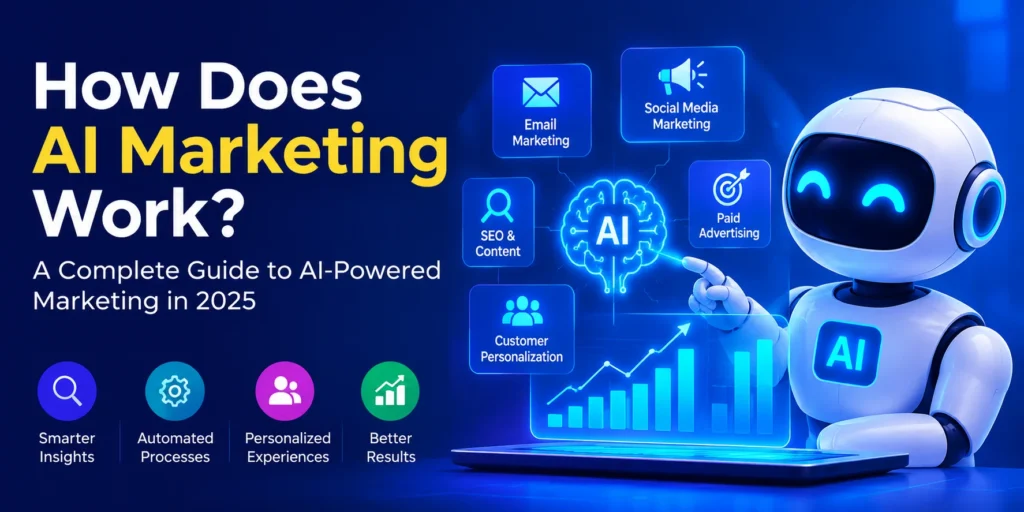
Table of Contents
What Is AI Marketing?
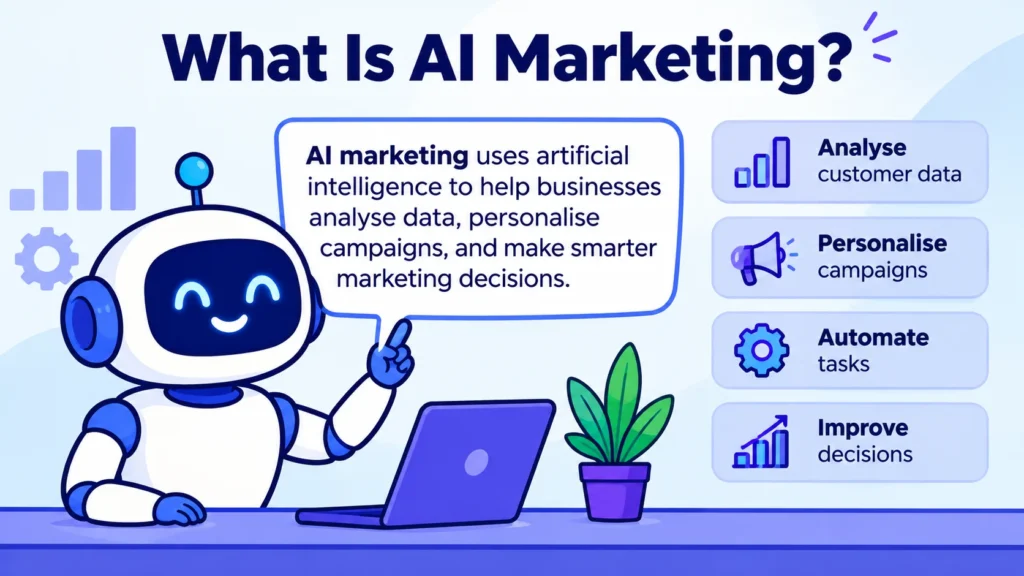
AI marketing refers to the use of artificial intelligence technologies to support, enhance, and sometimes automate marketing activities.
At its simplest, the idea is straightforward: give software access to relevant information, allow it to analyze that information using appropriate models, and use the resulting insights to support better marketing decisions.
Traditional marketing can involve hours of manual work. Marketers gather customer information, analyze campaign reports, create audience lists, write copy, review performance, and make decisions about what to do next.
AI can assist with many of these activities.
Depending on the system, AI marketing may involve:
- Machine learning
- Natural language processing
- Generative AI
- Predictive analytics
- Recommendation systems
- Computer vision
- Automated decision systems
- Conversational AI
These technologies do different jobs.
A machine-learning model, for example, might identify behavioral patterns among customers. A recommendation engine could determine which products or content might be relevant to a particular visitor. Generative AI, meanwhile, can help produce an initial draft of an email, article, advertisement, or social media post.
The technology varies. The underlying principle remains similar.
AI is a marketing capability, not a complete marketing strategy.
A business still needs to understand its audience, define its objectives, establish a compelling message, decide where and how to communicate, and determine what success actually looks like.
AI can accelerate parts of that process. It cannot magically provide a coherent strategy where none exists.
Read a complete article about What Is AI Marketing?
How Does AI Marketing Work?
So, how does AI marketing work in practice?
Although AI-powered marketing platforms can be remarkably sophisticated, their underlying workflow can often be understood through a sequence of connected stages.

Data Collection
The process generally begins with information.
Depending on the organization and its systems, relevant marketing data might include website interactions, purchase history, email engagement, campaign responses, customer preferences, product activity, or other appropriately collected business information.
The quality of this information matters enormously.
An AI system does not automatically transform unreliable data into reliable insight. If the underlying information is inaccurate, incomplete, outdated, duplicated, or poorly structured, the resulting recommendations may be equally unreliable.
Data Processing
Once data is available, AI systems can process it at a scale that would be difficult to manage manually.
The system may compare thousands or millions of records, identify relationships between variables, classify information, and search for signals that could be useful for marketing decisions.
For instance, a system might notice that customers who repeatedly view a particular product category also tend to engage with educational content about that category.
That observation can then become part of a broader marketing workflow.
Pattern Recognition
Pattern recognition is one of the central capabilities behind many AI marketing applications.
Instead of asking a marketer to manually examine every customer record, a machine-learning system can evaluate large datasets and identify recurring behaviors or correlations.
These patterns might relate to:
- Customer engagement
- Purchase behavior
- Content preferences
- Conversion activity
- Churn risk
- Campaign response
- Product interests
Importantly, recognizing a pattern does not necessarily mean discovering a cause. Correlation can be useful, but marketers should avoid treating every AI-generated association as proof of causation.
Prediction and Recommendation
Some AI systems go beyond describing what has already happened. They attempt to estimate what might happen next.
A predictive model could, for example, help identify leads that appear more likely to convert or customers who may be interested in a particular product category.
Recommendation systems can similarly estimate which content, products, or messages may be relevant to a user.
These outputs are best understood as decision support, not certainty.
A prediction is an informed estimate based on available information and the design of the underlying model. It can be useful without being infallible.
Content or Decision Generation
Generative AI adds another layer.
Instead of simply analyzing existing information, generative systems can produce new material such as text, images, summaries, ideas, outlines, or advertising variations.
Other AI systems may generate classifications, scores, recommendations, or suggested actions.
At this point, human judgment becomes particularly valuable. A marketer can review the output, correct inaccuracies, adapt the tone, verify important claims, and determine whether the proposed action makes sense.
Automation
Once a workflow has been designed and tested, selected actions can be automated.
Imagine a customer downloading a guide from a website. A marketing automation platform could record the event, update the customer’s profile, place the person into an appropriate audience, trigger a follow-up email, and notify another team when predefined conditions are met.
The system handles the sequence.
The marketer defines the strategy and the rules.
Measurement and Improvement
AI marketing does not end when a campaign is launched.
Performance data feeds back into the process.
Marketers can examine engagement, conversions, customer behavior, campaign efficiency, and other relevant outcomes, then use those findings to refine future campaigns.
The cycle can be summarized as:
Data → Analysis → Prediction → Action → Measurement → Improvement
That feedback loop is one of the most important characteristics of modern AI-assisted marketing.
How AI Collects and Analyzes Marketing Data
Data sits at the center of many AI marketing systems.
The exact information available depends on the business, its technology stack, customer relationships, permissions, and applicable privacy requirements. AI is only as useful as the information it is allowed and able to work with.
Customer Interaction Data
Marketing systems may analyze interactions such as:
- Website visits
- Product views
- Email opens and clicks
- Purchases
- Form submissions
- Customer-service interactions
- Campaign responses
- Content engagement
These signals can provide context about how customers interact with a brand.
However, businesses must collect and use customer information responsibly. More data is not automatically better data.
Campaign Performance Data
AI can also examine how previous campaigns performed.
For example, it may help marketers understand:
- Which campaigns generated engagement
- Which audiences responded most strongly
- Which messages produced better results
- Which channels contributed to conversions
- Where customers dropped out of a funnel
- Which creative variations performed differently
Instead of looking at isolated metrics, marketers can use AI-assisted analysis to uncover relationships across multiple datasets.
Predictive Analysis
Predictive systems use historical information to estimate future possibilities.
A company might use predictive analysis to prioritize sales leads, estimate customer churn risk, identify likely product interests, or determine which audiences may be more responsive to particular campaigns.
The important word is estimate.
Predictive marketing is not fortune-telling. Customer behavior can change, external circumstances can shift, and models can make mistakes.
Why Data Quality Matters
There is a simple rule worth remembering:
Poor data can produce poor recommendations.
If customer records contain duplicates, missing information, outdated preferences, incorrect classifications, or systematic bias, an AI system may reproduce those problems at scale.
This is why responsible AI marketing begins long before the model is selected. Data governance, accuracy, privacy, and relevance are foundational.
AI-Powered Customer Segmentation and Targeting
Customer segmentation involves dividing an audience into groups that share relevant characteristics, behaviors, needs, or interests.
Traditional segmentation may rely on relatively broad attributes such as location, age, industry, purchase history, or customer status.
AI can examine combinations of signals that are considerably more complex.
An ecommerce company, for example, might identify groups according to:
- Product interests
- Purchase frequency
- Browsing behavior
- Engagement patterns
- Customer lifecycle stage
- Previous campaign responses
- Average order behavior
Dynamic Segmentation
One of the more interesting advantages of AI-assisted segmentation is that customer groups do not necessarily have to remain fixed.
People change.
A visitor who has never purchased may become a first-time buyer. That customer may later become a repeat purchaser, a high-value customer, or eventually an inactive customer.
AI-powered systems can help marketing platforms respond to these changing signals rather than treating every customer as permanently belonging to the same category.
More Relevant Targeting
Better segmentation can make marketing communication more useful.
Instead of sending one generic message to an entire database, marketers can adapt campaigns according to customer needs, behavior, or stage in the buying journey.
But there is a boundary.
Targeting should never become an excuse for invasive, discriminatory, or irresponsible marketing practices. Privacy, fairness, transparency, and applicable regulations must remain part of the decision-making process.
AI Personalization in Marketing
Personalization is the practice of adapting marketing experiences so they are more relevant to individual users or defined audience groups.
AI can support this process by analyzing available signals and helping determine which message, product recommendation, content element, or experience may be most appropriate.
Examples of AI Personalization
Consider an online retailer.
A visitor who repeatedly browses running shoes may receive recommendations related to running footwear rather than unrelated products. An email platform might present different content to customers based on previous interactions. A streaming service can recommend programs according to viewing behavior.
The technology varies by industry, but the principle is similar:
Use relevant information to make the customer experience more useful.
Personalization Versus Excessive Targeting
There is, however, a delicate balance.
Personalization can feel helpful when it reflects an obvious customer interest. It can feel unsettling when a company appears to know far more about an individual than that person expected.
Effective AI marketing therefore considers not only relevance, but also context and customer expectations.
The question is not merely, “Can we personalize this?”
A better question is:
“Should we personalize this, and will the customer understand why?”
AI Content Creation and Optimization
Generative AI has rapidly become part of many marketing workflows.
It can help marketers move from a blank page to a workable first draft much faster.
Common applications include:
- Brainstorming content ideas
- Creating article outlines
- Drafting social media posts
- Developing email variations
- Summarizing research
- Generating advertising concepts
- Rewriting material for different audiences
- Suggesting headlines
- Producing initial content drafts
The key word is assist.
AI-generated content should not automatically be treated as finished content.
Why Human Review Matters
Generative AI can produce information that sounds polished while being incorrect. It can misinterpret context, invent details, use an inappropriate tone, or create wording that conflicts with a brand’s positioning.
A responsible workflow is therefore closer to:
Research → AI assistance → Human review → Fact-checking → Editing → Publication → Monitoring
rather than:
AI generation → Immediate publication
That distinction matters.
Human review provides an opportunity to verify facts, improve originality, adjust tone, remove unnecessary claims, and ensure the final piece actually serves the reader.
AI Content and SEO
Using AI does not automatically make content more useful to searchers.
A website can publish hundreds of AI-generated articles and still provide very little value if those pages merely repeat information that already exists elsewhere.
Search-focused content should answer real questions, demonstrate useful expertise, remain accurate, and give readers a reason to trust and remember the site.
The tool used to produce the first draft is secondary to the quality of the final experience.
AI in Advertising and Campaign Management
Advertising is another area where AI can influence how marketing campaigns are planned, delivered, and optimized.
Modern digital advertising systems can use automated models to evaluate campaign signals and assist with tasks such as audience selection, bidding, creative testing, and optimization.
AI-Assisted Audience Selection
Rather than relying exclusively on manually constructed audience definitions, AI-powered systems can analyze available signals and identify users who may be more likely to respond to a particular campaign.
This can make audience targeting more dynamic.
But automation does not eliminate the need for monitoring. Marketers still need to understand what the system is optimizing for and whether the resulting audience aligns with the campaign’s actual business objective.
Creative Testing
AI can also help produce multiple creative variations.
These might include:
- Headlines
- Descriptions
- Images
- Calls to action
- Ad copy
- Promotional concepts
Marketers can then review the alternatives and test appropriate versions through the advertising platform.
The objective is not simply to create more variations. It is to learn which combinations actually resonate with the intended audience.
Campaign Optimization
AI can help identify patterns across audience, placement, creative, timing, and performance signals.
This may allow campaigns to adjust more quickly than a completely manual workflow.
Still, marketers should not assume that automated optimization is always correct. The system is optimizing according to its inputs, objectives, and constraints. Human oversight remains necessary.
AI Marketing Automation
Marketing automation allows software to execute predefined workflows with limited manual intervention.
AI can make these workflows more adaptive by helping systems interpret information, classify customers, generate content, or recommend an action.
Common AI Marketing Automation Examples
Businesses can automate or assist with:
- Welcome email sequences
- Lead follow-ups
- Product recommendations
- Content suggestions
- Audience updates
- Campaign alerts
- Customer-service responses
- Reporting and summaries
Imagine that someone downloads an industry guide.
The system could record the interaction, classify the contact according to established criteria, send a relevant follow-up message, update the customer’s marketing profile, and notify a sales representative if specific conditions are satisfied.
That is not magic.
It is a connected workflow in which AI may perform analysis or classification while automation executes the operational steps.
Automation Still Needs Supervision
Automation can save enormous amounts of time.
It can also repeat a mistake thousands of times.
That is why responsible implementation involves testing, monitoring, clear rules, approval points, and mechanisms for intervention when something behaves unexpectedly.
The more consequential the action, the more carefully it should be supervised.
AI-Powered SEO and Search Marketing
AI is increasingly woven into SEO workflows, from research and content planning to analysis and optimization.
It can help marketers identify topics, organize information, uncover possible content gaps, summarize research, generate ideas, and improve the structure of existing material.
AI Keyword and Topic Research
AI tools can help organize related topics and surface questions that audiences may be asking.
However, automated keyword suggestions should not be accepted blindly.
Search volume is only one part of the equation. Search intent, relevance, competition, content quality, and the actual needs of the audience matter too.
Content Optimization
AI can assist with:
- Content outlines
- Topic organization
- Internal linking suggestions
- Title variations
- Meta description drafts
- Readability improvements
- Content gap analysis
Used properly, these capabilities can reduce repetitive work and help marketers examine large amounts of information more efficiently.
Technical SEO Support
AI can also help analyze substantial quantities of website data and flag potential technical issues.
That can be useful for large websites.
However, technical SEO decisions can have far-reaching consequences. Changes involving indexing, site architecture, accessibility, redirects, structured data, or performance should be reviewed by someone who understands the underlying systems.
AI-Generated SEO Content
Generating thousands of pages solely because they might attract search traffic is not a sustainable SEO strategy.
The important question is not:
“Was AI used?”
It is:
“Does this content provide genuine value?”
AI can support research, drafting, editing, and maintenance. But content created primarily at scale without meaningful value can create quality and search visibility problems.
AI for Email and Social Media Marketing
Email and social media marketing contain many repetitive activities, making them natural candidates for AI assistance.
AI in Email Marketing
AI can support tasks such as:
- Subject-line generation
- Audience segmentation
- Personalization
- Send-time analysis
- Content variation
- Campaign summaries
- Performance analysis
For example, a marketer might use AI to generate several subject-line ideas, refine them according to brand guidelines, and then test selected versions against a defined audience.
The technology accelerates the process. The marketer remains responsible for the final decision.
Learn more about Emaile Marketing.
AI in Social Media Marketing
Social media teams can use AI for:
- Content ideation
- Caption drafting
- Post variations
- Audience analysis
- Content calendars
- Comment categorization
- Performance summaries
Yet social media is particularly sensitive to context.
A sentence that appears harmless in isolation can become inappropriate when paired with a particular event, audience reaction, or cultural moment. Human review is therefore especially valuable.
Real-World Examples of AI Marketing
AI marketing is not confined to one sector.
Its applications differ according to the business model, customer journey, available data, and operational needs.
Ecommerce
An ecommerce company can use AI to recommend products, analyze customer behavior, personalize email campaigns, generate product-content drafts, segment customers, and evaluate campaign performance.
A recommendation engine might identify that visitors with certain browsing patterns frequently purchase particular combinations of products and then use that insight to personalize future experiences.
B2B Marketing
B2B organizations can use AI to analyze leads, summarize customer interactions, organize account information, identify potential opportunities, and prioritize follow-up activities.
But B2B relationships are rarely built by algorithms alone.
Sales professionals still need to understand the customer’s business, communicate thoughtfully, and verify important information before acting on automated recommendations.
Media and Publishing
Publishers can use AI for research assistance, topic organization, recommendation systems, audience analysis, and content workflows.
Editorial judgment remains indispensable.
When accuracy, credibility, and public trust matter, a polished AI output is not enough.
Travel and Hospitality
Travel companies can use AI to personalize recommendations, analyze customer preferences, support customer-service workflows, and improve campaign targeting.
A hotel, for example, might use customer preferences and previous interactions to provide more relevant recommendations or communications.
Small Businesses
Small businesses do not necessarily need complicated AI infrastructure.
Practical applications may include:
- Drafting marketing content
- Summarizing performance reports
- Generating campaign ideas
- Organizing customer information
- Drafting emails
- Analyzing campaign results
- Creating content variations
Sometimes the most valuable AI application is also the simplest.
Saving several hours every week on a repetitive task can be more meaningful than implementing an elaborate system that nobody fully understands.
Benefits of Using AI in Marketing
AI marketing can provide substantial advantages when the technology is matched to a genuine business need.
Faster Analysis
AI can process large quantities of information rapidly.
This can help marketers identify trends, compare campaign performance, and uncover patterns without manually examining every individual record.
Greater Personalization
AI can help businesses adapt marketing experiences to different customer groups and behavioral signals.
Done responsibly, this can make communication more relevant rather than simply more frequent.
Reduced Repetitive Work
Tasks involving summarization, classification, drafting, reporting, and routine analysis can often be assisted or partially automated.
That frees marketers to spend more time on strategy, creativity, experimentation, and customer understanding.
More Scalable Marketing Operations
A well-designed AI workflow can help teams handle larger volumes of data, content, or customer interactions without increasing every manual task at the same rate.
This is particularly valuable for growing organizations.
Better Decision Support
AI can surface patterns, recommendations, and predictions that provide additional context for marketing decisions.
It should strengthen human judgment, not remove human accountability.
Faster Experimentation
AI can help marketers generate multiple ideas quickly, making it easier to explore alternative messages, creative concepts, audience strategies, or content structures.
But speed should not replace rigor. Experiments still need clear objectives, appropriate measurement, and careful interpretation.
Challenges and Risks of AI Marketing
AI marketing has considerable potential, but it is not without weaknesses.
The technology can amplify both good processes and bad ones.
Inaccurate Information
Generative AI can produce convincing statements that are factually wrong.
This is particularly important when creating content involving legal, financial, medical, technical, or other high-impact subjects.
Fact-checking is not optional in these situations.
Privacy Concerns
Marketing systems can process considerable amounts of customer information.
Businesses need to understand what information is being collected, why it is needed, where it goes, who can access it, and what privacy requirements apply.
The introduction of AI does not remove existing responsibilities around customer information.
Bias and Unfair Outcomes
AI systems can reflect problems contained within their data, design, or implementation.
If a historical dataset contains biased patterns, an automated system may reproduce or even magnify them.
Organizations should therefore consider fairness, potential harmful bias, transparency, and accountability when evaluating AI systems.
Brand Inconsistency
AI-generated copy may be grammatically polished but still feel completely wrong for the brand.
It may use an overly promotional tone, make claims the company would never normally make, or communicate in language that does not fit its audience.
Clear brand guidelines and human editing can help.
Over-Automation
There is a temptation to automate everything.
That can backfire.
Some customer interactions require empathy, nuance, judgment, and genuine human understanding. Turning every interaction into an automated sequence may make a brand feel less personal, not more.
Dependence on Tools
Marketing teams can become overly dependent on particular AI platforms.
Tools change. Pricing changes. Features disappear. Models improve and sometimes behave differently.
A resilient marketing strategy should therefore remain understandable and operational even when individual tools evolve.
Regulatory and Platform Changes
AI-related regulations, privacy requirements, and platform policies continue to evolve.
Businesses should review current requirements in the countries and industries where they operate instead of assuming that guidance from several years ago remains accurate.
How to Use AI Marketing Effectively
Successful AI marketing is not about collecting the largest possible number of AI tools.
It is about solving the right problems.
Start With a Specific Marketing Problem
Instead of asking:
“How can we use AI?”
Ask:
“Which marketing task consumes too much time, produces inconsistent results, or requires analysis that could be improved?”
That small change in perspective can dramatically improve the quality of an AI project.
Start with the problem. Then choose the technology.
Choose the Right Data
AI systems need relevant and reliable information.
Use data that is accurate, appropriately collected, properly governed, and genuinely connected to the marketing objective.
More data does not automatically mean better marketing.
Sometimes it simply means more noise.
Keep Humans Involved
Define where human approval is required.
For instance, an AI system might draft an email, but a marketer could review the copy, verify its claims, check personalization, and approve the final message before it reaches customers.
The appropriate level of oversight depends on the potential consequences of the action.
Test Before Scaling
Do not begin by automating an entire marketing department.
Start with a manageable workflow.
Measure what happens. Identify failures. Refine the process. Then expand.
Small experiments can reveal problems before those problems become expensive.
Protect Customer Information
Every AI tool connected to customer or business information deserves scrutiny.
Marketing teams should understand how the platform handles data, what permissions are required, where information may be processed, and whether the intended use is appropriate.
Avoid placing sensitive information into systems without understanding the associated risks and controls.
Establish Quality Standards
AI marketing workflows should have clear standards covering:
- Brand voice
- Accuracy
- Privacy
- Human review
- Content quality
- Customer experience
- AI disclosure where appropriate
- Performance measurement
These standards make AI adoption more consistent and easier to govern.
Measure Business Outcomes
Do not judge an AI project solely by the amount of content it produces.
A system can generate thousands of headlines and still provide little business value.
Instead, consider meaningful outcomes such as:
- Customer experience
- Qualified leads
- Conversion quality
- Customer retention
- Marketing efficiency
- Content quality
- Campaign performance
- Revenue contribution
The right metrics depend on the objective.
The Future of AI Marketing
AI marketing will continue to evolve as artificial intelligence models, marketing platforms, automation systems, customer-data technologies, and search experiences become increasingly interconnected.
The most significant change may not be the arrival of another standalone AI tool.
It may be the gradual disappearance of the boundaries between tools.
Instead of using one application for research, another for content creation, another for campaign management, and yet another for performance analysis, marketing platforms may increasingly connect these activities into unified workflows.
Imagine a system that helps identify a customer need, researches relevant topics, develops content, distributes it through appropriate channels, measures the response, and recommends improvements.
That direction is already shaping how marketers think about automation.
But technology does not make marketing fundamentals obsolete.
They remain remarkably durable:
Understand the customer → Provide value → Communicate clearly → Build trust → Measure results → Improve
AI can accelerate parts of this sequence. It can make certain processes more scalable. It can reveal patterns that humans might overlook.
What it cannot do is eliminate the need for responsible decision-making.
The future of marketing is therefore unlikely to be as simple as “AI replaces marketers.”
A more realistic model is AI-assisted marketing.
Machines handle more analysis, repetitive processing, pattern recognition, and routine production. People remain responsible for strategy, creativity, context, judgment, relationships, oversight, and accountability.
That distinction will become increasingly important as AI systems become more capable.
Frequently Asked Questions
What is AI marketing in simple terms?
AI marketing is the use of artificial intelligence to help businesses analyze marketing information, understand audiences, personalize customer experiences, create content, automate repetitive tasks, and improve marketing decisions.
In simple terms, AI helps marketers work with more information and automate selected activities more efficiently.
How does AI marketing work?
AI marketing generally works by collecting relevant data, processing that information, identifying patterns, generating predictions or recommendations, assisting with content or decisions, automating selected actions, and analyzing results to improve future marketing activities.
The exact process varies according to the technology and marketing objective.
Can AI replace human marketers?
AI can automate or assist with many marketing tasks, but it does not eliminate the need for human strategy, creativity, judgment, communication, and accountability.
The strongest approach is often collaborative: AI handles tasks it is well suited to perform while marketers provide context, direction, quality control, and final decision-making.
Is AI-generated content good for SEO?
AI-generated content can be useful when it is accurate, relevant, original, helpful, and created to satisfy genuine user needs.
However, using AI primarily to produce large quantities of low-value pages for search manipulation can create problems.
The quality and usefulness of the finished content matter far more than simply whether AI was involved in producing it.
What are the biggest risks of AI marketing?
Common risks include inaccurate outputs, privacy issues, biased results, poor-quality content, excessive automation, security concerns, brand inconsistency, and overreliance on automated recommendations.
Businesses should assess these risks before connecting AI to important customer-facing or business-critical workflows.
Conclusion
Understanding How Does AI Marketing Work begins with a simple but important distinction: artificial intelligence is not a replacement for marketing strategy.
It is a collection of technologies that can help marketers process information, recognize patterns, generate predictions, personalize experiences, create content, automate repetitive work, and make more informed decisions.
The strongest AI marketing strategies do not begin with a fascination for technology. They begin with a real business problem.
A marketing team identifies an inefficient process, determines what data is genuinely useful, chooses an appropriate AI capability, establishes human oversight, tests the workflow, measures the results, and improves it over time.
That approach is far more sustainable than trying to automate everything at once.
AI can make marketing faster. It can make certain operations more scalable. It can help teams analyze information that would otherwise be difficult to process manually.
But speed is not the ultimate objective.
The real goal is to create better customer experiences, deliver more relevant communication, improve decision-making, and generate meaningful business outcomes without compromising accuracy, privacy, quality, trust, or human judgment.
For businesses adopting AI today, the smartest path is usually incremental.
Start small. Test carefully. Measure honestly. Improve continuously. Then scale what works.
That is where AI marketing becomes more than a collection of impressive tools. It becomes a practical capability that can strengthen the way a business understands, serves, and communicates with its customers.