
Introduction
What Is AI Marketing? AI marketing uses artificial intelligence to analyse customer data, personalise campaigns, automate repetitive tasks, and improve marketing decisions. From AI-generated content and chatbots to predictive analytics and personalised recommendations, AI is changing how businesses connect with customers.
In this guide, we’ll explore how AI marketing works, its key benefits, real-world examples, challenges, and its future.
Table of Contents
What Is AI Marketing?
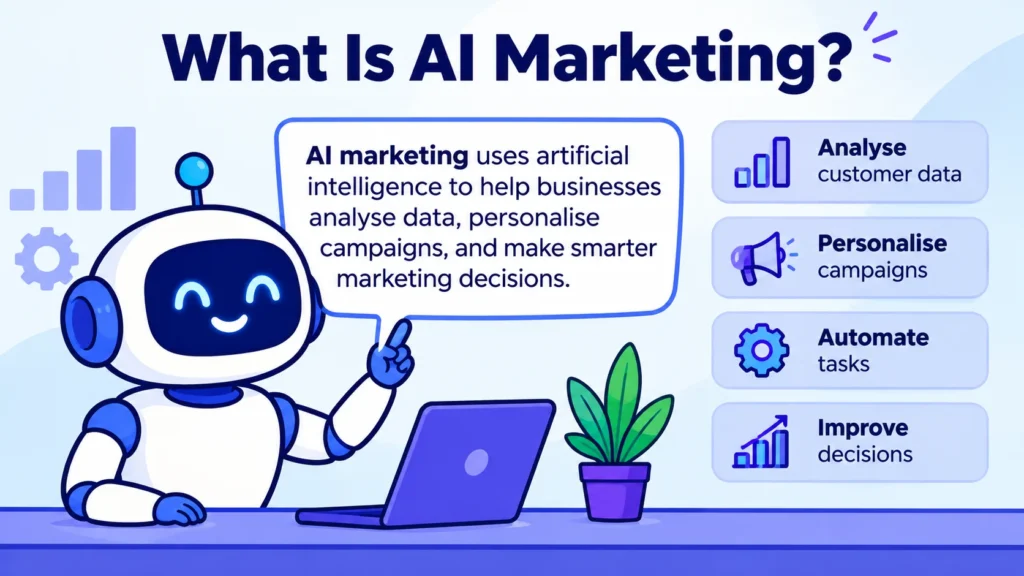
What Is AI Marketing? AI marketing refers to the use of artificial intelligence technologies to make marketing more intelligent, efficient, personalised, and responsive. Rather than depending entirely on manual research, fixed processes, and historical assumptions, businesses can use AI to process vast amounts of information, uncover behavioural patterns, and turn those insights into practical marketing decisions.
AI can influence almost every stage of the customer journey. It can help marketers discover content opportunities, generate campaign ideas, segment audiences, personalise communications, predict customer behaviour, optimise advertising, respond to routine enquiries, and evaluate campaign performance. In other words, AI is not confined to one marketing channel. It can become part of the broader marketing ecosystem.
One of its biggest advantages is speed. A marketing team might spend hours reviewing customer data, campaign reports, or engagement patterns. An AI system can analyse comparable information far more quickly, potentially revealing relationships that would be difficult to identify manually. This allows marketers to move from simply collecting data to actually using it.
Consider an ecommerce company with thousands of customers. AI could examine browsing activity, previous purchases, product interactions, and engagement history to determine what each customer might be interested in next. The business could then use those insights to recommend products, personalise email campaigns, or deliver more relevant advertising.
But AI marketing does not mean removing people from marketing. That distinction matters.
AI is particularly effective at handling data-heavy, repetitive, and highly scalable tasks. Human marketers, meanwhile, remain essential for strategy, creativity, brand positioning, ethical judgement, and understanding the emotional side of customer relationships. The strongest results often come from combining both strengths rather than treating them as competing approaches.
What Makes AI Marketing Different?
The biggest difference lies in how marketing data is processed and acted upon. Traditional marketing can involve marketers manually examining reports, identifying trends, creating audience segments, and deciding what to do next. AI can perform many of these analytical tasks at a much greater scale and speed.
AI can also make personalisation more dynamic. Instead of showing every visitor the same website experience or sending every subscriber an identical message, AI systems can consider behavioural signals and adjust recommendations, content, or offers accordingly.
For example, an ecommerce website could recognise that a visitor repeatedly views a particular category and use that information to surface related products. An email platform might identify which types of content a subscriber engages with most frequently and use those signals to make future communications more relevant.
However, AI is not automatically intelligent simply because it is automated. Its effectiveness depends on the quality of the data, the technology being used, and the decisions made by the people overseeing it.
Marketers still need to define clear objectives, evaluate AI-generated recommendations, verify important information, protect customer data, and ensure that every campaign reflects the company’s brand and values.
Ultimately, AI marketing works best as a partnership between technology and human expertise. AI brings speed, scale, pattern recognition, and automation. People bring creativity, context, judgement, and strategic direction. Together, they can create marketing that is not only more efficient, but also more relevant and meaningful.
How Does AI Marketing Work?
To understand What Is AI Marketing, it helps to look beyond the definition and examine what happens behind the scenes. AI marketing brings together customer data, machine learning, predictive analytics, automation, and intelligent software to help businesses understand their audiences and make faster, more informed decisions.
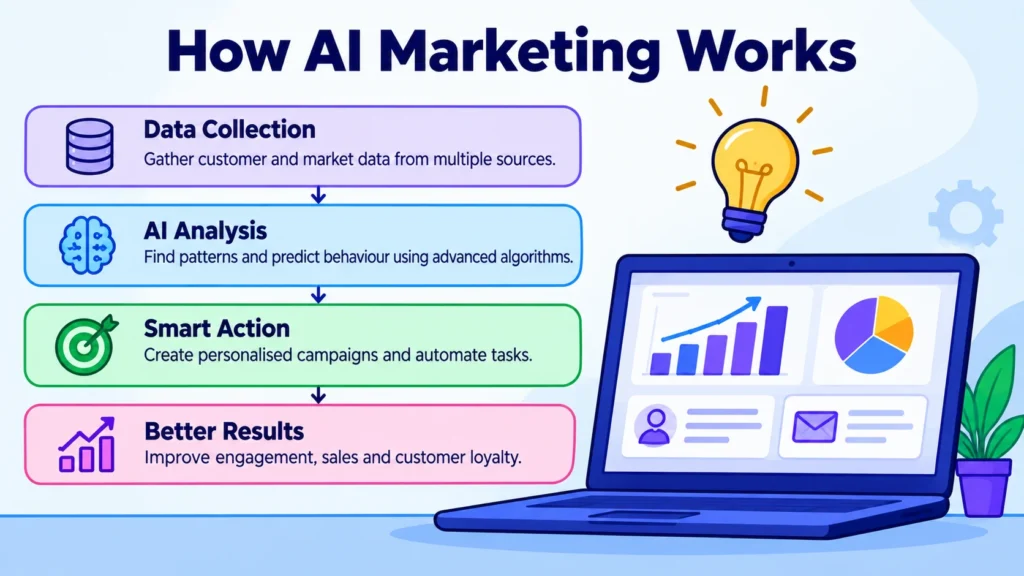
The process is not identical for every company or platform. Some systems focus on customer recommendations, while others optimise advertising, personalise emails, or analyse campaign performance. Even so, most AI marketing workflows follow a similar pattern: collect data, identify patterns, generate insights, take action, and learn from the results.
Collecting and Analysing Customer Data
Everything begins with data.
Businesses can gather information from websites, ecommerce platforms, email campaigns, advertising networks, social media, CRM systems, customer support interactions, and purchase histories. Individually, these data points may reveal very little. Together, they can provide a much clearer picture of customer behaviour.
AI can process this information at a scale that would be difficult for a marketing team to manage manually. It can examine browsing patterns, engagement levels, purchase activity, and other signals to identify relationships and trends.
For example, an AI system might discover that customers who repeatedly view a particular product category are more likely to purchase when they receive a personalised email within a certain period.
Identifying Customer Patterns
Once the data has been processed, AI can search for meaningful patterns.
Machine learning models can analyse historical behaviour to identify customer segments, recognise purchasing signals, estimate engagement, and detect changes in customer activity. The system may uncover patterns that are easy to overlook when marketers are working with large or fragmented datasets.
This does not mean every AI prediction will be correct. Rather, it gives marketers another layer of evidence they can use when making decisions.
Personalising Marketing Messages
One of the most visible applications of AI marketing is personalisation.
Instead of treating an entire audience as one group, AI can use customer information to help determine which products, content, offers, or messages may be most relevant to different individuals.
An online retailer, for instance, could recommend products based on browsing behaviour and previous purchases. An email campaign could feature different content depending on a subscriber’s interests or previous interactions.
The result is a marketing experience that feels less generic and more closely connected to what the customer actually wants.
Automating Repetitive Marketing Tasks
AI becomes particularly valuable when combined with automation.
Marketing teams can use AI-powered systems to assist with audience segmentation, email workflows, lead scoring, customer follow-ups, content recommendations, chatbot interactions, and campaign optimisation. Once the appropriate rules and safeguards are established, many routine actions can happen automatically.
That frees marketers from constantly performing repetitive tasks. More importantly, it gives them additional time to focus on strategy, creative development, testing, and customer relationships.
Predicting Future Customer Behaviour
AI can also look forward rather than simply analysing what has already happened.
By examining historical and current data, predictive models can estimate the likelihood of certain customer actions. A system might identify customers who are more likely to purchase, respond to an offer, become inactive, or cancel a subscription.
These predictions can help marketers act proactively. Instead of waiting for a customer to disengage, for example, a business could launch a targeted retention campaign when early warning signals appear.
Measuring and Optimising Campaigns
AI marketing does not end when a campaign goes live.
Performance data continues to flow in, giving AI systems new information to analyse. Depending on the platform, AI may help identify high-performing audiences, recommend better content, adjust advertising strategies, or highlight unusual changes in engagement.
This creates a continuous feedback loop:
Campaign → Customer Response → Data → AI Analysis → Optimisation → Improved Campaign
Over time, this process can help marketing teams make more informed adjustments instead of relying solely on assumptions or delayed reporting.
Why Human Oversight Still Matters
Despite its capabilities, AI should not operate without appropriate human supervision.
Marketers still need to establish objectives, assess recommendations, review important content, monitor customer data, and make strategic decisions. An AI system can identify a pattern, but a human must consider whether that pattern actually makes sense in the broader business and customer context.
The most effective approach is therefore not AI versus marketers. It is AI plus marketers.
AI provides speed, scale, automation, and analytical power. Humans contribute creativity, judgement, empathy, and strategic thinking. When those strengths are combined thoughtfully, businesses can build marketing operations that are both more efficient and more customer-focused.
What Are the Main Types of AI Marketing?
When exploring What Is AI Marketing, it is important to recognise that artificial intelligence is not a single marketing technique. It is an umbrella term covering a wide range of technologies and applications, each designed to solve a different problem.
Some AI systems help marketers create content. Others analyse customer behaviour, predict future actions, personalise experiences, automate campaigns, or improve advertising performance. The common thread is the ability to process information and turn it into useful marketing actions at speed and scale.
The main types of AI marketing include the following.
AI-Powered Content Marketing
Generative AI has changed how marketing teams approach content production. It can help marketers brainstorm topics, develop outlines, draft copy, create product descriptions, produce social media ideas, and adapt existing content for different channels.
That does not mean AI-generated content should automatically be published. Human expertise remains essential for checking accuracy, originality, tone, brand consistency, and usefulness.
Used properly, AI acts less like a replacement writer and more like a highly efficient creative assistant.
Predictive Marketing
Predictive marketing uses AI and historical data to estimate what customers may do next.
Businesses can use predictive models to identify potential buyers, forecast demand, estimate customer lifetime value, predict purchasing behaviour, or recognise customers who may be at risk of leaving.
Instead of focusing exclusively on what happened yesterday, marketers can use these insights to prepare for what might happen tomorrow.
AI-Powered Personalisation
Personalisation becomes far more sophisticated when AI is involved.
AI can analyse browsing behaviour, purchase history, engagement patterns, preferences, and other signals to determine which experiences may be most relevant to individual customers. These insights can influence website content, email campaigns, product recommendations, promotional offers, and advertising.
For example, two visitors entering the same ecommerce website may receive completely different recommendations because their previous behaviour suggests different interests.
AI Marketing Automation
Automation allows AI to move from analysing information to helping execute marketing activities.
Businesses can use AI-powered systems to manage email workflows, segment audiences, score leads, trigger follow-ups, personalise customer journeys, and optimise campaigns. Some systems can respond to customer behaviour almost immediately.
A customer who downloads a guide, abandons a basket, or repeatedly views a product, for instance, could automatically enter a relevant marketing journey.
Conversational AI and Chatbots
Conversational AI allows businesses to interact with customers through chatbots and virtual assistants.
These systems can answer frequently asked questions, provide product information, guide visitors through websites, assist with basic support requests, and sometimes help customers discover suitable products.
The most useful implementations do not attempt to replace human support entirely. Instead, they handle straightforward interactions and allow human representatives to concentrate on situations requiring deeper judgement or empathy.
AI-Powered Advertising
Digital advertising is another major area where AI plays an important role.
Advertising platforms can use AI to analyse campaign performance, identify potentially valuable audiences, optimise bids, evaluate placements, and respond to changing performance signals. This can help marketers allocate budgets more efficiently and reduce some of the manual work involved in campaign management.
Even so, AI optimisation should operate within a broader strategy. Marketers still need to define objectives, assess creative quality, monitor performance, and decide whether the results align with business goals.
AI-Powered Customer Segmentation
Traditional segmentation often relies on broad characteristics such as age, location, or demographic information. AI can go much further.
By analysing purchasing patterns, engagement, interests, browsing behaviour, and other signals, AI can identify groups of customers who behave in similar ways. These segments can then be used to create more relevant campaigns.
For example, a business might identify frequent buyers, highly engaged prospects, inactive customers, and customers showing strong interest in a particular product category.
AI-Powered Analytics
Marketing produces enormous quantities of data. AI can make that information easier to understand.
AI-powered analytics tools can process campaign results, identify trends, detect unusual changes, summarise reports, and highlight potential opportunities. Instead of forcing marketers to manually examine every metric, these systems can help direct attention toward the information that matters most.
The value is not simply faster reporting. It is the ability to turn large amounts of fragmented information into clearer marketing insights.
How Is AI Used in Marketing?
Understanding What Is AI Marketing becomes much easier when you see how artificial intelligence is applied to real marketing activities. AI is no longer limited to analysing complicated datasets in the background. It can now influence how businesses create content, identify audiences, communicate with customers, manage advertising, and measure performance.
The objective is not simply to automate everything. The real value comes from using AI to process information faster, uncover useful insights, and help marketers deliver more relevant experiences without adding unnecessary manual work.
AI for Customer Segmentation
AI can examine customer information and identify groups based on behaviour, interests, purchasing patterns, engagement, and other signals.
This makes segmentation more dynamic than simply dividing an audience according to basic demographic characteristics. A retailer, for example, could use AI to distinguish between first-time buyers, frequent customers, inactive shoppers, and visitors who repeatedly explore a particular product category.
These insights can then inform more targeted campaigns.
AI for Content Creation
Generative AI can assist marketing teams throughout the content development process. It can help brainstorm ideas, research topics, create outlines, draft copy, develop product descriptions, and generate variations for different platforms.
But speed should not replace quality.
AI-generated content still needs human review. Marketers should verify important claims, improve the writing, maintain the brand voice, and add original expertise that makes the content genuinely useful.
AI for Email Marketing
Email marketing is particularly well suited to AI because campaigns generate large amounts of behavioural data.
AI can help determine which subscribers should receive particular messages, personalise content, recommend products, segment audiences, and identify potentially effective sending times. It can also analyse engagement patterns to help marketers understand what resonates with different groups.
For example, an ecommerce business could automatically recommend products based on a customer’s previous purchases and recent browsing behaviour.
AI for Advertising
Modern advertising platforms rely heavily on automated systems to analyse campaign signals and optimise delivery.
AI can assist with audience targeting, bidding, placements, budget allocation, and performance optimisation. Instead of manually adjusting every campaign element, marketers can use AI to respond to changing performance data more efficiently.
The technology can be particularly useful when campaigns involve large audiences and numerous variables that would be difficult to manage manually.
AI for Customer Personalisation
Personalisation is one of the most powerful applications of AI marketing.
AI can combine customer data with real-time behavioural signals to help businesses determine what an individual customer may find relevant. This can influence product recommendations, website experiences, promotional offers, email content, and advertising.
Rather than creating one experience for everyone, businesses can use AI to make customer interactions more responsive and context-aware.
AI for Social Media Marketing
Social media produces a constant stream of conversations, reactions, trends, and engagement data. AI can help marketing teams make sense of this information.
Businesses can use AI to identify emerging topics, analyse audience sentiment, monitor engagement, generate content ideas, and evaluate social media performance.
This does not eliminate the need for creative thinking. Instead, it gives marketers more information about what audiences are discussing and responding to.
AI for Search Engine Optimisation
AI can support SEO research by helping marketers analyse search intent, identify related topics, organise content opportunities, and uncover potential gaps.
It can also assist with large-scale content analysis and optimisation. However, effective SEO still depends on creating useful, accurate, trustworthy content that genuinely satisfies the searcher’s needs.
AI can accelerate the research process, but it cannot replace the need to understand the audience.
AI for Customer Service
AI-powered chatbots and virtual assistants can handle many straightforward customer interactions.
They can answer common questions, provide product information, guide users through basic processes, and help customers find relevant information without waiting for a support representative.
For complicated or sensitive issues, however, customers should have a clear path to human assistance. Convenience matters, but so does the ability to speak with a real person when the situation requires it.
AI for Marketing Analytics
Marketing teams often spend significant time reviewing dashboards, spreadsheets, and performance reports. AI can simplify this process by analysing large amounts of data and highlighting meaningful changes.
It can identify trends, flag anomalies, summarise performance, and help marketers discover potential opportunities. This allows teams to spend less time searching through numbers and more time deciding what those numbers actually mean.
AI for Predictive Marketing
AI can also help marketers anticipate future customer behaviour.
By analysing historical and current data, predictive systems can estimate which customers may be ready to purchase, which leads are more likely to convert, which products may experience increased demand, or which customers may be becoming inactive.
These predictions allow businesses to move from a purely reactive approach toward more proactive marketing.
What Are the Benefits of AI Marketing?
When considering What Is AI Marketing, it is not enough to focus on what artificial intelligence can do. The more important question is what businesses actually gain from using it.
AI can transform the way marketing teams handle data, communicate with customers, manage campaigns, and allocate their time. When implemented thoughtfully, it can reduce repetitive work while giving marketers a clearer view of what customers want and how campaigns are performing.
Faster Data Analysis
Modern marketing generates an enormous amount of information. Websites, advertising platforms, email campaigns, social media, ecommerce systems, and CRM platforms can all produce valuable data.
Reviewing that information manually can take hours, sometimes longer. AI can process large datasets rapidly, identify patterns, and surface important changes that might otherwise remain hidden.
This allows marketers to spend less time collecting and sorting information and more time deciding what to do with it.
Better Personalisation
Customers are more likely to engage with marketing that feels relevant to them.
AI can analyse browsing activity, purchasing behaviour, interests, engagement history, and other signals to help businesses tailor their communications. Product recommendations, email content, website experiences, and promotional offers can all become more personalised.
The result is a shift away from generic messaging toward experiences that are better aligned with individual customer needs.
Improved Marketing Efficiency
Many marketing processes involve repetitive work. Segmenting audiences, preparing reports, updating campaigns, managing email workflows, and analysing performance can consume a significant portion of a team’s time.
AI can automate or assist with many of these activities.
That does not simply mean doing more work faster. It gives marketers more room for tasks that require human thinking, such as strategy, creative development, positioning, and relationship building.
More Informed Decision-Making
Good marketing decisions depend on good information.
AI can examine large volumes of campaign and customer data to identify patterns, correlations, and potential opportunities. These insights can help marketers understand which audiences are responding, which campaigns are underperforming, and where adjustments may be worthwhile.
Instead of relying entirely on assumptions or intuition, teams can combine human experience with evidence from data.
Better Customer Targeting
Not every customer has the same needs, interests, or purchasing intent.
AI can analyse behavioural signals to help businesses identify more specific audience groups. These segments may be based on purchasing patterns, engagement, product interests, browsing activity, or predicted behaviour.
More precise targeting can make marketing messages more relevant and potentially reduce wasted advertising spend.
Increased Marketing Productivity
AI can support marketers across research, brainstorming, content development, reporting, analysis, and campaign management.
A task that previously required several manual steps may become significantly faster with the right AI workflow. Over time, these small improvements can accumulate into substantial productivity gains.
However, productivity should not be measured simply by how much AI can generate. The real question is whether the technology helps the team produce better work and achieve stronger business outcomes.
Faster Customer Responses
Customers often expect immediate assistance, particularly when they are researching a product or trying to resolve a straightforward problem.
AI-powered chatbots and virtual assistants can respond to common questions almost instantly. They can provide information, guide users through basic processes, and direct more complicated enquiries to human support staff.
This combination can improve response times without forcing customer service teams to handle every routine interaction manually.
More Scalable Marketing
Personalising marketing for ten customers is relatively simple. Doing it for hundreds of thousands is another matter entirely.
AI makes large-scale personalisation more practical by processing customer information and automating individual interactions. Businesses can use these capabilities across email, websites, advertising, ecommerce, and other channels without manually creating every experience.
This scalability is particularly valuable for growing companies and large marketing teams.
Potential Cost Savings
AI can potentially reduce costs by decreasing manual workload, improving campaign efficiency, and helping businesses allocate resources more effectively.
But AI should not be treated as a shortcut to automatic cost reduction. Businesses still need to consider software subscriptions, implementation, data infrastructure, employee training, integration, and ongoing oversight.
The strongest business case is usually based on value created, not simply hours removed.
Continuous Campaign Optimisation
Traditional campaign analysis often happens after a campaign has finished. AI can make optimisation a more continuous process.
Depending on the technology, AI can analyse performance signals and help identify opportunities to improve targeting, content, recommendations, advertising, or customer journeys.
This creates a cycle of testing, learning, adjusting, and improving. Over time, that cycle can help marketing teams become more responsive and data-driven.
What Are Some Examples of AI Marketing?
If you are trying to understand What Is AI Marketing, practical examples make the concept much easier to grasp. Artificial intelligence is already being used across ecommerce, advertising, email, customer service, content creation, and other areas of the customer journey.
The applications can range from simple automation to sophisticated systems that analyse behaviour and predict what a customer may want next. Here are some of the most common examples.
Personalised Product Recommendations
Ecommerce businesses can use AI to analyse browsing activity, previous purchases, product views, and other behavioural signals.
The system can then recommend products that are more likely to interest each individual customer. Someone who frequently browses running shoes, for example, might receive recommendations for related footwear or accessories rather than completely unrelated products.
This creates a shopping experience that feels more relevant without requiring marketers to manually select recommendations for every customer.
AI-Powered Email Campaigns
AI can make email marketing considerably more personalised.
Marketing platforms can analyse engagement patterns and help determine which customers should receive particular messages. AI may also assist with subject lines, content recommendations, audience segmentation, product suggestions, and sending-time optimisation.
A retailer could, for instance, send different product recommendations to subscribers based on their previous purchases and recent browsing activity.
AI Chatbots
AI-powered chatbots can communicate with website visitors and customers in real time.
They can answer frequently asked questions, provide product information, help users navigate a website, and handle straightforward support requests. If a conversation becomes too complicated, the system can pass the customer to a human representative.
The value is not simply automation. A well-designed chatbot can make basic assistance available immediately, including outside normal business hours.
AI-Generated Marketing Content
Generative AI can help marketers create initial versions of many types of content, including blog drafts, social media captions, product descriptions, email copy, advertising variations, and campaign ideas.
However, the best results usually come when marketers treat AI output as a starting point rather than a finished product.
Human review is still needed to check accuracy, originality, tone, brand consistency, and overall usefulness.
Predictive Lead Scoring
Sales and marketing teams can use AI to analyse information about prospects and estimate which leads are most likely to convert.
The system might consider engagement, website activity, previous interactions, company characteristics, or other available signals. Leads showing stronger buying intent can then receive greater attention from sales teams.
This can help businesses prioritise their resources instead of treating every prospect as equally likely to purchase.
AI-Powered Advertising
Digital advertising platforms use AI to analyse campaign performance and optimise different elements of advertising delivery.
AI can assist with audience selection, bidding, placements, budget allocation, and performance optimisation. As new campaign data becomes available, automated systems can respond to changing signals much faster than a purely manual process.
Marketers still need to define the strategy and evaluate whether the resulting performance supports their broader business objectives.
Automated Customer Segmentation
AI can automatically organise customers into groups based on behaviour and other characteristics.
For example, a business could identify frequent purchasers, first-time customers, inactive users, high-value customers, or people who show strong interest in a particular category.
These segments can then become the foundation for more relevant campaigns and customer journeys.
Dynamic Website Personalisation
AI can help websites adapt the experience based on visitor behaviour.
A returning customer might see products related to previous activity, while a new visitor could receive introductory information or recommendations based on their current browsing session.
Instead of delivering one identical experience to everyone, businesses can use AI to make websites more responsive to individual customer signals.
AI-Powered Social Media Analysis
Social media generates huge volumes of conversations and engagement data. AI can help marketing teams analyse this information at scale.
It can identify emerging topics, evaluate engagement patterns, monitor conversations, analyse sentiment, and generate ideas based on what audiences are discussing.
These insights can help marketers respond to trends more quickly while keeping their content strategy connected to audience interests.
Predictive Customer Behaviour
AI can use historical and current customer information to estimate what a person might do next.
A business could identify customers who appear likely to make another purchase, prospects showing strong buying intent, or existing customers whose engagement is declining.
Marketers can then create targeted campaigns around those predictions, turning customer data into proactive action rather than simply using it to explain what has already happened.
What AI Marketing Tools and Technologies
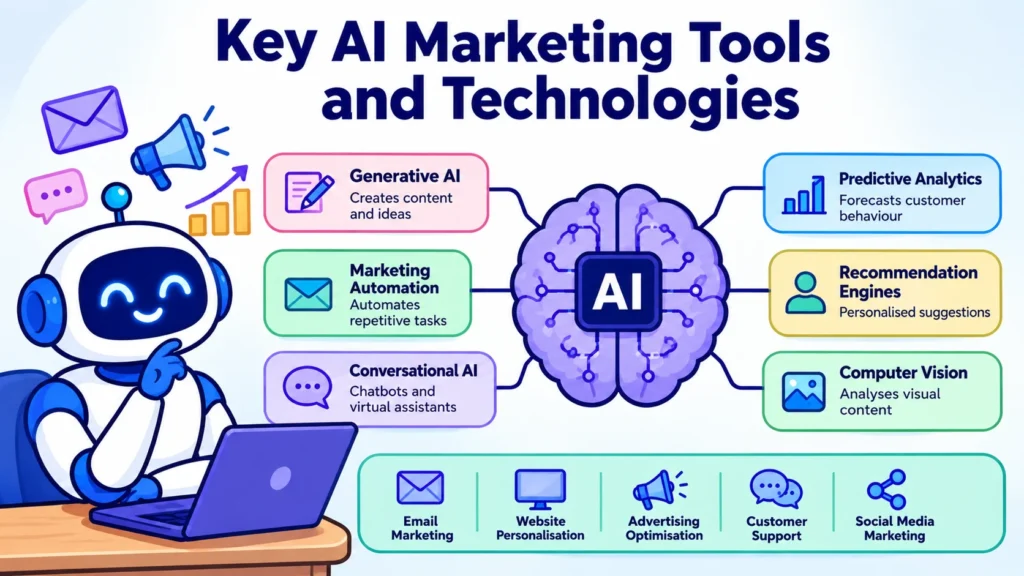
To fully understand What Is AI Marketing, it helps to look at the technologies powering it. AI marketing is not built around one single tool. Instead, it brings together several technologies that can analyse information, recognise patterns, generate content, predict behaviour, automate tasks, and personalise customer experiences.
Different businesses will use different combinations depending on their objectives, data, marketing channels, and technical infrastructure. A small business might rely on AI features built into an email platform, while a large enterprise may connect several AI systems across its CRM, ecommerce platform, advertising stack, and analytics environment.
To learn more about What Is Email Marketing
Generative AI
Generative AI can create new content based on prompts, instructions, and available information.
Marketing teams can use it to brainstorm campaign ideas, draft articles, create product descriptions, develop email copy, produce social media content, and adapt messaging for different audiences.
Its speed is impressive, but speed alone does not guarantee quality. Human marketers should review AI-generated material for accuracy, originality, brand consistency, and relevance before publishing it.
Machine Learning
Machine learning allows systems to identify patterns within data and improve their predictions as they process more information.
In marketing, machine learning can support customer segmentation, recommendation systems, lead scoring, churn prediction, audience targeting, and campaign optimisation.
For example, a machine-learning model could examine historical purchasing behaviour and identify patterns associated with customers who are likely to buy again.
Predictive Analytics
Predictive analytics focuses on estimating what could happen in the future.
Marketing teams can use predictive models to forecast demand, identify likely buyers, estimate customer lifetime value, predict churn, and determine which prospects may be most valuable.
This changes the role of analytics. Instead of only asking “What happened?”, marketers can also begin asking “What is likely to happen next?”
Natural Language Processing
Natural language processing, commonly known as NLP, enables computers to interpret and work with human language.
It plays an important role in chatbots, sentiment analysis, conversational marketing, text classification, search, and automated customer interactions.
For example, NLP can help a business analyse thousands of customer reviews and identify whether the overall feedback is positive, negative, or neutral.
Marketing Automation
AI-powered marketing automation connects intelligence with action.
Businesses can use these systems to manage email sequences, lead nurturing, customer journeys, audience segmentation, campaign triggers, and follow-up communications.
Instead of manually checking whether a customer has completed a particular action, an automated system can respond when the relevant condition occurs.
AI-Powered Analytics
Marketing teams often work with multiple dashboards and large amounts of performance data. AI-powered analytics can make that information easier to interpret.
These tools can identify trends, detect unusual changes, summarise reports, and highlight potential opportunities. This helps marketers focus on the insights that deserve attention rather than spending excessive time searching through raw numbers.
Recommendation Engines
Recommendation engines use AI to determine which products, services, or content may be most relevant to an individual user.
They are particularly useful for ecommerce, streaming platforms, publishing businesses, and other organisations with large catalogues of products or content.
Recommendations can be influenced by browsing behaviour, previous purchases, engagement, similar customers, and other behavioural signals.
Conversational AI
Conversational AI powers chatbots and virtual assistants capable of interacting with customers using natural language.
Businesses can use these systems for customer support, product discovery, lead generation, appointment assistance, and basic sales conversations.
More advanced systems can retain conversational context, allowing interactions to feel more natural and relevant. Even then, human escalation remains important for complex or sensitive situations.
Computer Vision
Computer vision allows AI systems to interpret visual information such as images and video.
In marketing, it can support visual search, image recognition, product discovery, and analysis of visual content. For ecommerce businesses, for example, visual search can allow customers to upload an image and discover visually similar products.
Customer Data Platforms and AI
AI can also work alongside customer data platforms (CDPs) and customer relationship management (CRM) systems.
These platforms can bring information from different customer touchpoints together. When the underlying data is accurate and properly integrated, AI can use it to create richer customer profiles, identify behavioural patterns, and support more relevant marketing campaigns.
The quality of the technology matters, but so does the quality of the data flowing into it. Even sophisticated AI can produce unreliable results when the information behind it is incomplete, outdated, or poorly structured.
What Are the Challenges of AI Marketing?
Understanding What Is AI Marketing also requires a realistic view of its limitations. Artificial intelligence can accelerate analysis, automate repetitive work, and improve personalisation, but it is not a flawless solution.
The technology introduces its own set of challenges. Businesses must think carefully about privacy, accuracy, security, bias, costs, integration, and the role of human judgement. Without appropriate safeguards, an AI-powered marketing strategy can create new problems instead of solving existing ones.
Data Privacy and Security
AI marketing often relies on customer information, including browsing activity, purchasing behaviour, preferences, interactions, and engagement history.
That makes responsible data management essential. Businesses need to understand what information they collect, why they collect it, how it is stored, and how it is used.
Poor data practices can undermine customer trust and may also create regulatory or legal risks. AI should therefore be implemented alongside appropriate privacy and security controls.
Inaccurate or Misleading Content
Generative AI can produce content that sounds convincing even when parts of it are incorrect.
This creates a particular challenge for marketers. A polished paragraph is not necessarily an accurate paragraph.
Publishing AI-generated material without proper review can introduce factual errors, misleading claims, or outdated information. Human verification remains important, especially when content involves specialised, sensitive, or high-impact subjects.
Lack of Human Creativity
AI can generate ideas and produce content remarkably quickly, but it does not possess human experience in the same way a marketer does.
Brand storytelling often depends on cultural understanding, emotional nuance, originality, and an ability to recognise what will genuinely resonate with an audience. If businesses rely too heavily on automated content, their messaging can begin to feel repetitive, predictable, or generic.
AI can assist creativity. It should not eliminate it.
Algorithmic Bias
AI systems learn from data, and data can contain existing biases.
If those biases are not identified and addressed, an AI system could produce recommendations, predictions, or audience segments that unfairly favour or exclude certain groups.
Businesses should therefore monitor AI outputs, test systems carefully, and investigate unusual or potentially discriminatory results rather than assuming that automated decisions are automatically objective.
Over-Automation
Automation is useful until it becomes excessive.
A business can automate emails, chat responses, recommendations, and customer journeys, but customers do not always want to interact with a machine. When a problem is complicated or emotionally sensitive, being unable to reach a real person can quickly turn convenience into frustration.
Effective AI marketing should create clear opportunities for human interaction when automation reaches its limits.
Implementation Costs
AI marketing can require more than simply purchasing a software subscription.
Businesses may need to invest in data infrastructure, integrations, employee training, implementation, security, monitoring, and ongoing optimisation. Advanced AI systems can become particularly expensive when they need to operate across multiple departments or large datasets.
The right question is therefore not “How advanced is this AI tool?” but “What measurable value can this technology create for the business?”
Integration With Existing Systems
Most marketing teams already use several platforms, including CRM systems, email tools, ecommerce software, advertising platforms, analytics solutions, and content management systems.
Connecting AI across these systems can be technically challenging. Poor integration may create disconnected data, duplicate information, inconsistent customer profiles, or inefficient workflows.
AI becomes much more useful when the systems surrounding it can communicate effectively.
Maintaining Brand Voice
AI-generated content does not automatically understand a company’s personality.
Without clear instructions, examples, and editorial standards, AI may produce messaging that sounds inconsistent with the brand. One campaign might feel professional while another sounds overly casual or generic.
Businesses should establish clear brand guidelines and maintain human review for important communications.
Lack of Transparency
Customers may reasonably want to know how their information is being used, particularly when automated systems influence the content, recommendations, or offers they receive.
Businesses should consider when and how to explain their use of AI and customer data. Greater transparency can help strengthen trust rather than leaving customers wondering how automated decisions are being made.
Dependence on AI
Perhaps the biggest strategic risk is becoming too dependent on the technology.
AI can identify patterns, generate recommendations, and automate processes, but it does not understand every market change, customer emotion, or business circumstance. A recommendation that looks sensible in isolation may be inappropriate when viewed in the broader context.
The strongest marketing teams use AI as an input into decision-making, not as an unquestionable authority.
AI Marketing vs. Traditional Marketing
When exploring What Is AI Marketing, comparing it with traditional marketing provides useful context. Both approaches have the same fundamental objective: reaching the right audience, communicating value, building relationships, and ultimately generating business results.
The difference is largely in how data is processed, how decisions are made, and how much of the marketing process can be automated or personalised.
Traditional marketing is not disappearing. In fact, the two approaches can complement each other remarkably well.
Data and Decision-Making
Traditional marketing often relies on market research, customer surveys, campaign reports, historical performance, and the experience of marketing professionals.
These sources remain valuable. The challenge is that manually analysing large datasets can take considerable time.
AI marketing can process much larger volumes of information at speed, identifying behavioural patterns and potential relationships that may be difficult to spot manually. Marketers can then combine those insights with their own experience and judgement.
Personalisation
Traditional campaigns often target broad audience segments. A business might create one campaign for a particular demographic, location, or customer category.
AI makes more granular personalisation possible.
By analysing individual behaviours and preferences, AI can help businesses customise product recommendations, email content, website experiences, advertising, and promotional offers for different customers.
Instead of one message being delivered to everyone, different customers can receive experiences shaped by their interactions with the brand.
Automation
Traditional marketing can involve substantial manual effort. Teams may need to create audience lists, schedule communications, analyse campaign results, and adjust customer journeys themselves.
AI marketing can automate many of these processes. Systems can trigger communications based on customer actions, analyse campaign performance, segment audiences, and assist with optimisation.
The result can be a more responsive marketing operation with less repetitive manual work.
Speed
Traditional marketing processes can move relatively slowly when research, analysis, and campaign adjustments require human intervention at every stage.
AI can process information rapidly and, in some applications, respond to new behavioural signals almost immediately.
This allows businesses to react more quickly when customer interests change or when a campaign begins performing differently than expected.
Customer Insights
Traditional marketing uses tools such as interviews, surveys, focus groups, market research, and analytics to understand customers.
These methods remain extremely valuable because they can reveal motivations and opinions that behavioural data alone may not explain.
AI adds another layer by analysing large amounts of behavioural information across multiple sources. It can identify patterns in browsing, purchasing, engagement, and other interactions that might otherwise be overlooked.
The strongest insights often emerge when quantitative AI analysis is combined with qualitative human research.
Creativity and Human Connection
This is where traditional marketing continues to play an especially important role.
Strong marketing is not only about numbers. It involves storytelling, emotional connection, cultural awareness, creative direction, positioning, and a deep understanding of what a brand represents.
AI can support brainstorming and content production, but human marketers remain responsible for turning those capabilities into authentic communication.
A campaign can be perfectly optimised and still fail if it does not connect with people.
Cost and Resources
Traditional marketing can require substantial human effort, particularly when campaigns involve large audiences or multiple channels.
AI can reduce some manual workload and improve operational efficiency. However, AI itself requires investment.
Businesses may need to pay for software, implementation, integrations, data infrastructure, training, and ongoing management. Therefore, the financial value of AI should be measured by the improvements it creates rather than simply by the number of tasks it automates.
Which Approach Is Better?
There is no universal winner.
The right approach depends on the company’s goals, audience, industry, budget, data maturity, and marketing channels. AI is particularly valuable for data analysis, personalisation, prediction, automation, and large-scale optimisation.
Traditional marketing remains essential for creativity, storytelling, strategic thinking, research, relationship building, and human judgement.
In practice, the strongest strategy is often a combination of both. AI can process information and handle repetitive operations at scale, while human marketers provide the context and creative direction needed to turn those capabilities into meaningful customer experiences.
How to Get Started With AI Marketing
If you are still asking What Is AI Marketing, the best way to understand its practical value is to start using it in a focused, measurable way. Businesses do not need to rebuild their entire marketing operation overnight. In fact, trying to automate everything at once can create unnecessary complexity.
A more sensible approach is to identify one clear problem, test an appropriate AI solution, measure the outcome, and expand only when the results justify it.
Define Your Marketing Goals
Before choosing an AI tool, determine what you actually want to improve.
Your objective might be to increase conversions, personalise customer experiences, reduce repetitive work, analyse marketing data faster, improve campaign performance, or respond to customers more efficiently.
A clearly defined goal gives the project direction. It also makes success easier to measure.
Identify Repetitive Marketing Tasks
Next, look at the daily workload of your marketing team.
Which activities consume significant amounts of time but require relatively little creative or strategic judgement? Audience segmentation, reporting, email workflows, content research, lead scoring, data analysis, and routine customer enquiries are often good candidates.
These tasks can provide useful starting points because AI can assist with them without removing human control from important decisions.
Choose the Right AI Marketing Tools
The AI market is crowded. New tools appear constantly, each promising to transform marketing in some way.
Do not choose technology simply because it carries an “AI-powered” label.
Instead, consider whether the tool solves your specific problem, integrates with your existing systems, protects customer information, provides useful controls, and can grow alongside your business.
More features do not automatically mean more value. The right tool is the one that addresses a genuine need.
Prepare Your Data
AI is only as reliable as the information it works with.
Before implementing an AI marketing solution, review your customer data. Remove unnecessary duplication, address obvious inaccuracies, organise information consistently, and establish appropriate processes for handling sensitive data.
Poor-quality data can lead to poor-quality predictions, recommendations, and personalisation.
Start With a Small Project
Resist the temptation to transform your entire marketing strategy immediately.
Choose one manageable application instead. You might begin by using AI to assist with email subject lines, customer segmentation, campaign reporting, content research, or basic customer support.
A small pilot allows your team to understand how the technology behaves in practice before making larger commitments.
Keep Humans in the Process
AI should support your marketing team, not operate as an unchecked decision-maker.
Establish clear processes for reviewing AI-generated content, validating important recommendations, protecting customer data, and approving significant campaign decisions.
Human marketers provide something AI cannot fully reproduce: context. They understand the company’s objectives, audience, brand personality, and broader market environment.
Measure the Results
Once the AI project is running, measure its impact.
Depending on the application, useful metrics might include conversion rates, engagement, campaign revenue, response times, productivity, customer satisfaction, or hours saved.
The purpose is not to prove that AI is impressive. It is to determine whether the technology is creating measurable business value.
Expand What Works
If the initial project produces meaningful results, consider extending AI into other areas.
For example, a successful email segmentation experiment could eventually lead to personalised recommendations, predictive customer targeting, automated journeys, or more advanced campaign optimisation.
This evidence-based approach is far safer than adopting AI across every department simply because competitors are doing it.
The goal is not to use more AI. It is to use AI more effectively.
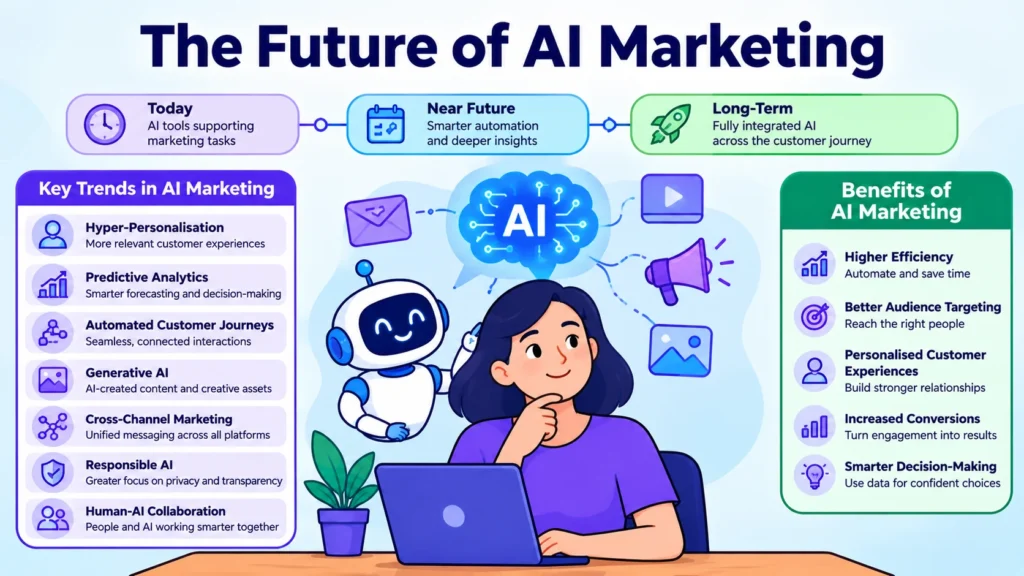
What Is the Future of AI Marketing?
As businesses continue asking What Is AI Marketing, the conversation is gradually shifting from experimentation to long-term adoption. AI is already influencing how companies analyse customer behaviour, personalise experiences, automate routine activities, and optimise campaigns. The next stage will likely make these capabilities more connected, predictive, and deeply embedded in everyday marketing operations.
But the future is unlikely to be a simple story of machines replacing marketers. A more realistic direction is collaboration. AI can process information at remarkable speed, while people remain responsible for strategy, creativity, context, and judgement.
Greater Marketing Personalisation
Personalisation is likely to become increasingly precise.
Future AI systems may consider a broader combination of real-time behavioural signals, previous interactions, preferences, and contextual information when determining what a customer is most likely to find useful.
Instead of simply recommending a product based on a previous purchase, an AI system could potentially adapt content, offers, recommendations, and communications according to what the customer appears to need at that particular moment.
More Advanced Predictive Marketing
Predictive analytics will likely become an even more important part of marketing strategy.
As businesses collect richer behavioural data, AI systems may become better at estimating purchase intent, forecasting demand, predicting customer lifetime value, and identifying early signs of disengagement.
This could allow marketers to act before an opportunity disappears rather than waiting until the customer has already made a decision.
AI-Powered Customer Journeys
The future of AI marketing may also involve connecting customer interactions across multiple channels.
Today, businesses often manage email, advertising, websites, ecommerce, and customer service through separate platforms. More advanced AI systems could help connect these touchpoints so that activity in one channel informs what happens in another.
For example, a customer’s interaction with a website could influence the content they later receive through email or the recommendations shown in another channel.
More Automated Marketing Operations
AI automation is likely to move beyond individual tasks.
Instead of simply automating an email or generating a report, AI systems may increasingly assist with larger portions of campaign planning, audience selection, testing, content variations, optimisation, and performance analysis.
Human marketers would still establish objectives and approve important decisions, while AI takes responsibility for more of the operational workload.
Growth of Generative AI
Generative AI is likely to remain one of the most influential technologies in marketing.
Future systems may become increasingly capable of producing and adapting text, images, video, audio, and other creative assets for different audiences and channels.
The challenge will be maintaining originality and authenticity. As AI-generated content becomes easier to produce, brands will need stronger editorial standards and clearer creative identities to avoid blending into a sea of generic content.
Stronger Focus on Responsible AI
Greater AI adoption will inevitably bring greater scrutiny.
Businesses will need to pay close attention to data privacy, security, transparency, bias, accuracy, and responsible use. Customers may also become more interested in understanding how their data is being used and how automated systems influence the experiences they receive.
Responsible AI will therefore become more than a technical consideration. It will increasingly be part of brand reputation and customer trust.
Human and AI Collaboration
Perhaps the most important development will be the changing role of the marketer.
AI can handle large-scale analysis, repetitive processes, pattern recognition, and content assistance. People can focus on strategic thinking, creative direction, emotional storytelling, ethical decisions, and understanding the wider business environment.
The marketer of the future may not compete with AI. They may become significantly more capable by learning how to work alongside it.
What Businesses Should Expect
AI marketing will continue to evolve rapidly, but businesses should resist the temptation to adopt every new tool simply because it is available.
Technology should serve a purpose.
Companies are more likely to benefit when they combine high-quality data, suitable AI technology, strong marketing strategy, responsible governance, and human expertise. The objective is not to make marketing completely automated. It is to make it more intelligent, relevant, efficient, and valuable for both the business and its customers.
Frequently Asked Questions About AI Marketing
If you are still wondering What Is AI Marketing, these frequently asked questions can help clarify how artificial intelligence is being used in modern marketing, where it creates value, and what businesses should consider before adopting it.
What Is AI Marketing in Simple Terms?
AI marketing is the use of artificial intelligence to support marketing activities such as analysing customer data, segmenting audiences, personalising experiences, creating content, automating campaigns, and optimising performance.
Put simply, AI helps businesses understand customer behaviour and complete certain marketing tasks faster and at greater scale.
How Is AI Used in Digital Marketing?
AI is used across many areas of digital marketing, including content creation, email personalisation, audience segmentation, predictive analytics, advertising optimisation, chatbots, SEO research, customer service, and marketing automation.
The most appropriate application depends on the company’s objectives, available data, marketing channels, and resources.
What Are the Main Benefits of AI Marketing?
AI can help businesses analyse data faster, personalise customer experiences, automate repetitive activities, improve audience targeting, increase productivity, generate predictive insights, and manage marketing at greater scale.
However, the technology itself does not guarantee better results. Its effectiveness depends on implementation, data quality, strategy, and human oversight.
Can AI Replace Marketing Professionals?
AI can automate or assist with many marketing activities, but it does not eliminate the need for skilled marketers.
Human professionals provide strategic direction, creativity, emotional understanding, brand judgement, and critical thinking. AI is most valuable when it strengthens those capabilities rather than attempting to replace them entirely.
Is AI Marketing Suitable for Small Businesses?
Yes. Small businesses can use AI for practical tasks such as content assistance, email automation, customer support, audience analysis, reporting, and advertising optimisation.
The key is to start with a specific problem rather than adopting complicated technology simply because it is available. A focused, affordable solution can often provide more value than an unnecessarily complex AI system.
What Are Some Examples of AI Marketing?
Common examples include personalised product recommendations, AI-powered email campaigns, chatbots, AI-assisted content creation, predictive lead scoring, automated customer segmentation, dynamic website personalisation, advertising optimisation, and predictive customer behaviour analysis.
These examples demonstrate that AI can support almost every stage of the customer journey.
Is AI Marketing Expensive?
The cost varies considerably.
Some AI capabilities are already included within existing marketing platforms, while more advanced enterprise solutions can involve substantial costs for software, implementation, integrations, data infrastructure, training, and ongoing management.
Businesses should therefore evaluate AI based on the value it is expected to create rather than focusing only on the initial technology cost.
What Are the Risks of AI Marketing?
Potential risks include inaccurate content, privacy concerns, security problems, algorithmic bias, over-automation, inconsistent brand messaging, and excessive dependence on automated recommendations.
Businesses can reduce these risks through strong data practices, human review, clear guidelines, appropriate security measures, and ongoing monitoring.
How Can a Business Start Using AI Marketing?
Start with one clearly defined marketing problem.
Identify a repetitive or data-heavy task, choose a suitable AI solution, prepare the relevant data, run a small test, and measure the outcome. If the results demonstrate genuine value, the business can gradually expand AI into other marketing activities.
A measured approach is generally more effective than trying to automate everything simultaneously.
Will AI Change the Future of Marketing?
Yes. AI is likely to influence marketing through greater personalisation, predictive analytics, automation, generative content, intelligent customer journeys, and cross-channel optimisation.
However, the future is unlikely to be purely automated. Human creativity, strategic thinking, ethical judgement, and relationship building will remain essential.
The most successful marketing teams will likely be those that understand how to combine AI capabilities with human expertise.
Conclusion
Understanding What Is AI Marketing goes beyond knowing what artificial intelligence can do. It means recognising how AI can help businesses analyse customer data, personalise experiences, automate repetitive work, and make faster, more informed marketing decisions.
The opportunities are significant. AI can uncover patterns, improve targeting, support predictive insights, and make personalised marketing more scalable. Yet it also brings challenges, including data privacy, accuracy, bias, implementation costs, and the risk of relying too heavily on automation.
The smartest approach is not to replace marketers with AI, but to combine AI efficiency with human creativity and judgement. With quality data, clear strategy, responsible implementation, and human oversight, businesses can use AI to create marketing that is more relevant, efficient, and effective.
As AI continues to evolve in 2026 and beyond, marketers who learn to use it strategically and responsibly will be better prepared to meet changing customer expectations and build stronger marketing results.
Looking for the right marketing tools? Explore expert reviews, comparisons, and guides at AmiinMarketer.com.