
How to Start Email Marketing is one of the most common questions asked by business owners and marketers who want to build stronger customer relationships and increase revenue. Email marketing has stood the test of time—and for good reason. Unlike social media platforms, where algorithms control your reach, email gives you direct access to an audience that has chosen to hear from you. It allows you to nurture leads, promote products, build trust, and drive consistent sales through personalised communication.
Whether you’re a freelancer, small business owner, or part of a growing marketing team, learning how to start email marketing can transform your digital marketing strategy. In this guide, you’ll learn everything from building an email list and choosing the right platform to creating automated campaigns that engage subscribers and deliver measurable business results.
By the end, you’ll have a clear roadmap for turning email into one of your most valuable marketing assets.
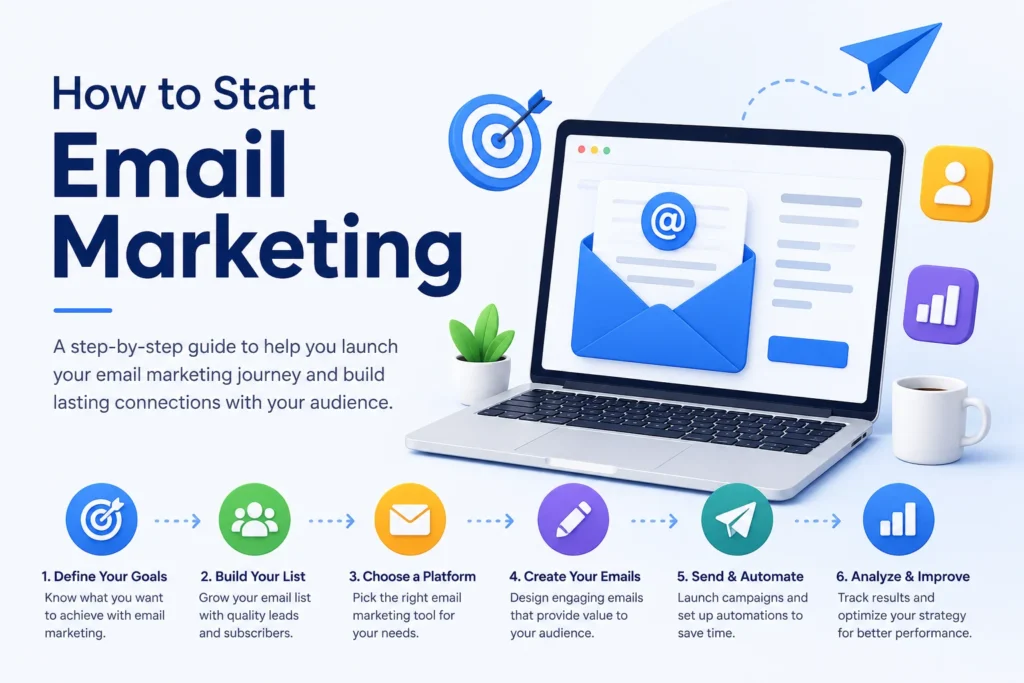
Table of Contents

What Is Email Marketing?
At its core, email marketing is the practice of sending valuable, permission-based emails to people who have willingly subscribed to receive them. Unlike unsolicited spam, these messages are expected, relevant, and designed to provide genuine value to the recipient.
Depending on your goals, email marketing can take many forms. You might send:
- Welcome emails to greet new subscribers
- Weekly or monthly newsletters packed with useful insights
- Product launches and company announcements
- Exclusive promotions and limited-time offers
- Educational content that solves customer problems
- Event invitations and webinar reminders
- Transactional emails such as order confirmations
- Customer onboarding sequences
- Re-engagement campaigns for inactive subscribers
Each type of email serves a different purpose, but they all contribute to building stronger customer relationships over time.
One of the greatest advantages of email marketing is ownership. Unlike followers on social media platforms, your email list belongs to you. You aren’t dependent on ever-changing algorithms deciding who sees your content. When someone joins your list, you’ve established a direct communication channel that can continue delivering value for years.
Learn More About Email Marketing vist amiin marketer
Why Every Business Should Invest in Email Marketing
Many marketing channels promise impressive results, but few consistently deliver the return on investment that email marketing does. Businesses across virtually every industry continue to rely on it because it combines affordability with remarkable effectiveness.
Here are just a few reasons why email marketing deserves a central place in your marketing strategy:
- Build direct relationships with customers
- Generate highly qualified leads
- Increase repeat purchases and customer loyalty
- Deliver personalised experiences at scale
- Automate repetitive marketing tasks
- Track performance with measurable data
- Reduce customer acquisition costs
- Create predictable long-term revenue
Another major advantage is flexibility. Whether you’re promoting a single product, running an online store, growing a personal brand, or managing a multinational business, email marketing scales effortlessly to suit your needs.
Modern platforms also make sophisticated marketing techniques accessible to beginners. Features such as audience segmentation, behavioural triggers, automated workflows, A/B testing, and detailed analytics allow businesses of all sizes to create highly targeted campaigns that feel personal rather than promotional.
The result? Better engagement, stronger customer relationships, and more sustainable business growth.
Step 1: Define Clear Email Marketing Goals
Before writing your first email—or even choosing a platform—it’s essential to know what success looks like.
Without clear objectives, it’s impossible to measure whether your campaigns are actually working. Every email should support a specific business outcome rather than simply filling your subscribers’ inboxes.
Ask yourself what you want your email marketing to achieve.
Perhaps your primary objective is to generate qualified leads. Maybe you’re focused on increasing online sales, improving customer retention, educating your audience, or strengthening brand authority. Whatever the goal, define it clearly and attach measurable key performance indicators (KPIs) to monitor progress.
For example:
| Goal | Key Performance Indicator |
|---|---|
| Generate leads | Number of new subscribers |
| Increase sales | Revenue per campaign |
| Improve customer retention | Repeat purchase rate |
| Build brand authority | Newsletter engagement |
| Educate customers | Click-through rate |
| Recover abandoned carts | Cart recovery percentage |
Setting measurable goals provides direction for every future decision—from the content you create to the automations you build and the metrics you monitor.
Instead of sending emails because “it’s time for another newsletter,” every campaign should have a purpose. When your emails consistently solve problems, answer questions, or guide subscribers towards meaningful actions, engagement naturally improves.
In the next section, we’ll explore how understanding your audience lays the foundation for every successful email marketing campaign.
Step 2: Understand Your Audience
No email campaign can succeed if it speaks to everyone. The most effective emails feel personal because they’re written with a specific reader in mind. Before you start building campaigns, take time to understand who your subscribers are, what challenges they face, and what motivates them to take action.
Think beyond basic demographics. Age and location are useful, but they rarely tell the full story. To create emails that resonate, you need to understand your audience’s goals, frustrations, buying habits, and stage in the customer journey.
Ask yourself questions such as:
- What problems are they trying to solve?
- What inspired them to subscribe?
- What type of content do they enjoy?
- How familiar are they with your products or services?
- What objections might stop them from making a purchase?
The answers will shape everything—from your subject lines and email copy to the offers you present.
For example, a first-time visitor who downloads a free guide requires a completely different message from a loyal customer who has purchased several times. Sending identical emails to both groups often leads to lower engagement and missed opportunities.
The more relevant your emails become, the more likely subscribers are to open, read, click, and ultimately convert.
Step 3: Choose the Right Email Marketing Platform
Your email marketing platform is the engine that powers every campaign, automation, and subscriber interaction. Choosing the right one early on will save you countless hours as your business grows.
While there are dozens of excellent platforms available, the best choice depends on your goals, budget, and technical requirements. A small business sending a monthly newsletter doesn’t need the same advanced features as a large e-commerce store running hundreds of automated campaigns.
When comparing platforms, look for features such as:
- A simple drag-and-drop email builder
- Customisable signup forms
- Landing page creation
- Marketing automation workflows
- Audience segmentation
- Detailed reporting and analytics
- A/B testing capabilities
- CRM integration
- E-commerce integration
- High email deliverability
Ease of use matters just as much as features. A platform packed with advanced tools isn’t particularly helpful if it’s difficult to navigate.
As your subscriber list expands, automation becomes increasingly valuable. The right software allows you to welcome new subscribers, recommend products, send follow-up emails, and recover abandoned carts without manual effort.
Choosing a scalable platform today means you won’t need to migrate your entire email database later.
Step 4: Build a High-Quality Email List
Growing your email list isn’t about collecting as many addresses as possible. It’s about attracting the right people—those who genuinely want to hear from you.
One of the biggest mistakes beginners make is purchasing email lists. It may seem like a shortcut, but it usually creates far more problems than it solves. Purchased contacts rarely engage with your emails, can damage your sender reputation, and may even violate privacy regulations.
Instead, focus on organic, permission-based growth.
Here are some of the most effective ways to build a healthy subscriber list:
- Add signup forms to your website
- Offer newsletter subscriptions on your blog
- Create downloadable lead magnets
- Host webinars or live events
- Launch free online courses
- Provide exclusive discount codes
- Include opt-in checkboxes during checkout
- Promote your email list on social media
- Collect subscribers at in-person events
- Use dedicated landing pages for campaigns
Remember, quality always outweighs quantity.
A list of 1,000 engaged subscribers who regularly open your emails is far more valuable than a database of 20,000 people who ignore every message you send.
Building trust starts from the very first interaction. Always be transparent about what subscribers can expect and how often you’ll email them.
Step 5: Create Lead Magnets That People Can’t Resist
People guard their inboxes carefully. Asking someone to hand over their email address without offering something valuable in return rarely works.
This is where lead magnets come into play.
A lead magnet is a free resource offered in exchange for a subscriber’s email address. The best lead magnets solve a specific problem quickly and demonstrate your expertise before asking for a sale.
Popular examples include:
- eBooks
- Practical checklists
- Ready-made templates
- Industry reports
- Free trials
- Discount vouchers
- Video tutorials
- Email courses
- Resource libraries
- Interactive calculators
Specificity is the secret.
Instead of offering a vague “Marketing Guide,” consider something like “10 Email Subject Line Templates That Increase Open Rates.” A focused promise feels more valuable because subscribers know exactly what they’ll receive.
Keep your lead magnet easy to consume. People appreciate resources they can apply immediately rather than lengthy documents they never finish reading.
Once someone downloads your lead magnet, follow up with a thoughtful welcome sequence that continues providing value and gradually introduces your products or services.
Step 6: Set Up Your Email Infrastructure
Creating beautiful emails means very little if they never reach your subscribers’ inboxes.
Before launching your first campaign, spend time setting up your email infrastructure correctly. It isn’t the most exciting part of email marketing, but it’s one of the most important.
Three authentication protocols deserve special attention:
SPF (Sender Policy Framework)
SPF verifies which mail servers are authorised to send emails on behalf of your domain. It helps prevent spoofing and improves your credibility with email providers.
DKIM (DomainKeys Identified Mail)
DKIM adds a digital signature to every email you send. This signature confirms that the message hasn’t been altered during delivery, increasing trust and authenticity.
DMARC (Domain-based Message Authentication, Reporting and Conformance)
DMARC builds on SPF and DKIM by instructing receiving mail servers how to handle emails that fail authentication. It also provides valuable reports about your domain’s email activity.
Together, these authentication methods help improve:
- Inbox placement
- Domain reputation
- Email deliverability
- Brand trust
- Protection against phishing attacks
Skipping authentication is a costly mistake. Even the most compelling email campaign can end up in the spam folder if your domain isn’t properly configured.
Most modern email marketing platforms provide step-by-step guidance for setting up these records, and the process usually takes only a short time. Once completed, you’ll be in a much stronger position to build a positive sender reputation and maximise the effectiveness of every campaign you send.
Step 7: Design Professional Email Templates
First impressions matter. The moment a subscriber opens your email, they’re making split-second decisions about whether it’s worth their attention. A cluttered layout, poor formatting, or overwhelming design can send them straight to the delete button.
Fortunately, creating an effective email doesn’t require flashy graphics or complicated designs. In fact, some of the highest-performing marketing emails are remarkably simple.
The goal is clarity.
Your readers should immediately understand who the email is from, why they’ve received it, and what action you’d like them to take next. Every design element should support that objective—not distract from it.
When designing your templates, follow these best practices:
- Use a responsive layout that adapts to every screen size.
- Keep branding consistent with your website and other marketing materials.
- Break text into short, digestible paragraphs.
- Include plenty of white space to improve readability.
- Use clear headings and subheadings to guide readers.
- Choose legible fonts and accessible text sizes.
- Optimise images so they load quickly.
- Make call-to-action buttons large enough to tap easily on mobile devices.
Above all, design with mobile users in mind.
A significant percentage of emails are opened on smartphones. If your emails are difficult to read on a small screen, subscribers are unlikely to stay engaged for long.
Consistency is equally important. When every email follows a familiar layout, subscribers instantly recognise your brand, creating a more seamless and trustworthy experience.
Step 8: Write Subject Lines That Get Opened
Your email could contain the most valuable content ever written—but none of it matters if nobody opens it.
The subject line acts as the gateway to your message. It’s often the deciding factor between an open and an ignored email.
Great subject lines create curiosity without becoming misleading. They promise value while remaining concise and authentic.
Here are several proven techniques:
Keep It Short
Long subject lines are often cut off on mobile devices. Aim for a concise message that delivers its point quickly.
Instead of:
“Everything You Need to Know About Improving Your Email Marketing Campaigns Today”
Try:
“Improve Your Email Campaigns Today”
Focus on Benefits
Subscribers care less about what you’re sending and more about how it helps them.
Examples include:
- Grow Your Sales with These Simple Tips
- Save Time with Email Automation
- Your Free Marketing Guide Is Ready
Spark Curiosity
A little mystery can encourage opens—but don’t overdo it.
Examples:
- The Mistake Costing You More Sales
- Most Businesses Miss This Opportunity
- One Small Change, Big Results
Personalise When Appropriate
Including a subscriber’s name or referencing previous activity can make your emails feel more relevant.
For example:
- Sarah, Here’s Your Free Checklist
- Still Thinking About That Product?
Avoid Spam Triggers
Overusing capital letters, excessive punctuation, or exaggerated promises can hurt deliverability.
Avoid subject lines like:
- BUY NOW!!!
- LIMITED OFFER!!!!!!!!
- GUARANTEED MILLIONS
Instead, focus on honesty and value.
Some effective examples include:
- Welcome to Our Community
- Your Free Guide Is Ready
- Three Ways to Improve Conversions
- Let’s Get Started
- Here’s What You Missed This Week
Remember, the purpose of a subject line isn’t to sell your product—it’s to earn the open.
Step 9: Build Your First Welcome Email Series
The moment someone subscribes is when their interest is at its highest.
They’ve trusted you with their email address because they expect value. A welcome sequence ensures you meet those expectations while introducing your brand in a structured, engaging way.
Rather than sending a single welcome email and disappearing for weeks, create a series that gradually builds familiarity and trust.
A simple seven-email sequence might look like this:
Email 1 – Welcome
Thank subscribers for joining your list.
Deliver any promised lead magnet, explain what they’ll receive in future emails, and set expectations for how often you’ll be in touch.
Email 2 – Your Story
People connect with people.
Share your business journey, explain why you started, and highlight the mission behind your brand.
Authenticity creates stronger relationships than polished marketing language ever could.
Email 3 – Educational Content
Teach something useful.
Offer practical advice that solves a genuine problem without asking for anything in return.
Value builds credibility.
Email 4 – Success Stories
Demonstrate real-world results through customer testimonials, reviews, or case studies.
Social proof reassures new subscribers that your products or services deliver on their promises.
Email 5 – Introduce Your Products or Services
Now that trust has been established, introduce your solutions naturally.
Focus on the problems you solve rather than simply listing features.
Email 6 – Frequently Asked Questions
Address common concerns before they become objections.
Answering questions proactively reduces uncertainty and helps subscribers move closer to making a decision.
Email 7 – Special Offer
Finish your welcome sequence with a compelling call to action.
Whether it’s an exclusive discount, free consultation, bonus resource, or limited-time promotion, give subscribers a clear reason to take the next step.
Automation ensures every new subscriber experiences this journey without requiring manual effort from your team.
Once your welcome series is active, it continues working quietly in the background—building relationships around the clock.
Step 10: Segment Your Subscribers
One-size-fits-all email marketing rarely produces outstanding results.
Subscribers have different interests, behaviours, and buying intentions. Treating everyone the same often leads to lower engagement because the content simply isn’t relevant to everyone.
Segmentation solves this problem.
By organising subscribers into meaningful groups, you can send highly targeted emails that speak directly to their needs.
Common audience segments include:
New Subscribers
These readers are just getting to know your brand.
Focus on education, trust-building, and introducing your products gradually.
Active Readers
These subscribers regularly open and click your emails.
Reward their engagement with valuable content, early access, or exclusive insights.
Existing Customers
Customers require a completely different approach from prospects.
Instead of convincing them to buy for the first time, focus on:
- Upselling complementary products
- Cross-selling related services
- Encouraging repeat purchases
- Providing educational support
- Building long-term loyalty
High-Value Customers
Some customers contribute significantly more revenue than others.
These subscribers deserve personalised attention through:
- VIP offers
- Exclusive product launches
- Early access
- Loyalty rewards
- Premium support
Making your best customers feel appreciated often increases their lifetime value even further.
Inactive Subscribers
Every email list eventually includes subscribers who stop engaging.
Rather than removing them immediately, create a re-engagement campaign.
Ask whether they’d still like to hear from you, offer fresh value, or invite them to update their preferences.
If they remain inactive after several attempts, removing them can improve your sender reputation and overall campaign performance.
Segmentation transforms generic broadcasts into meaningful conversations. Instead of speaking to a crowd, you’re speaking to individuals—and that difference is reflected in higher open rates, stronger engagement, and increased conversions.
Coming up next, we’ll explore personalisation, essential email automations, improving deliverability, measuring campaign performance, avoiding common mistakes, and advanced strategies that help scale your email marketing for long-term success.
Step 11: Personalise Every Email Campaign
Personalisation has evolved far beyond inserting a subscriber’s first name into the subject line. Today’s consumers expect brands to understand their interests, recognise their behaviour, and deliver content that genuinely matters to them.
A personalised email feels like a one-to-one conversation. A generic email, on the other hand, feels like it was sent to thousands of people with little thought or care.
The more relevant your message, the more likely subscribers are to engage.
You can personalise campaigns using information such as:
- Previous purchases
- Browsing behaviour
- Products viewed
- Geographic location
- Industry or profession
- Interests selected during signup
- Customer lifecycle stage
- Past email engagement
Imagine an online clothing retailer. Instead of emailing every subscriber about every new arrival, they could recommend products based on previous purchases or browsing history. Someone who recently bought running shoes is far more likely to appreciate recommendations for sportswear than formal clothing.
Likewise, a software company could send beginner tutorials to new users while offering advanced features and integrations to long-term customers.
Personalisation isn’t about collecting endless amounts of data. It’s about using the information you already have to make every email feel timely, useful, and relevant.
Step 12: Build Essential Automated Email Campaigns
Automation is where email marketing truly begins to shine.
Rather than manually sending individual emails every day, automated workflows deliver the right message at exactly the right moment. Once configured, these campaigns continue working in the background—welcoming subscribers, nurturing leads, recovering lost sales, and strengthening customer relationships with minimal ongoing effort.
Every business should consider implementing these core automations.
Welcome Series
As discussed earlier, this is usually the first automation you’ll create.
A strong welcome sequence introduces your brand, delivers immediate value, builds trust, and gently guides subscribers towards becoming customers.
Since engagement is typically highest immediately after signup, this automation often generates exceptional results.
Abandoned Cart Emails
For e-commerce businesses, abandoned cart emails can recover a surprising amount of lost revenue.
Customers frequently add products to their shopping basket before becoming distracted or deciding to postpone their purchase.
A timely reminder—perhaps accompanied by customer reviews, product benefits, or a limited-time incentive—can encourage them to complete the checkout process.
Post-Purchase Follow-Up
The customer journey doesn’t end after a sale.
Following up with customers allows you to:
- Thank them for their purchase.
- Provide helpful product information.
- Request reviews or testimonials.
- Recommend complementary products.
- Encourage repeat business.
Satisfied customers often become loyal advocates when they’re supported after the sale.
Product Recommendation Emails
Behaviour-based recommendations keep your brand relevant while increasing average order value.
Examples include:
- Products frequently purchased together
- New arrivals matching previous purchases
- Accessories for recently purchased items
- Seasonal recommendations
- Replenishment reminders
Relevant suggestions consistently outperform random promotions.
Birthday and Anniversary Emails
Small gestures can have a lasting impact.
Sending birthday wishes or celebrating a customer’s anniversary with your business creates a more personal relationship.
Adding an exclusive discount or special reward often increases engagement while strengthening customer loyalty.
Re-engagement Campaigns
Even the healthiest email lists contain subscribers who gradually stop opening emails.
Instead of allowing them to remain inactive indefinitely, launch a re-engagement campaign.
You might ask whether they still wish to hear from you, invite them to update their preferences, or offer fresh content that reignites their interest.
If subscribers continue ignoring your emails after several attempts, removing them is often the healthiest decision for your list.
Step 13: Optimise Email Deliverability
Creating exceptional emails means very little if they never reach the inbox.
Deliverability refers to your ability to successfully place emails in subscribers’ primary inboxes rather than spam folders or promotional tabs.
Several factors influence this.
Maintain a Healthy Email List
Inactive subscribers reduce engagement rates over time.
Regularly remove contacts who never open or click your emails. A smaller, engaged audience almost always performs better than a large, unresponsive one.
Authenticate Your Domain
Properly configuring SPF, DKIM, and DMARC helps email providers recognise your messages as legitimate.
This simple step significantly improves sender reputation.
Send Emails Consistently
Long periods of inactivity followed by sudden spikes in email volume can raise red flags.
Establish a consistent sending schedule so mailbox providers become familiar with your behaviour.
Avoid Purchased Email Lists
Purchased contacts often mark emails as spam because they never requested them in the first place.
High complaint rates damage your reputation quickly and make future campaigns less effective.
Encourage Engagement
Inbox providers monitor how recipients interact with your emails.
Positive signals include:
- Opening emails
- Clicking links
- Replying to messages
- Moving emails from spam into the inbox
- Saving emails for later
The more engagement your campaigns generate, the stronger your sender reputation becomes.
Step 14: Measure the Metrics That Matter
One of email marketing’s greatest strengths is measurability.
Every campaign generates valuable insights that help you understand what’s working—and what isn’t.
Rather than relying on guesswork, you can make informed decisions backed by real data.
Pay particular attention to these metrics:
| Metric | Why It Matters |
|---|---|
| Delivery Rate | Shows whether emails successfully reach recipients. |
| Click-Through Rate (CTR) | Indicates how engaging your content and calls-to-action are. |
| Conversion Rate | Measures how many subscribers complete your desired action. |
| Bounce Rate | Highlights issues with list quality or invalid addresses. |
| Unsubscribe Rate | Helps identify whether your content remains valuable. |
| Revenue Per Email | Measures the financial impact of each campaign. |
| Customer Lifetime Value | Demonstrates long-term profitability generated through email marketing. |
Although open rates can still provide useful insights, modern privacy updates from major email providers have made them less reliable than they once were.
Today’s marketers place greater emphasis on clicks, conversions, purchases, and revenue when evaluating campaign success.
Remember, optimisation isn’t a one-time task.
Test regularly.
Experiment with subject lines, send times, layouts, calls-to-action, and email frequency. Even small improvements can produce significant gains over time.
Common Email Marketing Mistakes to Avoid
Every marketer makes mistakes while learning. The key is recognising the most common pitfalls before they damage your results.
Here are several errors worth avoiding.
Buying Email Lists
This shortcut rarely ends well.
Purchased contacts didn’t request your emails, making low engagement and spam complaints almost inevitable.
Sending Without Permission
Permission-based marketing builds trust.
Sending unsolicited emails damages both your reputation and your deliverability.
Ignoring Audience Segmentation
Treating every subscriber the same leads to generic campaigns that appeal to very few people.
Relevant emails consistently outperform mass broadcasts.
Misleading Subject Lines
Never promise something your email fails to deliver.
Clickbait may increase opens temporarily, but it quickly erodes trust.
Sending Too Many Promotions
Subscribers don’t join email lists simply to receive constant sales pitches.
Balance promotional content with educational resources, helpful advice, industry insights, and entertaining stories.
Give more value than you ask for.
Forgetting Mobile Users
Always preview emails on multiple devices.
An email that looks perfect on a desktop may appear cluttered on a smartphone.
Ignoring Analytics
Every campaign provides feedback.
Businesses that consistently review performance data improve faster than those relying on assumptions.
Advanced Email Marketing Strategies
Once you’ve mastered the fundamentals, it’s time to explore more sophisticated techniques that can significantly increase engagement and revenue.
Dynamic Content
Dynamic emails display different content to different subscribers based on their interests, behaviour, or customer profile.
One email can effectively become hundreds of personalised experiences.
Behavioural Triggers
Instead of sending emails on fixed schedules, trigger messages based on specific actions, such as:
- Visiting a product page
- Downloading a guide
- Completing a purchase
- Registering for a webinar
- Becoming inactive
- Browsing a pricing page
These emails arrive precisely when subscribers are most likely to engage.
Predictive Product Recommendations
Artificial intelligence can analyse customer behaviour and recommend products with impressive accuracy.
These recommendations often increase both conversion rates and average order values.
Multi-Step Customer Journeys
Rather than viewing each email individually, map the entire customer experience.
Consider every interaction—from first signup to repeat purchase—and design automated workflows that guide subscribers naturally through each stage.
The smoother the journey, the stronger the customer relationship becomes.
AI-Assisted Optimisation
Modern email marketing platforms increasingly use artificial intelligence to improve campaign performance.
AI can help optimise:
- Subject lines
- Send times
- Product recommendations
- Audience segmentation
- Personalised content
- A/B testing
- Workflow optimisation
While AI accelerates many marketing tasks, human creativity remains essential for building authentic relationships and compelling brand stories.
AI should enhance your strategy—not replace it.
Email Marketing Checklist
Before launching your first campaign—or scaling an existing one—use this checklist to make sure every essential element is in place. Think of it as a final quality check that helps you avoid common mistakes while setting your campaigns up for long-term success.

Strategy
Define clear business goals.
Identify your target audience.
Create detailed customer personas.
Decide what type of emails you’ll send.
Establish a consistent sending schedule.
Platform Setup
Choose a reliable email marketing platform.
Connect your custom sending domain.
Configure SPF, DKIM, and DMARC authentication.
Create branded email templates.
Set up signup forms and landing pages.
List Building
Create a valuable lead magnet.
Add opt-in forms across your website.
Promote your newsletter on social media.
Collect subscribers ethically using permission-based methods.
Never purchase email lists.
Automation
Build a welcome email series.
Create abandoned cart recovery emails (if applicable).
Set up post-purchase follow-ups.
Configure re-engagement campaigns.
Test every automation before activating it.
Optimisation
Segment your subscribers.
Personalise email content.
Optimise emails for mobile devices.
Test subject lines.
Monitor campaign performance.
Clean inactive subscribers regularly.
Completing this checklist gives your email marketing programme a strong foundation, making future growth far easier and more sustainable.
Frequently Asked Questions
Is Email Marketing Still Effective?
Absolutely.
Despite the rise of social media, short-form video, and paid advertising, email marketing continues to deliver exceptional results because it provides direct access to an audience that has already expressed interest in your business.
Unlike social platforms, where algorithms determine who sees your content, email allows you to communicate directly with subscribers whenever you choose.
When combined with personalisation and automation, it remains one of the highest-performing digital marketing channels available.
How Often Should I Send Marketing Emails?
There isn’t a universal answer.
Some businesses send daily updates, while others communicate once a month. The ideal frequency depends on your audience, industry, and the value you’re providing.
Rather than asking, “How many emails should I send?” ask yourself:
“Can I consistently send emails that people genuinely want to read?”
Consistency almost always matters more than volume.
Whether you send one email each week or two per month, maintain a predictable schedule so subscribers know what to expect.
Should I Buy an Email List?
No.
Buying email lists may seem like a quick way to grow your audience, but it usually produces poor results.
Purchased subscribers didn’t request your emails, making them far less likely to engage with your content. High bounce rates, spam complaints, and low open rates can seriously damage your sender reputation.
Building your own list organically takes longer, but it produces subscribers who are genuinely interested in your business—and that’s what drives meaningful results.
What Is the First Automation Every Business Should Build?
A welcome email series.
New subscribers are typically at their highest level of engagement immediately after joining your list. A well-crafted welcome sequence introduces your brand, delivers value, builds trust, and encourages subscribers to take their next step.
Because it’s completely automated, a welcome series continues working around the clock, creating positive first impressions for every new subscriber.
How Long Should Marketing Emails Be?
Length matters less than relevance.
Some highly effective emails contain fewer than 100 words. Others provide detailed educational content spanning several hundred words.
Focus on delivering value rather than reaching a specific word count.
If every sentence serves a purpose, subscribers will continue reading regardless of length.
What Is a Good Email Open Rate?
Open rates vary across industries, making comparisons difficult.
Instead of chasing a universal benchmark, concentrate on improving your own results over time. Test different subject lines, sending times, and content formats while monitoring trends rather than isolated campaigns.
More importantly, remember that opens are no longer the most reliable performance metric.
Clicks, conversions, purchases, and revenue provide a much clearer picture of campaign success.
How Can I Improve Email Deliverability?
Deliverability improves when you consistently follow email marketing best practices.
This includes:
- Authenticating your sending domain.
- Growing your list organically.
- Removing inactive subscribers.
- Sending valuable content consistently.
- Avoiding spam-like language.
- Monitoring bounce and complaint rates.
- Encouraging subscribers to engage with your emails.
Healthy engagement signals help mailbox providers recognise your emails as trustworthy.
Can Small Businesses Benefit from Email Marketing?
Without question.
In fact, email marketing is often one of the most cost-effective marketing channels available to small businesses.
Whether you’re a local service provider, online retailer, consultant, freelancer, or startup, email allows you to build lasting relationships without requiring a massive advertising budget.
As your subscriber list grows, your ability to generate repeat business and referrals grows alongside it.
Final Thoughts
Starting an email marketing strategy may seem overwhelming at first, but the process becomes far more manageable when approached one step at a time.
Begin by understanding your audience and setting clear objectives. Choose a reliable email marketing platform, create valuable lead magnets, and focus on attracting subscribers who genuinely want to hear from you. Build trust through helpful, relevant content before asking for the sale.
As your confidence grows, introduce automation, segmentation, and personalisation to deliver the right message at the right moment. These techniques not only save time but also create more meaningful customer experiences that lead to stronger engagement and higher conversions.
Remember that successful email marketing isn’t about sending more emails—it’s about sending better ones.
Every campaign should educate, inspire, solve a problem, or provide genuine value. When subscribers consistently benefit from hearing from you, they’ll look forward to your messages instead of ignoring them.
Finally, treat email marketing as an ongoing process rather than a one-time project. Review your analytics, test new ideas, refine your strategy, and continue learning from your audience’s behaviour. Small improvements made consistently over time often produce remarkable long-term results.
With patience, creativity, and a commitment to delivering value, email marketing can become one of the most dependable and profitable assets in your entire digital marketing strategy.
The first email you send won’t be perfect—and it doesn’t need to be. What matters is getting started, learning from each campaign, and continually improving. Every successful email marketer began exactly where you are now: with a single subscriber, a simple message, and a willingness to take that first step.
Conclusion
Email marketing is more than just sending emails—it’s about building lasting relationships with your audience. By setting clear goals, growing a permission-based email list, creating valuable content, and using automation and personalisation, you can turn email into a powerful tool for generating leads, increasing sales, and strengthening customer loyalty.
Remember, success doesn’t come from sending more emails but from sending the right message to the right person at the right time. Keep testing, analysing your results, and refining your strategy. With consistency and a focus on delivering value, email marketing can become one of the most effective and profitable channels for growing your business.
Looking for the right marketing tools? Explore expert reviews, comparisons, and guides at AmiinMarketer.com.