
Finding the Best digital asset management platform enterprise marketing teams can depend on has become increasingly important as organizations contend with vast and ever-expanding libraries of images, videos, documents, creative files, product content, and brand materials. Without the right system, valuable assets can become scattered across folders, drives, and disconnected tools, making even simple content tasks unnecessarily time-consuming.
A capable DAM platform brings order to this complexity. It enables teams to discover assets quickly, collaborate more effectively, maintain brand consistency, manage permissions, and keep track of digital rights. Yet enterprise DAM selection is rarely as straightforward as comparing feature checklists.
Marketing leaders must also examine AI-powered search, workflow automation, integrations, security, scalability, user experience, pricing, implementation, and long-term support. These factors can significantly influence whether a platform becomes a productive part of the organization or another underused technology investment.
In this guide, we explore the key capabilities and considerations that matter when evaluating enterprise DAM solutions, helping marketing teams identify a platform that aligns with their workflows, technology ecosystem, operational demands, and future growth.
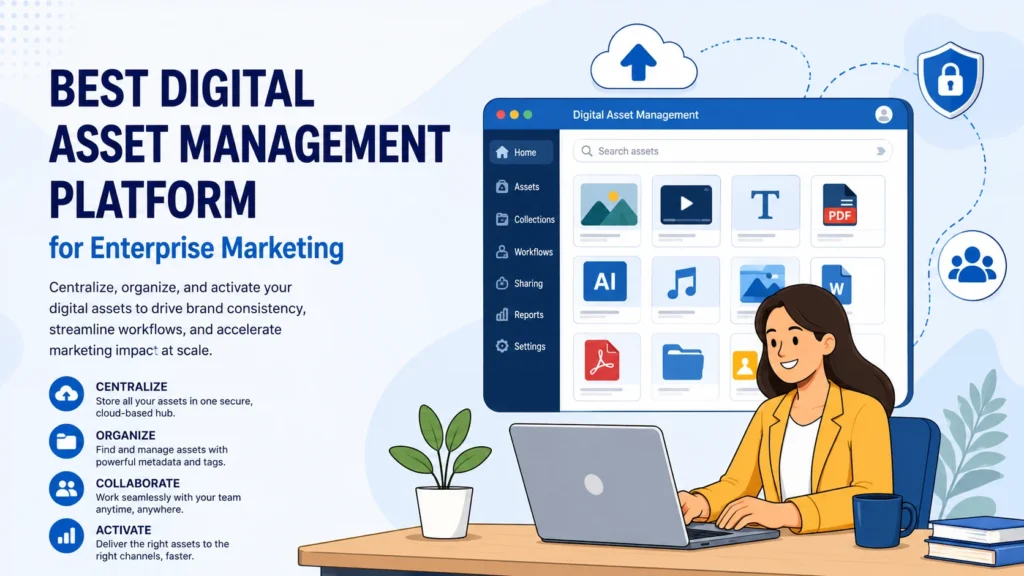
Table of Contents
Overall Features & DAM Capabilities
When evaluating the Best digital asset management platform enterprise marketing teams can adopt, the starting point should always be the platform’s core capabilities. Enterprise DAM software is not merely a sophisticated storage cabinet. It should function as a centralized content hub where marketing, creative, sales, brand, and other teams can organize, discover, review, approve, manage, and reuse digital assets with confidence.
The difference becomes obvious at scale. A platform that works perfectly for a few thousand files may become cumbersome when an organization is managing millions of assets across brands, regions, campaigns, and departments.
Centralized Digital Asset Library
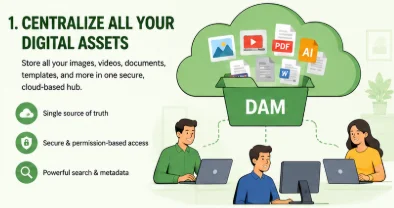
A reliable DAM should create a single, structured home for the organization’s digital content. That may include images, videos, audio files, presentations, PDFs, logos, design source files, product materials, campaign resources, and other forms of marketing content.
Without a centralized library, valuable assets tend to scatter across shared drives, personal computers, cloud folders, email attachments, and collaboration platforms. Over time, this creates a familiar enterprise problem: employees spend more time searching for content than actually using it.
A centralized DAM establishes a trusted source of truth. It can reduce duplicate files, make approved content easier to locate, and give teams greater confidence that they are working with the latest version.
When comparing platforms, evaluate:
- Support for diverse asset formats
- Large-scale storage
- Folders and collections
- Asset previews
- Bulk uploads
- Bulk editing
- Categorization
- Duplicate detection
- Asset history
Metadata Management and Organization
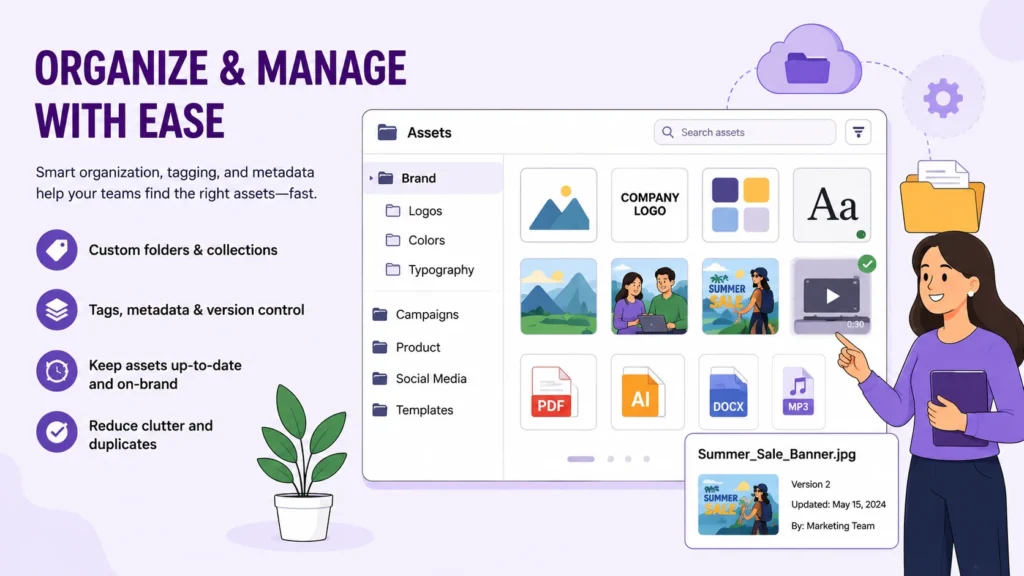
Metadata is the organizational framework behind an effective DAM. It tells the system—and its users—what an asset represents, where it belongs, how it can be used, and why it matters.
Useful metadata may include campaign name, product, region, asset type, department, copyright status, language, usage rights, and expiration information.
For enterprise marketing teams, flexibility matters. A global brand may need metadata structures that differ between departments, markets, or product categories. Advanced DAM platforms can therefore support custom fields, taxonomies, controlled vocabularies, templates, and automated metadata generation.
Look for:
- Custom metadata fields
- Metadata templates
- Structured taxonomies
- Controlled vocabularies
- Bulk metadata editing
- Custom categories
- Metadata inheritance
- Automated metadata creation
Asset Search and Filtering
A DAM’s value is closely tied to how quickly people can find what they need.
Basic keyword search is useful, but enterprise environments usually require much more. Users should be able to narrow results using metadata, categories, asset status, file type, campaign, product, region, and other relevant attributes.
Advanced platforms may also provide predictive search, relevance ranking, related-asset recommendations, semantic search, and AI-powered discovery.
Ideally, a marketer searching for assets from a particular campaign should not have to open dozens of folders and inspect hundreds of thumbnails. The platform should do much of that work.
Version Control
Version control protects organizations from a surprisingly expensive mistake: using the wrong file.
A strong DAM should preserve asset history while making the current or approved version immediately recognizable. Depending on the platform, users may also be able to compare previous versions or restore an earlier file.
This becomes particularly valuable when designers, agencies, marketers, and regional teams are working simultaneously on related campaigns. Everyone can see how an asset evolved and, more importantly, which version should be used.
Asset Preview and Renditions
Users should not have to download every file simply to determine whether it is relevant.
Strong DAM platforms provide previews for common image, video, audio, and document formats. Some also generate renditions automatically, creating channel-ready variations from an original asset.
That can be useful when one campaign image needs to appear on a website, social media platform, email campaign, digital advertisement, and mobile experience. Rather than repeatedly preparing separate versions by hand, automated transformations can reduce repetitive production work.
Asset Lifecycle Management
Enterprise DAM capabilities should extend across the complete asset lifecycle rather than stopping at upload.
A typical process might look like:
Create → Upload → Organize → Review → Approve → Distribute → Reuse → Expire → Archive
This lifecycle approach gives organizations greater control over content from its creation to its retirement.
Expiration and archival are especially important for seasonal campaigns, licensed photography, temporary promotions, product launches, and other assets that should not remain actively available forever.
Collaboration and Basic Workflow Support
DAM platforms can also become collaboration environments rather than simple repositories.
Depending on the solution, teams may be able to comment on assets, add annotations, request approvals, assign tasks, define review stages, and automate notifications.
This reduces the need to move files between email, messaging applications, spreadsheets, and project-management tools simply to complete an approval cycle.
Permissions and Access Controls
Enterprise libraries often contain assets with very different levels of sensitivity. An unreleased product campaign should not necessarily be visible to every employee, and an external agency should not automatically have access to the entire corporate library.
Granular permissions allow administrators to control who can:
- View assets
- Download files
- Upload content
- Edit metadata
- Approve assets
- Share content externally
- Manage users
- Access specific collections
These controls become increasingly important as the DAM expands across multiple brands, countries, departments, and external partners.
What to Compare When Evaluating Core DAM Capabilities
| Capability | What to Evaluate |
|---|---|
| Asset library | Storage, organization, formats, previews |
| Metadata | Custom fields, taxonomy, bulk editing |
| Search | Keywords, filters, facets, relevance |
| Version control | History, comparison, restoration |
| Asset lifecycle | Approval, expiration, archiving |
| Renditions | Automated versions and transformations |
| Collaboration | Comments, reviews, approvals |
| Permissions | Roles, access controls, sharing |
| Administration | User management, configuration, auditability |
Ultimately, the Best digital asset management platform enterprise marketing teams choose should establish a solid foundation before advanced AI, analytics, integrations, or automation enter the conversation.
A dazzling feature list cannot compensate for a poorly organized asset library. If employees struggle to find, govern, approve, or maintain content, the platform is failing at its most fundamental job.
AI-Powered Search & Asset Discovery
For organizations evaluating the Best digital asset management platform enterprise marketing teams can depend on, AI-powered discovery deserves serious attention.
Enterprise libraries can contain hundreds of thousands—or even millions—of digital assets. At that scale, searching by filename alone becomes increasingly impractical. Employees may remember what an image depicts without remembering its filename, folder, campaign, or metadata.
AI changes that equation by allowing DAM platforms to understand content more intelligently.
AI-Powered Search
AI-powered search aims to understand what the user means rather than simply matching individual words.
A marketer might search for:
- “Summer campaign images featuring a family outdoors”
- “Blue product photography approved for the UK”
- “People using laptops in a business environment”
- “Approved social graphics for the latest product campaign”
The objective is contextual discovery. The user describes the desired content, and the platform identifies assets that are semantically relevant.
When comparing enterprise DAM solutions, examine whether AI search supports natural-language queries, contextual interpretation, metadata filters, relevance ranking, and business-specific terminology.
Semantic Search
Semantic search goes a step beyond conventional keyword matching.
Instead of requiring users to know exactly how an asset was named or tagged, the system attempts to understand relationships between the query and the content.
A user who cannot remember campaign_final_07.jpg can describe the image instead. This seemingly small difference can save substantial time across a large marketing organization.
Automatic AI Tagging
Manually tagging thousands of assets is tedious, inconsistent, and difficult to maintain.
AI-powered tagging can examine assets and automatically generate descriptive tags. Depending on the platform, it may identify objects, products, environments, people, scenes, or other characteristics.
When comparing platforms, consider whether automated tagging covers:
- Images
- Videos
- Documents
- Products
- Objects
- People
- Scenes
- Custom terminology
- Bulk processing
AI-Generated Metadata
Some DAM platforms go beyond tags and generate titles, descriptions, keywords, and other metadata automatically.
This can be especially useful during large migrations. Instead of asking employees to manually catalogue an enormous legacy library, organizations can use automation to accelerate the process.
Human review remains important, however. AI-generated metadata can contain errors, misunderstand business terminology, or apply tags that do not fit the organization’s taxonomy.
The strongest systems therefore combine automation with editorial control.
Visual Similarity Search
Visual search allows users to find assets based on appearance.
For example, a marketer might start with one product photograph and use it to discover:
- Similar product images
- Alternative compositions
- Related campaign photography
- Different creative versions
- Visually related assets
This capability can be particularly useful for ecommerce, retail, media, and global organizations with enormous visual libraries.
OCR and Text Recognition
Optical character recognition, commonly known as OCR, makes text embedded within images or scanned documents searchable.
Imagine an enterprise with thousands of brochures, advertisements, screenshots, packaging files, and promotional graphics. OCR can allow users to locate assets containing specific words even when those words are not part of the file’s original metadata.
When evaluating DAM platforms, consider supported file types, languages, accuracy, and how extracted text becomes searchable.
Video and Audio Discovery
Large video libraries present an even greater discovery challenge.
Advanced DAM systems may analyze video scenes, recognize objects, transcribe speech, and make specific moments searchable. Instead of manually watching a 30-minute video to locate a particular statement or scene, users may be able to search for the relevant spoken phrase or visual element.
Duplicate and Similar Asset Detection
Duplicate detection helps organizations identify identical or nearly identical files.
This matters because enterprise libraries often grow through contributions from different departments, agencies, countries, and campaigns. Without detection tools, teams may commission new content that already exists somewhere in the organization.
Identifying duplicates can reduce clutter, improve search quality, and potentially lower unnecessary storage and production costs.
Saved Searches and Smart Collections
Marketing teams often repeat the same searches. Saved searches allow users to preserve commonly used criteria instead of rebuilding filters from scratch.
Smart collections can go further by updating automatically as new assets satisfy defined conditions.
For example, a dynamic collection could continuously gather approved product photography for a particular region or campaign.
AI Accuracy and Human Control
AI should not be evaluated purely on how impressive it sounds.
Accuracy matters just as much.
Enterprise administrators should ideally be able to:
- Correct inaccurate tags
- Edit generated metadata
- Create custom taxonomies
- Control approved terminology
- Review AI-generated information
- Exclude inappropriate tags
- Promote important search terms
- Adapt discovery to business-specific language
The best AI-powered DAM is therefore not one that removes humans from the process. It is one that removes unnecessary manual effort while keeping people in control.
What to Compare
| AI Discovery Capability | What to Evaluate |
| AI search | Natural-language and contextual discovery |
| Semantic search | Meaning-based asset retrieval |
| Automatic tagging | AI-generated tags and keywords |
| Metadata generation | Titles, descriptions, structured metadata |
| Visual search | Image similarity and visual discovery |
| OCR | Searchable text within assets |
| Video discovery | Objects, scenes, speech, transcripts |
| Duplicate detection | Duplicate and similar-asset identification |
| Smart collections | Dynamic asset groups |
| AI governance | Human review and taxonomy controls |
Ultimately, the Best digital asset management platform enterprise marketing teams select should make discovery faster without turning accuracy and governance into afterthoughts.
AI should reduce the friction between a marketer’s question and the right asset.
Workflow & Collaboration
When assessing the Best digital asset management platform enterprise marketing teams can use, workflow and collaboration deserve more than a passing glance.
Enterprise campaigns rarely involve one person. Designers, copywriters, marketers, brand managers, legal teams, agencies, and regional stakeholders may all touch the same asset before it reaches the public.
Without structure, that process can become a maze of emails, chat messages, attachments, spreadsheets, and approval requests.
A capable DAM brings these activities into a more coherent workflow.
Review and Approval Workflows
A structured approval process can transform how teams move creative content from concept to publication.
A typical workflow may look like:
Create → Submit → Review → Revise → Approve → Publish
The important point is flexibility. A social graphic might require one approval, while a global advertising campaign could require creative, legal, compliance, and brand review.
Collaboration and Comments
Collaboration tools keep conversations connected to the asset itself.
Useful capabilities include:
- Comments
- Mentions
- Annotations
- Feedback threads
- Approval requests
- Internal notes
- Task assignments
- Notifications
Instead of writing “the logo needs to move left” in a separate chat, a reviewer can leave feedback directly on the relevant creative.
That creates context—and context prevents confusion.
Version Control
Version control becomes essential when several people are editing related files.
Look for:
- Automatic version history
- Version comparison
- Previous-version access
- Restoration
- Approval status
- Change tracking
This is particularly useful when agencies and regional teams produce localized variations from a shared master campaign.
Task Assignment and Workflow Automation
Automation can eliminate repetitive administrative work.
For example:
Designer uploads asset → Brand manager receives review task → Legal receives approval request → Marketing receives completion notification
Useful automation features include:
- Automated task assignments
- Approval notifications
- Deadline reminders
- Conditional workflows
- Automatic status changes
- Escalation rules
- Workflow templates
Role-Based Workflow Management
Workflow permissions should reflect responsibilities.
A designer may be allowed to create and edit an asset, while a brand manager approves it. A legal reviewer may only need access to content waiting for compliance review.
This separation improves accountability and reduces accidental or unauthorized changes.
Agency and External Partner Collaboration
External agencies, photographers, freelancers, distributors, and other partners frequently participate in enterprise marketing.
A DAM should allow collaboration without opening the entire content library.
Useful controls include:
- Guest accounts
- Temporary access
- Shared collections
- Secure download links
- Expiring links
- Permission-based access
- External review workflows
Feedback and Annotation Tools
Visual annotations can make creative reviews dramatically clearer.
Rather than writing a vague instruction, a reviewer can point directly to the relevant area of an image, PDF, or video.
Workflow Templates
Many enterprise marketing processes repeat.
Workflow templates can standardize common activities such as:
- Product launches
- Social campaigns
- Paid advertising
- Website content
- Packaging
- Email campaigns
- Regional localization
- Legal review
Standardization reduces unnecessary variation and makes processes easier for new employees to understand.
Workflow Reporting and Visibility
Marketing leaders should be able to see where assets are getting stuck.
Useful reporting may show:
- Assets awaiting approval
- Overdue tasks
- Average approval time
- Stalled reviews
- Rejected assets
- Completed workflows
- Team workload
These insights can reveal bottlenecks that are difficult to spot when approval happens through disconnected tools.
What to Compare
| Capability | What to Evaluate |
| Approval workflows | Custom stages and rules |
| Collaboration | Comments, mentions, feedback |
| Annotations | Visual review tools |
| Version control | History, comparison, restoration |
| Task management | Assignments, deadlines, reminders |
| Automation | Notifications and automated actions |
| Permissions | Role-based workflow access |
| External collaboration | Agency and partner access |
| Workflow templates | Reusable processes |
| Reporting | Workflow visibility and bottlenecks |
The Best digital asset management platform enterprise marketing teams choose should make collaboration more structured—not more complicated.
The objective is simple: connect people, assets, feedback, and approvals so content can move from production to publication with fewer delays and fewer mistakes.
Brand Management & Governance
For enterprises comparing the Best digital asset management platform enterprise marketing teams can rely on, brand governance is fundamental.
Large organizations may have thousands of logos, templates, campaign visuals, product photographs, presentations, videos, and other branded materials spread across countries and departments. Without clear governance, inconsistency becomes almost inevitable.
A strong DAM creates a controlled environment where approved content can be organized, accessed, and distributed without unnecessarily slowing teams down.
Centralized Brand Asset Management
A DAM should provide a trusted home for:
- Logos
- Brand guidelines
- Product images
- Templates
- Fonts
- Brand photography
- Videos
- Illustrations
- Presentation templates
- Social graphics
- Advertising materials
The goal is not merely centralization. It is confidence.
When employees know where the official assets live, they are less likely to reuse outdated or unofficial files.
Brand Guidelines Management
A PDF containing brand guidelines is useful, but it should not be the entire governance strategy.
Modern DAM environments can place guidelines close to the assets they govern, making it easier for users to understand which logos, fonts, imagery, colours, and templates are appropriate.
Consider:
- Brand guideline libraries
- Brand portals
- Template management
- Approved collections
- Usage instructions
- Brand-specific metadata
- Regional guidelines
Approved Asset Management
Employees need a clear distinction between content that is being developed and content that is ready for use.
A DAM can establish statuses such as:
Draft → In Review → Approved → Published → Expired
Approved collections then become a reliable destination for everyday marketing needs.
Brand Portals and Self-Service Access
Brand portals can give authorized employees and external partners controlled access to approved materials.
A regional marketing team, for example, might receive access to:
- Approved logos
- Product photography
- Campaign assets
- Social content
- Advertising materials
- Templates
- Sales collateral
The team gets what it needs without gaining unrestricted access to the entire corporate library.
Image suggestion: Add a 16:9 illustration showing a branded self-service portal used by regional marketing teams to access approved content.
Governance and Asset Ownership
Governance defines responsibility.
Who creates an asset? Who approves it? Who can modify it? Who can distribute it?
A well-configured DAM can make these responsibilities explicit, reducing uncontrolled changes and creating greater accountability.
Brand Consistency Across Global Teams
Global enterprises face an additional challenge: localization.
Regional teams may need different languages, imagery, campaigns, or product variations while still following the organization’s core identity.
DAM metadata, permissions, collections, and workflows can distinguish content by:
- Country
- Region
- Language
- Brand
- Campaign
- Product
- Channel
This allows local flexibility without sacrificing global consistency.
Templates and Content Creation
Approved templates can help marketers create simple content variations without repeatedly involving designers.
Possible use cases include:
- Social posts
- Presentations
- Digital advertisements
- Email graphics
- Sales materials
- Promotional campaigns
Where supported, editable templates can protect important brand elements while allowing users to customize approved fields.
Asset Usage Rules
Some assets are subject to specific usage conditions.
Organizations may need to identify:
- Approved channels
- Geographic restrictions
- Campaign limitations
- Internal-only assets
- Partner-only content
- Usage periods
- Licensing requirements
- Expiration dates
Embedding this information within the DAM gives users more context before they distribute content.
Audit Trails and Governance Reporting
Enterprise organizations may need to know who uploaded, edited, approved, downloaded, or shared an asset.
Audit trails provide that visibility.
Evaluate coverage for:
- Asset changes
- User activity
- Approvals
- Downloads
- Sharing
- Permission changes
- Metadata updates
Governance Automation
Automation can enforce certain rules without depending entirely on human memory.
A DAM may be able to:
- Remove expired assets from active collections
- Notify users about upcoming expirations
- Route content to designated approvers
- Restrict sensitive assets
- Apply metadata
- Mark content as approved
- Trigger review workflows
What to Compare
| Capability | What to Evaluate |
| Brand library | Centralized approved assets |
| Brand guidelines | Standards and usage instructions |
| Approved assets | Statuses and controlled collections |
| Brand portals | Self-service access |
| Templates | Brand-safe content creation |
| Global governance | Regional and multilingual controls |
| Usage rules | Channel, region, campaign restrictions |
| Asset ownership | Responsibilities and permissions |
| Audit trails | User and asset activity |
| Governance automation | Expiration and approval automation |
The Best digital asset management platform enterprise marketing teams select should protect the brand without turning governance into a bottleneck.
The ideal balance is controlled freedom: employees can move quickly, but they are guided toward content that is current, approved, and appropriate.
Digital Rights & Compliance
For organizations searching for the Best digital asset management platform enterprise marketing teams can trust, digital rights should be treated as a core requirement.
Marketing libraries frequently contain licensed photography, video, music, illustrations, fonts, product imagery, and other content with specific conditions of use.
A file can be technically available while still being legally inappropriate to publish.
That distinction matters.
Copyright and Licensing Management
A capable DAM should allow rights information to live alongside the relevant asset.
This may include:
- Copyright holder
- License agreement
- Permitted usage
- Expiration date
- Ownership
- Contract reference
- Geographic rights
- Approved channels
License Expiration Tracking
Expiration tracking is one of the most practical rights-management features.
A useful process might be:
License approaching expiration → Notification → Marketing review → Renew, replace, restrict, or archive
This is considerably safer than relying on spreadsheets and individual calendars to remember thousands of licensing dates.
Usage Rights and Restrictions
Rights can differ by:
- Country
- Region
- Channel
- Campaign
- Product
- Audience
- Time period
- Distribution method
An image may be approved for a website but prohibited in paid advertising. Another may be licensed for one territory but not another.
The DAM should make those distinctions visible before users download or distribute content.
Geographic Rights Management
Global organizations often need market-specific controls.
Users may be able to filter content according to:
Country → Region → Language → Campaign → Approval status
This helps regional teams locate content they are actually authorized to use.
Model and Property Releases
Images and videos containing identifiable people or private property can require additional documentation.
Organizations should be able to associate relevant release information with the appropriate assets and, where supported, track restrictions and expiration dates.
Regulatory and Compliance Requirements
Industries such as financial services, healthcare, telecommunications, and government may have additional requirements governing marketing content.
A DAM can support these processes through:
- Approval workflows
- Permissions
- Audit logs
- Asset histories
- Usage restrictions
- Retention policies
- Controlled distribution
A DAM does not automatically make an organization compliant with every regulation. It does, however, provide infrastructure for managing content responsibly.
Compliance Audit Trails
Audit records can answer important questions:
- Who uploaded the asset?
- Who approved it?
- Who changed its metadata?
- Who downloaded it?
- Who shared it?
- When was it modified?
- When did its rights expire?
That visibility can be valuable during internal audits or investigations.
Automated Rights Notifications
Useful automated alerts may include:
- Upcoming expiration notifications
- Expired asset alerts
- Renewal reminders
- Review requests
- Compliance notifications
- Escalation workflows
As the asset library grows, automation becomes increasingly important.
Restricting Access to Sensitive Assets
Some content should remain inaccessible until a specific event occurs.
For example, unreleased product photography could be restricted to the launch team until the official release date.
Permissions combined with rights metadata provide a practical way to manage such situations.
Expired and Restricted Asset Management
Expired content does not always need to be deleted.
Organizations may need to retain historical files while preventing them from appearing in ordinary searches or being used in current campaigns.
Useful capabilities include:
- Automatic archiving
- Expiration statuses
- Restricted access
- Search exclusion
- Replacement workflows
- Historical records
What to Compare
| Capability | What to Evaluate |
| Copyright management | Ownership and copyright records |
| License management | Terms, agreements, restrictions |
| Expiration tracking | Dates and automated alerts |
| Usage rights | Channel, campaign, territory controls |
| Geographic restrictions | Country and regional permissions |
| Releases | Model and property documentation |
| Compliance workflows | Review and approval processes |
| Audit trails | User and asset activity |
| Access controls | Restricted content |
| Asset expiration | Archiving and replacement |
The Best digital asset management platform enterprise marketing teams choose should connect rights information to everyday content operations.
The goal is not simply to store licensing data. It is to make the right information visible at the moment a marketer decides whether an asset can be used.
Integrations & Marketing Ecosystem
When evaluating the Best digital asset management platform enterprise marketing teams can use, integration capability can be the difference between a connected content ecosystem and another isolated application.
Enterprise organizations already depend on CMS platforms, PIM systems, CRM software, ecommerce systems, creative applications, marketing automation tools, analytics platforms, and internal applications.
A DAM should fit into that environment.
CMS Integrations
CMS integration allows marketers to work with approved DAM assets while creating website content.
Rather than downloading an image, saving it locally, and uploading it again, users may be able to search and select DAM content directly from their publishing workflow.
Evaluate support for:
- Traditional CMS platforms
- Headless CMS
- Digital experience platforms
- Asset delivery
- Synchronization
- Metadata synchronization
Adobe Creative Cloud Integration
Creative teams often spend their days in applications such as Photoshop, Illustrator, and InDesign.
Deep DAM integration can reduce the distance between asset creation and asset management.
Potential capabilities include:
- Accessing DAM assets from creative tools
- Uploading finished designs
- Version management
- Metadata synchronization
- Check-in and check-out
- Centralized storage
For large creative departments, this integration can have a noticeable impact on productivity.
PIM Integrations
PIM systems manage structured product information. DAM platforms manage the digital content associated with those products.
Connecting them allows organizations to link product photography, packaging designs, technical documents, videos, and other assets with relevant product records.
This is particularly valuable for retailers, manufacturers, distributors, and ecommerce organizations.
CRM Integrations
CRM integration can bring approved content closer to sales teams.
Sales representatives may be able to access product brochures, presentations, case studies, and images without searching through separate repositories.
That makes content more accessible while reducing the likelihood of outdated materials being reused.
Marketing Automation Integrations
Connected DAM and marketing automation platforms can streamline content use across:
- Email campaigns
- Landing pages
- Lead nurturing
- Paid advertising
- Customer journeys
- Personalized campaigns
The fewer times employees have to download and re-upload the same file, the smoother the workflow becomes.
Ecommerce Integrations
For ecommerce organizations, product information and product media must work together.
DAM integrations can help deliver:
- Product photography
- Videos
- Lifestyle imagery
- Promotional graphics
- Product media
- Channel-specific content
Evaluate compatibility with ecommerce platforms, PIM systems, product catalogues, storefronts, and CDNs.
Social Media and Content Distribution
Campaign assets often need to appear across multiple social and digital channels.
DAM integrations can centralize approved content while connecting it to distribution or publishing workflows where supported.
This can reduce repetitive manual handling and improve consistency.
APIs, Webhooks and SDKs
Native integrations are useful, but enterprise technology stacks are rarely identical.
Developer tools therefore matter.
Look for:
- REST APIs
- Webhooks
- SDKs
- API documentation
- Authentication options
- Custom integration capabilities
APIs allow organizations to connect internal applications and specialized systems.
Webhooks can notify connected systems when an asset is uploaded, approved, updated, or deleted.
Integration Marketplace
An integration marketplace can simplify connections with third-party applications.
However, quantity should not be confused with quality.
Evaluate:
- Integration depth
- Supported enterprise systems
- Partner ecosystem
- Maintenance
- Custom integration options
A platform with ten excellent integrations for your core systems may be more valuable than one with fifty shallow connections.
CDN and Content Delivery
For organizations distributing large amounts of media, delivery infrastructure matters.
DAM platforms may integrate with CDNs to deliver images and videos efficiently to websites, applications, ecommerce stores, and other channels.
Look for:
- Global delivery
- Image optimization
- Automatic resizing
- Format conversion
- Caching
- Responsive delivery
- Video delivery
Data Synchronization
Integration is about more than moving files.
Metadata and status information may also need to remain synchronized.
For example, if an asset changes from Draft to Approved, connected systems may need to recognize the new status.
Evaluate synchronization of:
- Metadata
- Product information
- Categories
- Tags
- Approval status
- Usage rights
- Version information
Integration Security
Every connection introduces another pathway through which information can move.
Security should therefore cover:
- Authentication
- API permissions
- SSO
- Role-based access
- Token management
- Audit logs
- Encryption
- Webhook security
What to Compare
| Integration Capability | What to Evaluate |
| CMS | Website and digital experience connections |
| Creative tools | Adobe and other creative applications |
| PIM | Product and asset synchronization |
| CRM | Sales and customer workflows |
| Marketing automation | Campaign workflows |
| Ecommerce | Product content and storefront delivery |
| Social media | Distribution capabilities |
| APIs | Developer access and REST APIs |
| Webhooks | Real-time events |
| SDKs | Custom application development |
| CDN | Delivery and optimization |
| Security | Authentication and access controls |
The Best digital asset management platform enterprise marketing teams choose should fit into their existing technology landscape rather than forcing employees to work around it.
Before selecting a vendor, map the systems your organization relies on every day. Integration quality matters far more than an impressive integration count.
Scalability & Enterprise Performance
When assessing the Best digital asset management platform enterprise marketing teams can depend on, scalability should be considered from day one.
Enterprise libraries do not remain static. Asset counts grow. User numbers increase. New brands arrive. Markets expand. Video files become larger. Integrations multiply.
A DAM must continue performing as those demands increase.
Support for Large Asset Libraries
Enterprise libraries may contain:
- High-resolution photography
- 4K and 8K video
- Product images
- Creative source files
- Presentations
- PDFs
- Audio
- Campaign materials
- Brand guidelines
- Archived content
The platform should maintain efficient indexing, retrieval, categorization, and search as the library expands.
Rather than focusing solely on theoretical storage limits, ask vendors about their experience with environments similar to yours.
Concurrent User Capacity
Hundreds or thousands of users may access an enterprise DAM simultaneously.
Campaign launches, product releases, seasonal promotions, and global events can create sudden spikes in activity.
Ask vendors how their infrastructure handles:
- Concurrent searches
- Large uploads
- High-volume downloads
- Asset processing
- Campaign peaks
- Global access
Global Performance
A global organization needs a consistent experience across locations.
CDNs, caching, optimized delivery, regional infrastructure, and efficient media processing can all improve performance for distributed teams.
Storage Scalability
Storage needs can increase rapidly when organizations begin managing large video libraries and high-resolution creative source files.
Evaluate:
- Maximum capacity
- Expansion options
- Large-file support
- Video storage
- Archive storage
- Pricing
- Backup and redundancy
Think beyond today’s requirements. A three-to-five-year growth projection can produce a much more realistic estimate.
Search Performance at Scale
Millions of assets are only useful if users can still find content quickly.
Evaluate:
- Search response time
- Metadata indexing
- Filtering
- Faceted search
- AI search
- Natural-language search
- Visual search
- Saved searches
Poor search performance can erase much of the productivity benefit a DAM is supposed to provide.
High-Volume Uploads and Downloads
Large campaigns can involve hundreds or thousands of files.
Look for:
- Bulk uploads
- Bulk downloads
- Batch metadata editing
- Large-file transfers
- Upload progress tracking
- Resumable uploads
- Automated processing
Performance During Peak Demand
Enterprise demand can be unpredictable.
Ask vendors how their infrastructure handles traffic spikes, mass uploads, large campaign launches, concurrent searches, and high-volume downloads.
Service-level commitments and reliability history can also provide useful context.
Multi-Brand and Multi-Region Support
Large enterprises often manage several brands, subsidiaries, markets, and business units.
Useful capabilities include:
- Multiple brand libraries
- Regional collections
- Separate workspaces
- Brand-specific permissions
- Localized metadata
- Multilingual support
- Shared global assets
Architecture and Infrastructure
The technical architecture beneath the user interface matters.
Evaluate:
- Cloud infrastructure
- High availability
- Redundancy
- Disaster recovery
- Automatic scaling
- Data replication
- Backup systems
- Monitoring
API and Integration Performance
A DAM may also receive heavy API traffic from websites, ecommerce platforms, mobile applications, and internal systems.
Evaluate:
- API rate limits
- API performance
- Webhook capacity
- Bulk operations
- Authentication
- Integration monitoring
- Error handling
Migration and Future Growth
A useful planning formula is:
Current assets + annual growth + new users + new brands + new regions + new channels
This produces a more realistic view of future demand.
A company with 500,000 assets today may have several million within a few years.
What to Compare
| Capability | What to Evaluate |
| Asset capacity | Large-library support |
| User capacity | Concurrent users |
| Storage | Expansion and large-file support |
| Search performance | Discovery speed at scale |
| Uploads | Bulk processing |
| Downloads | High-volume distribution |
| Global performance | Regional access and CDN |
| Peak demand | Traffic-spike handling |
| Multi-brand support | Business-unit separation |
| API scalability | High-volume integrations |
| Infrastructure | Availability and recovery |
The Best digital asset management platform enterprise marketing teams choose should not merely accommodate growth. It should remain fast, dependable, and manageable while growth occurs.
Scalability is ultimately about more than storage. It is about preserving the user experience as complexity increases.
Security, Permissions & Administration
Security is a foundational requirement when selecting the Best digital asset management platform enterprise marketing teams can trust.
Enterprise DAMs may contain confidential campaigns, unreleased products, licensed content, intellectual property, customer-facing materials, and sensitive brand resources.
At the same time, hundreds or thousands of people may need access.
The challenge is finding the right balance between protection and usability.
Role-Based Access Control
Role-based access control allows organizations to assign permissions according to responsibilities.
For example:
- Designers can upload and edit creative content.
- Brand managers can review and approve assets.
- Marketing teams can download approved content.
- Agencies can access selected collections.
- Administrators can manage users and system settings.
This is safer than giving everyone identical permissions.
Granular Asset Permissions
Roles alone may not be enough.
Permissions may need to vary by:
- User
- Team
- Department
- Region
- Brand
- Collection
- Asset
- Project
This is especially important when global teams share the same infrastructure but work with different campaigns and markets.
Single Sign-On
Single sign-on simplifies authentication by allowing users to access the DAM through the organization’s existing identity system.
It can also make onboarding and offboarding easier because access can be controlled centrally.
Multi-Factor Authentication
MFA adds another layer of security beyond passwords.
For enterprise environments, evaluate whether administrators can enforce MFA and apply appropriate authentication policies to different groups.
External User and Agency Access
External collaboration is common in marketing.
A secure DAM should provide controlled access for:
- Agencies
- Photographers
- Freelancers
- Distributors
- Contractors
- Partners
Useful controls include guest accounts, temporary access, expiring links, collection-level permissions, and download restrictions.
Secure Asset Sharing
Controlled sharing links can be safer than email attachments or unmanaged file-sharing services.
Administrators should ideally control:
- Who can access a link
- Link expiration
- Download permissions
- Password protection
- Shared assets
Audit Logs and User Activity
Audit logs provide a record of what happened and who performed each action.
Organizations may need to know:
- Who uploaded an asset
- Who edited it
- Who downloaded it
- Who shared it
- Who approved it
- Who changed permissions
- When each event occurred
Evaluate the detail and retention period of these logs.
Encryption and Data Protection
Security should protect assets both during transmission and while stored.
Consider:
- Encryption at rest
- Encryption in transit
- Secure data transfer
- Backup protection
- Data redundancy
- Infrastructure security
- Disaster recovery
Data Residency and Compliance
Global organizations may have specific requirements regarding where information is stored or processed.
Ask vendors about:
- Data center locations
- Regional hosting
- Data transfer policies
- Compliance certifications
- Data retention
- Backup locations
Administrative Controls
Administrators should have centralized control over:
- Users
- Groups
- Roles
- Permissions
- Metadata
- Taxonomies
- Workflows
- Brands
- Integrations
- Security settings
User Provisioning and Deprovisioning
Automated provisioning can streamline onboarding, while automated deprovisioning can remove access when employees leave or change responsibilities.
This becomes increasingly important as organizations grow.
Security Monitoring and Alerts
Some platforms provide alerts for unusual behavior such as:
- Suspicious logins
- Large downloads
- Permission changes
- Unusual sharing
- Failed authentication
- Administrative changes
These capabilities can help security teams respond to potentially risky activity.
What to Compare
| Capability | What to Evaluate |
| Role-based access | Custom roles |
| Asset permissions | Granular access |
| SSO | Enterprise identity integration |
| MFA | Multi-factor authentication |
| External access | Agency and partner controls |
| Secure sharing | Expiring and controlled links |
| Audit logs | User activity records |
| Encryption | Protection in transit and at rest |
| Data residency | Regional hosting |
| Administration | Centralized controls |
| User provisioning | Automated onboarding/offboarding |
| Security monitoring | Alerts and activity tracking |
The Best digital asset management platform enterprise marketing teams select should make digital assets secure without making legitimate access unnecessarily difficult.
The right platform gives administrators control while allowing authorized employees to work quickly.
User Experience & Marketing Team Adoption
When evaluating the Best digital asset management platform enterprise marketing teams can use, user experience deserves the same attention as technical specifications.
A DAM may offer sophisticated AI, governance, security, analytics, and integrations. Yet if employees find the interface frustrating, adoption can collapse.
A platform only creates value when people actually use it.
Intuitive User Interface
Common tasks should feel straightforward.
Users should be able to upload, search, preview, organize, share, and download assets without requiring extensive technical knowledge.
Look for:
- Clear navigation
- Simple search
- Easy filtering
- Asset previews
- Logical categories
- Drag-and-drop uploads
- Straightforward downloads
- Clear approval statuses
Fast and Simple Asset Discovery
Search is often the most important everyday feature.
If employees cannot find content quickly, they may return to familiar alternatives such as shared drives or personal cloud folders.
A strong experience should support:
- Keywords
- Filters
- Categories
- Tags
- Metadata
- Natural-language queries
- Visual search
Easy Upload and Organization
Uploading content should not feel like an administrative project.
Bulk uploads, drag-and-drop functionality, automatic metadata, and batch editing can make campaign uploads substantially easier.
Self-Service Access
A major DAM benefit is reducing dependency on other teams.
A salesperson, for example, should be able to locate an approved product presentation independently instead of sending another request to marketing.
Image suggestion: Add a 16:9 illustration showing marketers, salespeople, and designers independently finding approved assets through the same DAM.
Mobile and Remote Accessibility
Marketing work happens across offices, homes, events, agencies, and countries.
Depending on the organization’s needs, evaluate:
- Mobile responsiveness
- Browser compatibility
- Remote access
- Mobile previews
- Secure sharing
- Downloads
Personalization and Customization
Different teams need different experiences.
Designers may need creative workflows. Marketers may prioritize campaign libraries. Sales teams may need presentations and product materials.
A customizable DAM can surface relevant content without forcing every user through the same interface.
Training and Onboarding
Even intuitive systems need structured onboarding.
Evaluate:
- Training sessions
- Documentation
- Tutorials
- Knowledge bases
- User guides
- Administrator training
- Dedicated onboarding
User Adoption and Change Management
Adoption is partly a communication challenge.
Employees should understand why the DAM exists and how it makes their work easier.
Useful benefits to emphasize include:
- Faster discovery
- Fewer duplicates
- Easier collaboration
- Stronger brand consistency
- Safer sharing
- Less time spent searching
Integrations and Familiar Workflows
Adoption improves when the DAM fits into existing workflows.
Creative users may want assets available inside design applications. Marketers may want approved content accessible through their CMS or campaign tools.
The more naturally the DAM fits into daily work, the less resistance users are likely to feel.
Performance and Reliability
Slow searches and failed uploads can damage adoption quickly.
Test:
- Search speed
- Upload speed
- Download speed
- Preview loading
- Availability
- Large-file performance
- High-usage performance
Analytics for Adoption
Usage analytics can reveal whether the platform is actually being adopted.
Useful metrics include:
- Active users
- Search activity
- Downloads
- Upload volume
- Popular assets
- Unused assets
- External sharing
- Department-level activity
What to Compare
| Capability | What to Evaluate |
| Interface | Navigation and usability |
| Search | Speed and simplicity |
| Uploading | Bulk upload and organization |
| Self-service | Independent access |
| Mobile experience | Remote usability |
| Customization | Role-specific experiences |
| Training | Onboarding resources |
| Integrations | Existing workflow compatibility |
| Performance | Speed and reliability |
| Adoption analytics | Usage and engagement |
The Best digital asset management platform enterprise marketing teams choose should combine enterprise power with everyday simplicity.
A feature-rich platform that nobody wants to use is not a successful DAM.
Pricing, Implementation & Customer Support
When selecting the Best digital asset management platform enterprise marketing teams can use, price should never be viewed as a standalone number.
Enterprise DAM costs can include licensing, storage, implementation, migration, integrations, training, support, professional services, and future expansion.
A platform that looks inexpensive on paper may become considerably more expensive once the full implementation is calculated.
Enterprise DAM Pricing Models
Vendors may use:
- Per-user pricing
- Tiered subscriptions
- Storage-based pricing
- Usage-based pricing
- Platform-based pricing
- Custom enterprise contracts
Enterprise solutions frequently require custom quotes.
When comparing options, determine exactly what the quoted price includes.
What Is Included in the Price?
Ask whether the package includes:
- Users
- Storage
- AI functionality
- Advanced search
- Workflow automation
- Integrations
- API access
- Support
- Training
- Security features
- Analytics
- Additional environments
A lower headline price may not represent lower total cost.
Implementation Costs
Enterprise implementation can involve:
- Planning the information architecture
- Defining metadata
- Creating taxonomies
- Configuring permissions
- Building workflows
- Connecting integrations
- Migrating assets
- Testing
- Training
- Launching
Asset Migration
Migration may involve content stored across:
- Shared drives
- Cloud storage
- Legacy DAMs
- CMS platforms
- Local computers
- Agency systems
- Archives
A successful migration is not simply a file transfer.
Metadata, versions, permissions, duplicates, rights information, and folder structures may all require attention.
Metadata and Taxonomy Setup
The information architecture is one of the most important parts of implementation.
Organizations may need to establish:
- Metadata fields
- Naming conventions
- Categories
- Tags
- Taxonomies
- Controlled vocabularies
- Asset statuses
Poor structure can make even a technically powerful DAM difficult to use.
Integration Implementation
Connecting the DAM to existing systems may require technical resources.
Evaluate the work required for:
- CMS
- PIM
- CRM
- Ecommerce
- Creative applications
- Marketing automation
- Analytics
- CDN
Determine who will implement each connection and whether professional-service fees apply.
Training and Change Management
Different users require different training.
Administrators need configuration knowledge. Everyday marketers may simply need to understand search, downloads, sharing, and approvals.
Look for:
- Administrator training
- End-user training
- Documentation
- Tutorials
- Knowledge bases
- Onboarding programs
- New-user training
Customer Support
Enterprise customers should carefully evaluate support.
Consider:
- Support availability
- Response times
- Support channels
- Dedicated account managers
- Technical support
- Knowledge bases
- Community resources
- SLAs
Service-Level Agreements
For mission-critical implementations, SLAs can clarify expectations around:
- Availability
- Incident response
- Support response
- Escalation
- Maintenance
- Service credits
Scalability and Future Costs
Costs can rise as organizations add:
- Users
- Storage
- Brands
- Regions
- Integrations
- API usage
- AI capabilities
- Support services
A multi-year projection is therefore more useful than a first-year price comparison.
Total Cost of Ownership
A practical TCO model can include:
Software + Implementation + Migration + Integrations + Training + Support + Storage + Future Users
A more expensive DAM may still deliver stronger value if it reduces manual work, increases asset reuse, accelerates approvals, and improves productivity.
What to Compare
| Capability | What to Evaluate |
| Pricing model | Per-user, tiered, storage, custom |
| Included features | AI, workflows, integrations, security |
| Implementation | Setup and configuration |
| Migration | Migration tools and services |
| Integrations | Cost and complexity |
| Training | Administrator and user training |
| Support | Availability and response |
| Account management | Dedicated enterprise support |
| SLA | Availability and escalation |
| Future costs | Growth-related expenses |
| TCO | Multi-year total cost |
The Best digital asset management platform enterprise marketing teams choose should balance price with capability, implementation support, usability, and long-term value.
Before signing, request a detailed commercial proposal separating software, implementation, migration, integrations, training, support, storage, and future expansion costs.
Best Digital Asset Management Platform for Enterprise Marketing
Choosing the Best digital asset management platform enterprise marketing teams can use requires more than counting features.
The real evaluation involves asset volume, discovery, governance, workflows, security, integrations, scalability, adoption, and total cost of ownership.
There is no universal winner. Different platforms solve different problems particularly well.
Bynder — Strong Option for Enterprise Brand and Marketing Management
Bynder can be a compelling choice for organizations that want centralized asset management alongside strong brand governance, collaboration, workflows, and controlled distribution.
It may be especially relevant for:
- Large marketing departments
- Global brands
- Creative teams
- Brand teams
- Multi-campaign environments
- Organizations focused on governance
Adobe Experience Manager Assets — Strong Option for Adobe-Centric Enterprises
Adobe Experience Manager Assets is particularly relevant for organizations deeply invested in Adobe’s broader ecosystem.
Its DAM capabilities can include metadata management, automated tagging, version control, workflows, permissions, rights management, and integration with Adobe technologies.
It may suit organizations that:
- Already use Adobe Experience Cloud
- Depend heavily on Creative Cloud
- Manage complex digital experiences
- Need extensive governance
- Have technical resources for sophisticated implementations
Brandfolder — Strong Option for Brand Asset Management
Brandfolder is relevant to organizations that place heavy emphasis on brand asset organization, controlled sharing, and self-service access.
It can be useful for managing:
- Logos
- Campaign materials
- Product photography
- Presentations
- Videos
- Brand resources
Acquia DAM — Strong Option for Structured Governance
Acquia DAM can be considered by organizations that require structured asset management, search, workflows, governance, and distribution.
It may be particularly relevant to organizations already operating within the broader Acquia ecosystem or those with sophisticated content-management requirements.
Canto — Strong Option for Ease of Use and Adoption
Canto may appeal to organizations that want useful DAM functionality without making everyday content management unnecessarily complicated.
Its emphasis on usability, organization, sharing, collaboration, and AI-supported capabilities can make it attractive to teams where adoption is a major priority.
It may be suitable for organizations prioritizing:
- Ease of use
- Fast adoption
- Collaboration
- Asset sharing
- Straightforward organization
Aprimo — Strong Option for Broader Marketing Operations
Aprimo takes a wider approach by connecting DAM capabilities with marketing operations and content processes.
This can make it appealing to organizations that want closer relationships between:
- Marketing operations
- Content workflows
- Campaign management
- Digital assets
- Governance
- Resource management
Cloudinary — Strong Option for Developer-Focused Media Delivery
Cloudinary is particularly relevant when DAM requirements overlap heavily with APIs, applications, websites, ecommerce, and dynamic media delivery.
Its developer-oriented approach can be useful for organizations that need to transform and deliver images and videos dynamically across digital experiences.
This makes it somewhat different from a traditional marketing-first DAM.
Quick Comparison
| Platform | Best Suited For | Key Strength |
| Bynder | Enterprise marketing and brand teams | Brand management and workflows |
| Adobe Experience Manager Assets | Adobe-centric enterprises | Adobe ecosystem integration |
| Brandfolder | Brand-focused organizations | Asset organization and sharing |
| Acquia DAM | Structured enterprise environments | Governance and content management |
| Canto | Teams prioritizing adoption | Ease of use and collaboration |
| Aprimo | Marketing operations | Content and marketing workflows |
| Cloudinary | Developer-focused organizations | Media delivery and APIs |
How to Choose the Right Platform
Instead of selecting a platform because it appears at the top of a generic ranking, test it against your actual operating environment.
Ask:
How many assets do we manage?
A library containing tens of thousands of files has different requirements from one containing millions.
Who needs access?
Include employees, agencies, distributors, contractors, regional teams, and external partners.
How important is AI?
Large libraries may benefit significantly from semantic search, automatic tagging, visual discovery, OCR, and AI-generated metadata.
What systems must the DAM connect with?
Map your CMS, PIM, CRM, ecommerce platform, creative tools, marketing automation systems, APIs, and other essential technologies.
How complex are our governance requirements?
Consider permissions, licensing, expiration, brand controls, approval workflows, regional restrictions, and compliance.
How quickly can employees adopt the system?
A sophisticated platform has little practical value if users avoid it because the interface is difficult.
What will the platform cost over several years?
Calculate software, implementation, migration, integrations, storage, training, support, and future expansion.
Which Platform Is Best?
The Best digital asset management platform enterprise marketing teams choose depends on the organization’s technology ecosystem, content operations, and growth plans.
Bynder can be compelling for brand-focused enterprise marketing teams. Adobe Experience Manager Assets can be particularly suitable for organizations deeply embedded in the Adobe ecosystem. Brandfolder emphasizes brand asset management and sharing, while Acquia DAM can fit structured governance environments. Canto places considerable emphasis on usability and adoption, Aprimo connects DAM with broader marketing operations, and Cloudinary stands out when developer-led media delivery is central to the business.
The better question is therefore not:
“Which DAM has the most features?”
It is:
“Which DAM fits the way our enterprise creates, governs, discovers, and distributes content?”
Once that question has a clear answer, the selection process becomes much more practical. Build a shortlist, test each platform with realistic assets and workflows, involve actual users, and calculate the full cost of ownership before signing a contract.
Conclusion
Choosing the Best digital asset management platform enterprise marketing teams can depend on requires more than comparing feature lists. The right DAM should combine powerful asset management, AI-powered search, collaboration, brand governance, security, integrations, scalability, and reliable support.
A strong platform helps marketing teams find the right files faster, manage approvals, protect digital rights, maintain brand consistency, and work efficiently across departments and regions.
Ultimately, the best DAM is the one that fits your organization’s workflows, team requirements, technology stack, asset volume, and future growth. When these factors are considered carefully, a DAM can become more than a storage system—it can become a central foundation for efficient, organized, and scalable enterprise marketing operations.
To learn more about marketing tools and discover detailed reviews, comparisons, and practical guides, visit AmiinMarketer.com.