
How to check competitors email marketing is a question that many marketers, entrepreneurs, and business owners ask when they’re looking for practical ways to improve their email campaigns. Instead of relying on guesswork or spending months testing different strategies, you can learn a great deal by studying how your competitors communicate with their subscribers. Every email they send—from welcome sequences and promotional offers to product announcements and abandoned cart reminders—provides valuable insights into what may be working in your industry.
Learning how to check competitors email marketing doesn’t mean copying another brand’s campaigns. The objective is to understand the strategies behind their emails, identify successful patterns, and uncover opportunities that can strengthen your own email marketing efforts. By analyzing subject lines, email design, content, calls to action, personalization, and sending frequency, you can make more informed decisions and create campaigns that better connect with your audience.
In this guide, you’ll discover how to check competitors email marketing step by step. We’ll cover the best methods for monitoring competitor emails, the most useful tools for competitor analysis, what to evaluate in every campaign, common mistakes to avoid, and how to transform competitor insights into original, high-performing email marketing campaigns that generate more opens, clicks, and conversions.
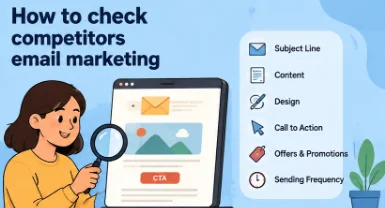
Table of Contents
How to Check Competitors’ Email Marketing: A Complete Guide
Every successful email marketing campaign leaves behind a trail of clues. The subject line that sparks curiosity. The offer that persuades readers to click. The timing that lands in an inbox at exactly the right moment. While these decisions may appear effortless, they’re usually the result of countless experiments, audience insights, and continuous optimization.
That’s precisely why learning how to check competitors’ email marketing can become one of the smartest moves you make as a marketer. Instead of relying on assumptions or spending months testing every idea yourself, you can study what other businesses in your industry are doing, identify patterns, and use those discoveries to strengthen your own strategy.
Competitor email analysis isn’t about copying another brand’s campaigns. It’s about understanding the psychology behind their emails. Why do they send messages on certain days? Which promotions appear repeatedly? How do they welcome new subscribers? More importantly, what can you learn from both their successes and their mistakes?
In this comprehensive guide, you’ll discover practical ways to monitor competitors’ email campaigns, evaluate every important element—from subject lines and design to automation workflows—and transform your research into actionable improvements that increase engagement, conversions, and long-term customer loyalty.
What Is Competitor Email Marketing Analysis?
Competitor email marketing analysis is the practice of evaluating the emails your competitors send to understand how they attract attention, nurture subscribers, and convert readers into paying customers. Rather than imitating their campaigns, you examine the strategy behind them, uncover what’s working, and apply those lessons in a way that aligns with your own brand.
Think of it as market research focused specifically on email marketing.
Every email your competitors send tells a story. A welcome sequence reveals how they introduce their brand. Promotional campaigns showcase their sales strategy. Product announcements highlight their priorities, while automated emails expose the customer journey they’ve carefully built behind the scenes.
By studying these messages consistently, you gain valuable insights that would otherwise take months—or even years—to discover through trial and error alone.
If you’re wondering how to check competitors’ email marketing, begin by subscribing to their newsletters exactly as a potential customer would. Once you’re receiving their emails, start evaluating every important component, including:
- Subject lines
- Preview text
- Email design and layout
- Content structure
- Promotional offers
- Calls to action (CTAs)
- Personalization techniques
- Sending frequency
- Automation sequences
- Landing pages linked from emails
The objective isn’t simply to collect emails in your inbox. The real value comes from asking deeper questions.
- How frequently do they communicate with subscribers?
- What types of campaigns dominate their email calendar?
- Which products receive the most attention?
- Do they educate subscribers or focus mainly on sales?
- How often do they personalize messages?
- What incentives encourage clicks and conversions?
- How do they guide subscribers through the buying journey?
Over time, clear patterns begin to emerge. You may notice that several competitors increase promotions during particular seasons, rely heavily on scarcity-based messaging, or consistently use educational content before pitching a product.
These observations reveal more than isolated marketing tactics—they expose broader industry trends.
Competitor email marketing analysis also helps you identify opportunities that others overlook. Perhaps everyone in your niche sends endless promotional emails but rarely offers educational content. Maybe competitors neglect existing customers while focusing almost exclusively on new leads. These gaps represent opportunities to differentiate your business instead of blending into an already crowded inbox.
Ultimately, competitor research should never replace your own creativity. Instead, it should sharpen your decision-making.
The strongest email marketers don’t copy campaigns. They study strategies, adapt proven principles, and combine those insights with customer data, brand personality, and original ideas to create campaigns that genuinely resonate with their audience.
Why You Should Check Your Competitors’ Email Marketing
Email marketing rarely succeeds by accident.
Behind every high-performing campaign are countless experiments involving subject lines, layouts, promotional offers, timing, segmentation, and automation. Your competitors have already invested significant time and money into those experiments, making their email campaigns an invaluable source of market intelligence.
Learning how to check competitors’ email marketing allows you to benefit from those insights without repeating the same costly trial-and-error process.
One of the greatest advantages is understanding what your audience has already become accustomed to seeing. Since competitors often target the same customers, their emails reveal the types of messaging, promotions, and content that are common within your industry.
That knowledge provides an important benchmark.
For example, if every major competitor sends weekly newsletters while you communicate only once a month, you may be missing opportunities to stay visible. Conversely, if subscribers are being overwhelmed with constant promotions, a more educational, value-driven approach could help your brand stand apart.
Competitor analysis also fuels creativity.
Instead of staring at a blank page wondering what to write next, you’ll have a steady stream of ideas to evaluate. Perhaps a competitor uses concise subject lines that consistently generate curiosity. Another might excel at storytelling. A third may produce beautifully designed product launch emails.
Each campaign offers inspiration—not templates to duplicate, but ideas you can reinterpret through your own brand voice.
You’ll also gain a clearer understanding of promotional strategies.
Questions naturally begin to answer themselves.
When do competitors launch seasonal campaigns?
How frequently do they offer discounts?
Do they rely on percentage-based savings, limited-time bonuses, free shipping, or exclusive bundles?
Which products receive the most promotional attention?
Monitoring these patterns helps you anticipate market activity and prepare stronger campaigns of your own.
Another overlooked benefit is discovering untapped opportunities.
Competitors often leave gaps without realizing it. Some rarely educate subscribers. Others neglect post-purchase engagement or fail to personalize their messaging. Identifying these weaknesses allows you to offer experiences that customers aren’t receiving elsewhere, making your emails far more memorable.
Long-term monitoring provides even deeper insights.
Email marketing evolves continuously. Designs change. Automation becomes more sophisticated. Personalization grows increasingly advanced. By tracking competitors throughout the year, you’ll notice emerging trends before they become industry standards, giving you valuable time to adapt.
Most importantly, competitor analysis encourages smarter decision-making.
Rather than guessing which ideas might work, you’ll make informed choices based on real-world examples supported by observable patterns. Combined with your own analytics and customer feedback, these insights help create campaigns that are not only more engaging but also more effective at driving clicks, conversions, and customer loyalty.
Key Benefits of Analyzing Competitors’ Email Marketing
- Discover proven email marketing strategies within your industry.
- Find inspiration for stronger subject lines, layouts, and campaign ideas.
- Understand how competitors position products and promotions.
- Identify overlooked opportunities your competitors aren’t addressing.
- Stay ahead of changing email marketing trends.
- Make better decisions using research instead of assumptions.
- Improve engagement, click-through rates, and conversions through continuous optimization.
How to Find and Subscribe to Your Competitors’ Email Lists
Before you can evaluate a competitor’s email strategy, you need access to the emails they send. Fortunately, the process is simple. In most cases, all you have to do is subscribe as if you were a genuine customer.
This approach gives you an authentic view of their email marketing—from the very first welcome message to promotional campaigns, abandoned cart reminders, product announcements, and post-purchase follow-ups.
The more touchpoints you experience, the clearer the picture becomes.
Visit Their Website
Most businesses make it easy for visitors to join their mailing list.
Look around the homepage, footer, blog, or dedicated landing pages for newsletter signup forms. Some brands also use exit-intent pop-ups, floating banners, or discount offers that encourage visitors to subscribe.
Once you’ve joined their list, pay attention to the experience immediately after signing up.
Do you receive a welcome email within minutes? Is there a discount code? Are you introduced to the company’s story before being sold a product?
Small details like these often reveal how seriously a business treats email marketing.
Download Their Lead Magnets
Many companies exchange valuable resources for an email address.
These resources may include:
- eBooks
- Whitepapers
- Checklists
- Templates
- Industry reports
- Free courses
- Webinars
- Discount coupons
- Product guides
Signing up for these offers often places you inside carefully designed automated sequences. Instead of receiving one email, you’ll experience an entire nurturing campaign intended to build trust before asking for a sale.
These sequences can be incredibly valuable to study because they’re usually optimized over time.
Create an Account or Start a Free Trial
If your competitors offer software, online services, or subscription products, registering for a free account opens the door to another layer of their email strategy.
Watch closely for emails such as:
- Account verification
- Product onboarding
- Feature tutorials
- Upgrade reminders
- Usage tips
- Customer success stories
- Renewal notices
Together, these emails reveal how competitors move users from curiosity to long-term customers.
Trigger an Abandoned Cart Sequence
For eCommerce brands, abandoned cart emails are among the most profitable automated campaigns.
To trigger one, simply add an item to your shopping cart and begin the checkout process without completing the purchase.
Within a few hours—or perhaps a day—you may receive reminders encouraging you to return.
Pay attention to questions like these:
- Do they offer a discount?
- How quickly do they follow up?
- How many reminders are sent?
- Do they create urgency?
- Are recommended products included?
These campaigns often provide some of the best insights into a brand’s conversion strategy.
Make a Small Purchase
If your budget allows, consider buying one inexpensive product.
This gives you access to the post-purchase customer journey—a stage many marketers overlook when studying competitors.
You may receive:
- Order confirmations
- Shipping notifications
- Delivery updates
- Product usage tips
- Cross-sell recommendations
- Review requests
- Loyalty program invitations
- Reorder reminders
Some businesses generate more revenue after the first purchase than during it. Studying these emails helps you understand how they retain customers instead of focusing only on acquiring them.
Use a Dedicated Research Email
Mixing competitor emails with your business inbox quickly becomes overwhelming.
Instead, create a separate email address solely for competitor research.
As more newsletters arrive, organize them into folders or labels based on company name.
This simple habit makes future analysis dramatically easier.
Build Your Own Email Swipe File
Collecting emails isn’t enough.
Create a personal library containing campaigns that stand out for one reason or another.
Save examples with:
- Outstanding subject lines
- Creative layouts
- Excellent storytelling
- Strong CTAs
- Unique offers
- Clever personalization
- Seasonal campaigns
Over time, this collection becomes an invaluable source of inspiration whenever you’re planning your own campaigns.
Best Practices
While monitoring competitors is perfectly acceptable, always approach the process ethically.
Keep these principles in mind:
- Subscribe through legitimate signup forms.
- Respect privacy laws and data regulations.
- Never copy another company’s emails.
- Focus on understanding strategies rather than duplicating content.
- Review competitor emails consistently to spot long-term patterns.
Remember, the goal isn’t to become another version of your competitors.
It’s to become better than them.
How to Check Competitors’ Email Marketing Step by Step
Subscribing to competitor newsletters is only the beginning.
The real value comes from analyzing what arrives in your inbox, documenting your observations, and transforming those insights into measurable improvements.
Here’s a practical framework you can follow.
Step 1: Identify Your Main Competitors
Start by building a list of businesses worth monitoring.
Include both direct competitors that sell similar products and indirect competitors targeting the same audience.
Aim for at least five to ten companies.
A broader sample gives you a much clearer picture of industry trends.
Step 2: Join Every Relevant Email List
Don’t stop with the newsletter.
Interact with the brand in different ways so you trigger as many automated campaigns as possible.
For example:
- Subscribe to newsletters.
- Download lead magnets.
- Create an account.
- Start a free trial.
- Abandon a shopping cart.
- Complete a purchase.
Each action unlocks another part of the customer journey.
Step 3: Organize Your Research
Without organization, competitor analysis quickly turns into chaos.
Create folders for every competitor and maintain a spreadsheet containing information such as:
- Date received
- Subject line
- Email category
- Primary offer
- CTA
- Landing page
- Personal observations
This database becomes increasingly valuable as weeks turn into months.
Step 4: Study Subject Lines
The inbox is crowded.
Subject lines determine whether an email gets opened or ignored.
As you review competitor campaigns, look for recurring characteristics.
Do they:
- Ask questions?
- Create urgency?
- Use numbers?
- Include emojis?
- Personalize with first names?
- Mention discounts?
Patterns often reveal what has worked consistently for that brand.
Step 5: Evaluate Email Design
Design influences readability, trust, and click-through rates.
Review each email carefully.
Notice:
- Overall layout
- Branding consistency
- Image usage
- White space
- Typography
- Mobile responsiveness
- CTA placement
Simple designs sometimes outperform highly visual ones because they reduce distractions.
Step 6: Analyze the Copy
Words sell.
Look beyond appearance and examine how competitors communicate.
Ask yourself:
What’s the objective?
Are they educating, entertaining, or selling?
How do they handle objections?
What emotions do they trigger?
Do they emphasize benefits more than features?
Understanding messaging often reveals more than design ever could.
Step 7: Track Frequency and Timing
Consistency matters.
Record:
- Emails per week
- Time sent
- Day sent
- Seasonal spikes
- Product launch schedules
After several months, you’ll begin noticing rhythms that casual observers completely miss.
Step 8: Examine Every CTA
Every marketing email exists to drive an action.
Study each call to action carefully.
Examples include:
- Shop Now
- Start Free Trial
- Claim Your Discount
- Book a Demo
- Download Guide
- Learn More
Pay attention not only to wording but also placement, color, visibility, and repetition.
Step 9: Compare Competitors Side by Side
Individual analysis is useful.
Comparative analysis is where real insights emerge.
Review competitors collectively.
Which brand sends the most emails?
Which uses stronger offers?
Who personalizes messages most effectively?
Who relies heavily on automation?
Comparisons expose strengths, weaknesses, and opportunities far more clearly than isolated observations.
Step 10: Turn Insights into Action
Research without implementation has little value.
Use your findings to:
- Improve subject lines.
- Redesign email templates.
- Strengthen CTAs.
- Refine promotional calendars.
- Expand automation workflows.
- Test new personalization tactics.
Remember, you’re not collecting ideas for imitation.
You’re collecting evidence that helps you make smarter marketing decisions.
What to Analyze in Your Competitors’ Email Campaigns
Receiving competitor emails is only half the equation.
Knowing what deserves your attention is what separates meaningful research from casual observation.
Every campaign contains dozens of signals that reveal how a business attracts, persuades, and retains customers.
Here are the areas worth examining.
Subject Lines
A subject line determines first impressions.
Evaluate:
- Length
- Personalization
- Curiosity
- Urgency
- Scarcity
- Emojis
- Numbers
- Promotional language
If certain approaches appear repeatedly, they’re probably delivering results.
Preview Text
Preview text quietly supports the subject line.
Strong examples expand curiosity rather than repeating what’s already been said.
Ask yourself:
- Does it complement the subject?
- Does it encourage opens?
- Is it concise?
- Does it include a subtle CTA?
Small improvements here can dramatically influence open rates.
Email Layout
Look beyond aesthetics.
Consider usability.
Evaluate:
- Visual hierarchy
- Spacing
- Branding
- Readability
- Mobile optimization
- Image balance
- CTA visibility
An attractive email means little if readers struggle to navigate it.
Email Copy
Words shape perception.
Analyze:
- Tone of voice
- Storytelling
- Message length
- Value proposition
- Customer pain points
- Benefits
- Social proof
Strong copy feels conversational while guiding readers naturally toward action.
Calls to Action
Every email should make the next step obvious.
Review:
- CTA wording
- Placement
- Frequency
- Visibility
- Landing page consistency
Sometimes changing only a few words significantly improves click-through rates.
Promotions
Track recurring offers such as:
- Percentage discounts
- Bundle deals
- Flash sales
- Loyalty rewards
- Free shipping
- Free gifts
- Coupon codes
Patterns often reveal long-term pricing strategies.
Personalization
Modern email marketing extends far beyond first-name greetings.
Look for:
- Product recommendations
- Location-based messaging
- Behavioral triggers
- Dynamic content
- Purchase history
- Browsing behavior
Sophisticated personalization often signals advanced segmentation behind the scenes.
Best Tools to Check Competitors’ Email Marketing
While manually subscribing to competitors’ newsletters remains one of the most effective research methods, the right software can make the process faster, more organized, and significantly more insightful.
Some tools archive competitor campaigns automatically. Others help you discover email design trends, compare marketing activity across brands, or organize your own research into a searchable database.
The best approach is rarely relying on a single platform. Instead, combine manual observation with specialized tools to build a complete picture of your competitors’ email strategies.
MailCharts
MailCharts has become one of the leading platforms for competitor email analysis, and for good reason. Rather than waiting months to collect enough emails yourself, you can explore an extensive database of campaigns from thousands of brands.
Among its most useful features are:
- Historical email archives
- Subject line tracking
- Promotional calendars
- Email frequency reports
- Industry benchmarks
- Campaign comparisons
If your goal is to understand how established companies structure their email marketing over time, MailCharts offers one of the most comprehensive solutions available.
Owletter
Owletter acts like a personal research assistant.
After choosing the brands you want to monitor, the platform automatically collects and stores every email they send. Instead of searching through an overflowing inbox, you’ll have a searchable archive organized for long-term analysis.
Its core features include:
- Automatic campaign collection
- Historical email storage
- Sending frequency reports
- Spam reputation monitoring
- Competitor comparisons
This is especially useful for marketers who want to track brands continuously without manual effort.
Milled
Sometimes you don’t want to monitor competitors—you simply need inspiration.
That’s where Milled excels.
The platform maintains a massive collection of promotional emails from well-known brands across numerous industries.
Search by company, keyword, holiday, or campaign type, and you’ll quickly uncover examples of:
- Product launches
- Holiday promotions
- Flash sales
- Seasonal campaigns
- Newsletter designs
It’s an excellent resource whenever creative ideas start running dry.
Really Good Emails
Design matters.
Really Good Emails isn’t designed specifically for competitor research, but it’s one of the internet’s richest collections of exceptional email examples.
Browse hundreds of professionally designed campaigns, including:
- Welcome sequences
- Transactional emails
- Product announcements
- Promotional campaigns
- Onboarding flows
- Newsletter layouts
Instead of guessing what modern email design should look like, you’ll have countless high-quality examples to study.
Similarweb
Email doesn’t exist in isolation.
It supports a broader digital marketing strategy.
Although Similarweb doesn’t provide direct access to competitor emails, it helps you understand the bigger picture by revealing:
- Website traffic trends
- Audience demographics
- Referral sources
- Marketing channels
- Competitor comparisons
Combined with email analysis, these insights create a far more complete understanding of a competitor’s marketing ecosystem.
Google Alerts
Sometimes valuable email campaigns begin with announcements made elsewhere.
Google Alerts notifies you whenever competitors are mentioned online, helping you spot:
- Product launches
- Company news
- Press releases
- New partnerships
- Industry updates
Once you know a promotion is happening, you can watch your inbox for the corresponding email campaign.
Your Own Email Inbox
Ironically, one of the most powerful research tools costs absolutely nothing.
Create a dedicated email address.
Subscribe to every competitor.
Organize messages into folders.
Review campaigns regularly.
Simple.
This firsthand experience often provides richer insights than automated platforms because you’re seeing exactly what subscribers receive.
Spreadsheets or Notion
Research quickly loses value if it’s scattered across dozens of emails.
Create a central database where every campaign can be logged.
Track details such as:
- Competitor
- Subject line
- Date received
- Campaign type
- Offer
- CTA
- Sending time
- Personal observations
Over several months, this database becomes an invaluable reference point.
Choosing the Right Tool
Different goals require different solutions.
If you need deep competitive intelligence, MailCharts is an excellent choice.
If automation matters most, Owletter saves considerable time.
Looking for creative inspiration? Milled and Really Good Emails are difficult to beat.
Working with a limited budget?
Your inbox, combined with Google Sheets or Notion, remains surprisingly powerful—and completely free.
Ultimately, tools don’t replace analysis.
They simply make good analysis easier.
How to Track Your Competitors’ Email Frequency and Strategy
Receiving emails is useful.
Tracking them consistently is where genuine competitive intelligence begins.
Patterns rarely appear after a handful of campaigns. They emerge gradually, revealing how brands communicate throughout the customer journey and across different seasons.
Here’s how to uncover those patterns.
Monitor Sending Frequency
Start by recording every email competitors send.
Keep things simple.
Track:
- Date
- Time
- Competitor
- Campaign type
Within a month, meaningful trends will begin to surface.
Some companies email daily.
Others communicate only once a week.
Neither approach is automatically better, but understanding each brand’s cadence provides valuable context.
Identify Their Schedule
Frequency tells only part of the story.
Timing matters just as much.
Pay attention to:
- Weekdays versus weekends
- Morning or evening sends
- Holiday campaigns
- Seasonal promotions
- Product launches
Many successful brands follow remarkably consistent schedules.
Recognizing those rhythms helps you anticipate future campaigns before they arrive.
Categorize Every Email
Not every email serves the same purpose.
Organize campaigns into categories like:
- Welcome emails
- Promotions
- Educational newsletters
- Product launches
- Event invitations
- Abandoned cart reminders
- Post-purchase emails
- Re-engagement campaigns
Categorization makes broader strategies much easier to recognize.
Analyze Promotional Cycles
Promotions often follow predictable patterns.
Watch for recurring campaigns such as:
- Monthly sales
- Flash discounts
- Free shipping weekends
- Holiday offers
- Product launches
- Clearance events
Once you’ve tracked competitors for several months, their promotional calendar becomes surprisingly predictable.
Study Subject Line Trends
Subject lines reveal marketing priorities almost immediately.
Notice recurring techniques like:
- Curiosity
- Questions
- Personalization
- Emojis
- Numbers
- Scarcity
- Discount-focused messaging
If the same style appears repeatedly, it’s probably producing strong results.
Trigger Automated Workflows
Don’t limit your research to newsletters.
Trigger automation by:
- Joining mailing lists
- Creating accounts
- Starting free trials
- Downloading resources
- Abandoning shopping carts
- Making purchases
Automation often generates significantly more revenue than one-off promotional emails.
Studying these workflows provides a deeper understanding of the customer journey.
Record Every CTA
Calls to action deserve individual attention.
Document:
- Button wording
- Placement
- Design
- Destination pages
- Associated offers
You’ll quickly discover which actions competitors prioritize throughout different stages of the buying process.
Compare Multiple Brands
Single-brand analysis offers limited perspective.
Comparing several competitors reveals industry norms.
Create comparison tables covering:
- Frequency
- Timing
- Promotions
- Personalization
- Automation
- Email length
- Design style
The similarities expose trends.
The differences reveal opportunities.
Review Your Findings Monthly
Email marketing evolves continuously.
Set aside time every month to review your research.
Ask yourself:
What’s changed?
Which promotions appeared?
Has email frequency increased?
Have designs evolved?
Are competitors introducing new automation?
Continuous monitoring ensures your insights stay relevant.
Common Mistakes to Avoid When Analyzing Competitors’ Emails
Competitor research is incredibly valuable—but only when approached correctly.
Many marketers unintentionally reduce the usefulness of their analysis by making a handful of avoidable mistakes.
Here are the biggest ones.

Copying Instead of Learning
This mistake is surprisingly common.
Successful competitor analysis isn’t about recreating someone else’s campaign.
It’s about understanding why it worked.
Borrow principles.
Never duplicate execution.
Your audience deserves something original.
Watching Only One Competitor
No single business represents an entire industry.
Study multiple brands.
Different companies solve similar marketing problems in different ways.
The broader your sample, the stronger your conclusions become.
Ignoring Automation
Welcome emails.
Abandoned carts.
Post-purchase follow-ups.
Review requests.
These campaigns often outperform newsletters in terms of revenue.
Ignoring them leaves major gaps in your research.
Judging Design Alone
Beautiful emails don’t always convert.
Strong strategy beats attractive visuals.
Evaluate:
- Copy
- Timing
- Offer
- CTA
- Customer journey
Design is only one piece of the puzzle.
Overlooking Email Frequency
One outstanding email tells you very little.
Fifty emails tell a story.
Track campaigns over weeks and months before drawing conclusions.
Skipping Landing Pages
Always click through.
A persuasive email can still fail if the landing page creates friction.
Review:
- Message consistency
- Design
- Mobile experience
- Checkout flow
- Page speed
Email and landing page should function as one seamless experience.
Poor Organization
An unorganized inbox eventually becomes unusable.
Use folders.
Maintain spreadsheets.
Record observations.
Future-you will be grateful.
Drawing Conclusions Too Early
Marketing changes throughout the year.
Holiday campaigns differ from spring promotions.
Product launches differ from newsletters.
Give yourself enough data before identifying trends.
Forgetting Your Own Audience
A competitor’s strategy may work brilliantly…
…for their customers.
Not necessarily yours.
Always validate ideas through testing instead of assumptions.
Failing to Experiment
Research without implementation produces no results.
Turn observations into experiments.
Measure performance.
Refine continuously.
That’s where real improvement happens.
How to Use Competitor Email Marketing Insights to Improve Your Campaigns
Gathering competitor emails is only the beginning. The real advantage comes from what you do with the information afterward.
Every campaign you analyze should answer an important question: How can this help improve my own email marketing?
The goal isn’t to recreate another company’s strategy. It’s to uncover proven ideas, adapt them to your audience, and create campaigns that are even more relevant and engaging.
Here’s how to put your research to work.
Look for Patterns, Not One-Off Ideas
A single successful email doesn’t necessarily indicate a winning strategy.
However, when multiple competitors repeatedly use similar techniques, it’s worth paying attention.
Watch for recurring patterns in:
- Subject line styles
- Promotional schedules
- Email layouts
- CTA placement
- Personalization
- Content structure
These repeated behaviors often reveal practices that have been refined through testing and real customer data.
Write Stronger Subject Lines
Your subject line is your first opportunity to capture attention.
As you study competitors, notice which approaches appear most frequently.
Do they:
- Ask intriguing questions?
- Highlight a limited-time offer?
- Use numbers or statistics?
- Create curiosity?
- Personalize the message?
- Keep the wording short and direct?
Don’t copy these headlines word for word. Instead, understand the psychology behind them and create original versions that reflect your own brand voice.
Improve Your Email Design
A well-designed email makes it easier for subscribers to consume information and take action.
As you review competitor campaigns, pay attention to design choices such as:
- Visual hierarchy
- White space
- Image placement
- Font readability
- CTA visibility
- Mobile responsiveness
Ask yourself a simple question:
Does the design make the next step obvious?
If the answer is yes, identify the principles behind that experience and apply them to your own templates.
Create More Valuable Content
Successful email marketing isn’t only about selling.
It’s about helping.
Review how competitors educate, entertain, and build trust with their subscribers.
Notice:
- Their tone of voice
- Storytelling techniques
- Educational content
- Product positioning
- Customer success stories
- Social proof
Then challenge yourself to go one step further.
Offer clearer explanations.
Share deeper insights.
Provide more useful resources.
Value is one of the strongest competitive advantages you can build.
Strengthen Your Calls to Action
Every email should guide readers toward a specific action.
Review how competitors present their CTAs.
Consider:
- The wording
- Button placement
- Number of buttons
- Visual prominence
- Supporting copy
Sometimes a subtle change—from “Learn More” to “Get My Free Guide,” for example—can dramatically improve click-through rates.
Small refinements often produce surprisingly meaningful results.
Optimize Your Email Schedule
Competitor analysis also helps you identify broader communication patterns.
Monitor:
- Weekly email frequency
- Preferred sending days
- Time of day
- Seasonal campaigns
- Product launch schedules
You don’t have to follow the same calendar.
Instead, use it as context.
If every competitor floods inboxes during a major sales event, perhaps your opportunity lies just before—or immediately after—that period.
Timing can become a competitive advantage.
Improve Your Automation Workflows
The highest-performing email programs rely heavily on automation.
Compare your workflows against those of your competitors.
Do they have:
- Welcome sequences?
- Educational onboarding emails?
- Abandoned cart reminders?
- Product recommendation campaigns?
- Customer win-back emails?
- Post-purchase follow-ups?
If your customer journey feels incomplete, competitor research can highlight exactly where improvements are needed.
Discover New Promotional Ideas
Promotions aren’t just about discounts.
They’re about perceived value.
As you monitor competitors, look beyond percentage-off offers.
Notice how they create urgency, reward loyalty, bundle products, or introduce exclusive bonuses.
Examples include:
- Early-access sales
- Free shipping
- Limited-edition products
- Bonus gifts
- Loyalty rewards
- Free consultations
- Extended trials
Rather than repeating the same offers, think about how your business can create something even more compelling.
Test Everything
Never assume a competitor’s strategy will automatically work for your audience.
Every market behaves differently.
Use competitor insights as hypotheses—not conclusions.
Run A/B tests on:
- Subject lines
- Email layouts
- Images
- CTA buttons
- Sending times
- Promotional offers
Then measure the results using key performance indicators such as:
- Open rate
- Click-through rate
- Conversion rate
- Revenue per email
- Unsubscribe rate
Real performance data should always guide your next decision.
Make Competitor Analysis an Ongoing Habit
Email marketing evolves constantly.
Design trends shift.
Customer expectations change.
Automation becomes more sophisticated.
Brands experiment with new messaging.
For that reason, competitor analysis shouldn’t be treated as a one-time project.
Review competitor campaigns regularly, update your research, and continue refining your own strategy based on both market trends and your internal performance data.
The businesses that improve the fastest are usually the ones that never stop learning.
Frequently Asked Questions
Is it legal to monitor competitors’ email marketing?
Yes.
Subscribing to a competitor’s public newsletter is completely legal. You’re simply joining their mailing list in the same way any prospective customer would.
What isn’t acceptable is accessing private systems, collecting restricted data, or copying copyrighted material.
Competitor research should always be ethical and transparent.
What’s the easiest way to monitor competitor emails?
The simplest method is also one of the most effective.
Create a dedicated email address and subscribe to your competitors’ newsletters, free trials, webinars, and lead magnets.
If you want deeper historical insights, combine this approach with platforms such as MailCharts or Owletter.
How many competitors should I follow?
There’s no perfect number, but monitoring between five and ten competitors usually provides enough variety to identify meaningful industry trends.
Include both direct competitors and businesses targeting a similar audience.
A wider perspective leads to stronger insights.
How long should competitor analysis continue?
Competitor research isn’t something you complete once and forget.
Ideally, monitor campaigns throughout the year.
Long-term observation reveals:
- Seasonal promotions
- Product launch cycles
- Email frequency
- Design evolution
- Automation improvements
The longer you track competitors, the clearer their strategy becomes.
Which parts of an email deserve the most attention?
Focus on the elements that directly influence engagement and conversions.
These include:
- Subject lines
- Preview text
- Copywriting
- Design
- Personalization
- Calls to action
- Promotional offers
- Automation
- Landing pages
- Sending frequency
Looking at the entire customer journey provides far more insight than evaluating individual emails in isolation.
Should I copy successful competitor campaigns?
No.
The objective is to understand why a campaign performs well—not to reproduce it.
Successful marketers borrow principles, not content.
Your competitive advantage comes from creating something distinctive that reflects your own brand and speaks directly to your audience.
Can small businesses benefit from competitor email analysis?
Absolutely.
In fact, smaller businesses often benefit the most.
Studying established competitors allows you to learn from years of testing without spending the same amount of money on experimentation.
Even a simple spreadsheet combined with a dedicated research inbox can uncover ideas that improve subject lines, automation, promotional planning, and customer engagement.
What’s the biggest mistake marketers make?
Copying instead of thinking.
Competitor analysis should inspire better questions, not duplicate answers.
The strongest campaigns are built by combining market research with creativity, customer feedback, and continuous testing.
Conclusion
Learning how to check competitors’ email marketing isn’t about keeping tabs on rival brands—it’s about becoming a smarter marketer. Every email your competitors send offers a glimpse into their strategy, from the subject lines that encourage opens to the promotions, automation sequences, and calls to action designed to generate sales. When you analyze these campaigns consistently, you gain valuable insights that can help shape and strengthen your own email marketing efforts.
The key is to observe, not imitate. Successful competitor analysis isn’t about copying someone else’s emails or borrowing their ideas word for word. Instead, focus on understanding the thinking behind their campaigns. Why does a particular subject line stand out? What makes their welcome sequence effective? How do they nurture subscribers over time? Once you understand the strategy, you can adapt those principles in a way that reflects your own brand voice and delivers a better experience for your audience.
Keep in mind that competitor research should never be treated as a one-time exercise. Email marketing is constantly evolving. New design trends emerge, customer expectations shift, and promotional strategies change throughout the year. By reviewing competitor campaigns on a regular basis, you’ll stay informed about what’s happening in your industry and uncover fresh opportunities to improve your own approach before your competitors do.
Ultimately, the most successful email marketing strategies are built on continuous learning, testing, and refinement. Use the insights you gather to experiment with stronger subject lines, optimize your email design, refine your automation workflows, and create more compelling offers. Measure the results, learn from the data, and keep improving.
Start monitoring your competitors today—not to follow in their footsteps, but to discover opportunities they may have missed. Combine those insights with your own creativity and customer knowledge, and you’ll be well on your way to building email campaigns that earn more opens, generate more clicks, and drive lasting business growth.
To explore more about email marketing tools and find expert comparisons, reviews, and helpful guides, visit AmiinMarketer.com.