
introduction
Email marketing vs marketing automation have become essential tools for businesses that want to connect with customers, increase engagement, and drive more conversions. By combining targeted email campaigns with automated workflows, businesses can deliver personalised messages at the right time while reducing manual marketing tasks.
With countless email marketing platforms available, choosing the right solution can be difficult. Each platform offers different features, pricing options, integrations, and automation capabilities, making it important to understand which tools best match your business needs.
In this guide, we’ll compare the leading email marketing platforms based on key factors such as ease of use, email builders, marketing automation features, personalisation, integrations, analytics, deliverability, pricing, and customer support. This will help you make an informed decision and choose a platform that supports your long-term marketing goals.
Table of Contents
How Marketing Automation Enhances Email Marketing
The effectiveness of email marketing depends heavily on timing, relevance, and consistency. A message delivered at the wrong moment can easily be ignored, while the same message delivered when a customer is actively considering a purchase can have a significant impact. This is where marketing automation becomes essential.
Without automation, managing a growing subscriber list quickly becomes overwhelming. Sending individual follow-ups, tracking customer behaviour, and remembering when each person should receive a particular message is not only inefficient but nearly impossible at scale.
Marketing automation solves this challenge by allowing businesses to create intelligent workflows that operate automatically. These workflows can send emails based on specific triggers, such as when someone subscribes to a list, downloads a resource, visits a webpage, abandons a shopping cart, completes a purchase, or becomes inactive.
Instead of manually managing every interaction, marketers can design customer journeys in advance and allow the system to handle repetitive communication. A new subscriber might automatically enter a welcome sequence. A potential customer who shows interest in a product may receive educational content followed by a targeted offer. A previous buyer may receive recommendations based on their purchase history.
The result is a more personalised experience without requiring additional effort for every individual customer.
Another major advantage of marketing automation is the ability to personalise communication at scale. Modern email platforms allow businesses to divide audiences into smaller groups based on characteristics such as demographics, browsing behaviour, previous purchases, engagement levels, and customer lifecycle stages.
This segmentation makes it possible to send highly relevant messages instead of generic broadcasts. A first-time visitor, a returning customer, and a long-term brand advocate should not receive the same email because they are at completely different points in their relationship with the business.
For example, an online retailer could send a welcome discount to new subscribers, product recommendations to existing customers, and a special loyalty offer to frequent buyers. Each message serves a different purpose, yet automation ensures the right audience receives the appropriate communication.
Marketing automation also plays a critical role in lead nurturing. Many customers do not make a purchase immediately after discovering a brand. They need information, reassurance, and multiple interactions before they are ready to buy.
Automated email sequences allow businesses to stay connected throughout this decision-making process. A prospect might receive helpful guides, customer testimonials, product comparisons, and promotional offers over several weeks. Rather than pushing for an immediate sale, the brand gradually builds trust and keeps itself visible.
Beyond improving efficiency and personalisation, automation provides valuable performance insights. Businesses can measure how different workflows perform, identify where customers lose interest, and adjust campaigns based on real behavioural data.
Many advanced platforms now incorporate artificial intelligence to further improve results. AI-powered tools can suggest optimal sending times, analyse audience behaviour, recommend subject line improvements, and identify patterns that may not be obvious through manual analysis.
Ultimately, marketing automation transforms email marketing from a simple broadcasting tool into a dynamic customer experience platform. It enables businesses to communicate more intelligently, strengthen relationships, increase retention, and generate more revenue—all while reducing the time spent managing repetitive marketing activities.

How We Evaluated the Best Email Marketing Platforms
Choosing the right email marketing platform is not simply a matter of comparing feature lists or selecting the tool with the most impressive collection of functions. The best platform depends on how effectively it helps a business communicate with its audience, automate repetitive tasks, analyse performance, and create meaningful customer experiences.
To identify the strongest email marketing solutions, we evaluated each platform against the factors that have the greatest impact on real-world marketing success. The goal was not only to find tools that make sending emails easier, but to uncover platforms that provide the flexibility, automation capabilities, and scalability businesses need as their audiences grow.
A reliable email marketing platform should support the entire marketing process—from creating the first campaign to analysing results and improving future strategies. It should empower beginners to launch professional campaigns quickly while also providing advanced features for experienced marketers who need deeper control over customer journeys.
The following criteria were used to assess each platform.
Ease of Use
A powerful platform is only valuable if people can actually use it effectively. Ease of use remains one of the most important considerations when selecting an email marketing solution, particularly for small businesses, entrepreneurs, and teams without dedicated technical specialists.
The strongest platforms combine advanced functionality with a straightforward user experience. A clean dashboard, logical navigation, and clearly organised tools allow users to manage contacts, create campaigns, build automation workflows, and review performance data without unnecessary complexity.
We examined how quickly new users could understand the platform, complete essential tasks, and begin sending campaigns. Important factors included the quality of the interface, the simplicity of contact management, the process of creating subscriber lists, and the overall learning curve.
A well-designed email marketing platform should remove friction rather than create additional challenges. Tasks that marketers perform regularly—such as importing contacts, creating segments, designing emails, scheduling campaigns, and reviewing analytics—should feel intuitive and efficient.
Another key area of evaluation was the platform’s automation builder. Since automated customer journeys are central to modern email marketing, the ability to create workflows easily is essential. Visual automation builders that allow users to connect triggers, conditions, and actions through a simple interface provide a significant advantage.
For example, creating a welcome sequence should not require technical knowledge or complicated configuration. Users should be able to define a trigger, such as a new subscriber joining a mailing list, and quickly build a series of follow-up emails that guide the customer through the next steps.
Strong onboarding also plays an important role. The best platforms provide guided setup processes, educational resources, tutorials, templates, and helpful recommendations that allow users to become productive quickly. These features reduce frustration and help businesses take advantage of more advanced capabilities sooner.
Ultimately, ease of use is about more than having a simple interface. It is about enabling businesses to execute effective marketing strategies efficiently, without spending unnecessary time navigating complicated software.
Email Builder and Templates
An effective email campaign begins with a message that captures attention. However, creating visually appealing emails should not require advanced design skills, programming knowledge, or hours of manual formatting. This is why email builders and template libraries are essential features when evaluating marketing platforms.
The best email marketing tools provide intuitive drag-and-drop editors that allow users to create professional campaigns without writing code. Elements such as text sections, images, buttons, videos, product displays, social media links, and promotional banners can be added, rearranged, and customised with minimal effort.
This flexibility allows both beginners and experienced marketers to produce polished emails that look professional across different devices. Since a large percentage of recipients view emails on mobile devices, responsive design is no longer optional—it is a fundamental requirement.
Template quality is another major consideration. A strong platform should offer a diverse selection of ready-made designs suitable for different marketing goals, including:
- Newsletters that educate and inform subscribers.
- Welcome emails that introduce new customers to a brand.
- Promotional campaigns designed to increase sales.
- Product launch announcements that generate excitement.
- Abandoned cart reminders that recover potential revenue.
- Seasonal campaigns that support holidays and special events.
High-quality templates provide a valuable starting point while still allowing businesses to maintain their unique branding. Users should be able to customise colours, layouts, images, fonts, and content so every campaign feels consistent with their identity.
Reusable content blocks are another feature that improves efficiency. Instead of rebuilding common elements for every campaign, marketers can save sections such as headers, footers, product displays, and call-to-action areas. This not only speeds up the design process but also helps maintain consistency across multiple campaigns.
The connection between email design and marketing automation is equally important. A well-designed email should easily integrate into automated workflows, whether it is part of a welcome sequence, customer onboarding journey, post-purchase follow-up, or re-engagement campaign.
Personalisation features further increase the effectiveness of email design. Many modern platforms allow marketers to insert dynamic content that changes based on subscriber information, purchase behaviour, location, or previous interactions.
For example, an eCommerce brand could display different product recommendations depending on what a customer has previously viewed, while a software company could highlight specific features based on how a user interacts with its platform.
When evaluating email builders, flexibility is crucial. Beginners benefit from simple visual editors and ready-to-use templates, while advanced users may require HTML editing, custom layouts, and greater control over design elements. The strongest platforms support both audiences by balancing simplicity with creative freedom.
Marketing Automation Features
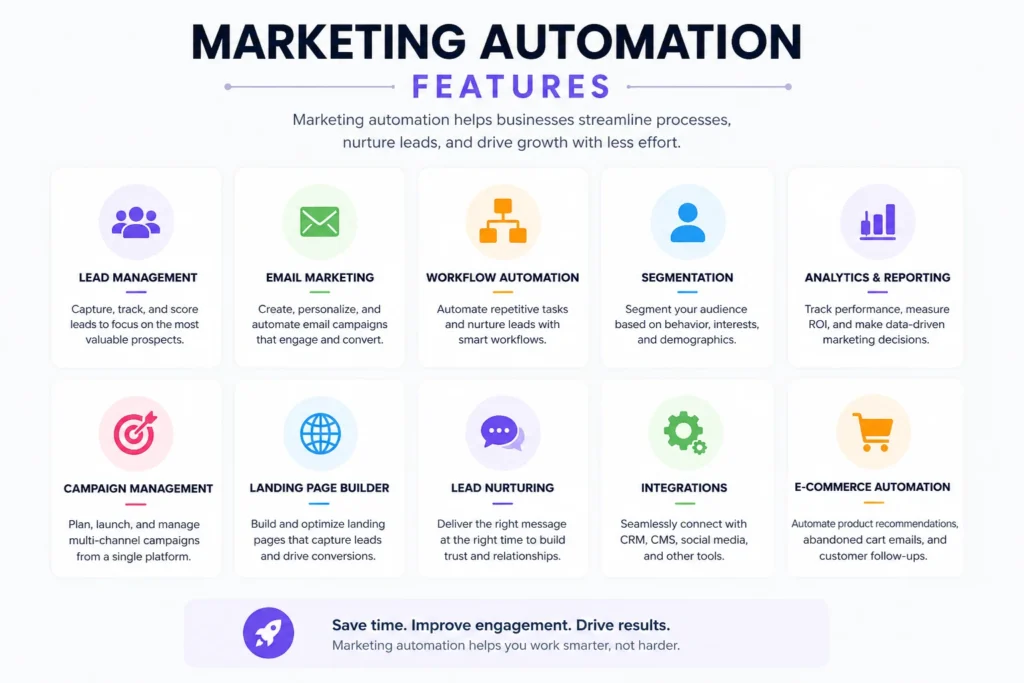
Marketing automation has become one of the defining features of modern email marketing platforms. Instead of relying on manual campaigns and repetitive follow-ups, businesses can create intelligent systems that respond automatically to customer behaviour.
The purpose of automation is not simply to send more emails. It is to send better emails—messages that are timely, relevant, and connected to the individual customer’s journey.
At the centre of every automation system are workflows. These workflows determine what happens after a specific event occurs. A subscriber joining a mailing list, clicking a link, viewing a product page, completing a purchase, or becoming inactive can all act as triggers that start a predefined sequence.
For example, a simple automated workflow might look like this:
A visitor subscribes → receives a welcome email → receives educational content → receives a personalised offer → enters a long-term engagement sequence.
Although the process appears simple from the customer’s perspective, sophisticated automation systems allow businesses to create highly detailed journeys behind the scenes.
The most capable platforms include visual workflow builders that make automation easier to design and manage. Instead of writing complicated rules, marketers can use a visual interface to connect triggers, decisions, and actions.
Advanced platforms often include conditional logic, allowing workflows to adapt based on individual behaviour. A customer who opens an email may receive one follow-up message, while someone who ignores it may enter a different sequence.
This flexibility is particularly valuable for lead nurturing. Not every customer is ready to buy immediately. Some need additional education, while others may simply require more time before making a decision.
Automated nurturing campaigns allow businesses to provide useful information gradually, building trust while keeping their brand present throughout the buying process.
Behaviour-based automation takes this personalisation even further. Platforms can respond to specific actions, such as recommending related products after a purchase, sending reminders after abandoned browsing sessions, or providing onboarding assistance when a new user explores a service.
Audience segmentation strengthens these automation efforts. By grouping subscribers according to interests, behaviour, demographics, and engagement levels, businesses can ensure that automated messages remain relevant rather than feeling generic.
As artificial intelligence becomes increasingly integrated into marketing platforms, automation capabilities are becoming even more advanced. AI tools can help identify customer patterns, recommend optimal sending times, predict purchasing behaviour, and suggest improvements to existing workflows.
However, automation technology is only effective when supported by a strong strategy. A poorly designed automated campaign can feel impersonal or intrusive, while a carefully planned workflow can create a seamless customer experience.
When comparing email marketing platforms, businesses should look beyond the number of automation features available. The most important factors are usability, flexibility, scalability, and whether the platform’s automation tools genuinely support business objectives.
A well-designed automation system saves time, improves engagement, strengthens customer relationships, and creates opportunities for sustainable growth.
Audience Segmentation and Personalisation
Sending identical emails to every subscriber may have been acceptable in the early days of email marketing, but modern audiences expect something far more relevant. People interact with brands in different ways, have different preferences, and occupy different stages of the buying journey. A message that resonates with one customer may be completely irrelevant to another.
This is why audience segmentation and personalisation have become fundamental components of successful email marketing strategies. When combined with marketing automation, these techniques allow businesses to move beyond generic mass communication and create experiences that feel timely, useful, and individually relevant.
Audience segmentation is the process of dividing a larger subscriber database into smaller, more focused groups based on shared characteristics or behaviours. Instead of treating an entire email list as a single audience, businesses can organise subscribers according to meaningful factors such as demographics, purchase history, engagement levels, website activity, geographic location, interests, or customer lifecycle stage.
The purpose of segmentation is simple: relevance.
A new subscriber who has never purchased from a brand should not necessarily receive the same message as a loyal customer who has made multiple purchases. Likewise, someone who frequently engages with emails should not be approached in the same way as a subscriber who has not opened a campaign in months.
By understanding these differences, businesses can create more targeted campaigns that align with what each audience segment actually needs.
For example, an online clothing retailer could divide its audience into several groups:
- New subscribers who have not made a purchase.
- Existing customers who regularly buy products.
- Customers who have abandoned their shopping carts.
- Previous buyers who have become inactive.
- High-value customers eligible for exclusive rewards.
Each group represents a different opportunity. New subscribers may respond well to introductory offers, while returning customers may be more interested in loyalty rewards or personalised product recommendations.
This approach creates a much stronger customer experience than sending the same promotional message to everyone.
The Role of Personalisation in Email Marketing
While segmentation determines who receives a message, personalisation determines how that message is adapted for the individual recipient.
Modern email marketing platforms provide numerous ways to personalise communication. Simple techniques, such as including a subscriber’s name in an email, can improve engagement. However, advanced personalisation goes much further.
Businesses can now customise email content based on previous purchases, browsing behaviour, preferences, location, engagement patterns, and other customer data points.
For example, an eCommerce company may display recommended products based on items a customer has previously viewed. A travel company might highlight destinations based on previous searches. A software provider could send educational content related to features a user has recently explored.
These personalised experiences create the feeling that a brand understands the customer rather than simply broadcasting advertisements.
The effectiveness of personalisation comes from relevance. Consumers are exposed to thousands of marketing messages every day, and generic content is increasingly easy to ignore. A personalised email stands out because it reflects the recipient’s interests, needs, and relationship with the brand.
However, effective personalisation requires more than inserting a first name into an email template. True personalisation relies on accurate data, thoughtful segmentation, and an understanding of customer behaviour.
How Marketing Automation Makes Personalisation Possible at Scale
Personalisation becomes significantly more powerful when combined with marketing automation. While manually creating individual campaigns for every customer segment would quickly become impossible, automation allows businesses to deliver personalised communication to thousands—or even millions—of subscribers.
Instead of manually deciding when each person should receive a message, automated workflows can respond instantly to customer actions.
For example:
A visitor downloads a buying guide → they automatically receive educational emails related to that topic.
A customer purchases a product → they receive follow-up instructions, recommendations, or complementary offers.
A subscriber stops engaging with emails → they enter a re-engagement campaign designed to bring them back.
Every interaction becomes an opportunity to deliver a relevant message at the right moment.
This behavioural approach is far more effective than relying only on scheduled campaigns because it reflects what customers are actually doing rather than making assumptions about what they might want.
Behavioural Targeting and Customer Journeys
One of the most advanced forms of personalisation is behavioural targeting. This involves using customer actions as signals that determine what communication they receive next.
Actions that can trigger personalised emails include:
- Visiting specific pages on a website.
- Clicking particular links within an email.
- Viewing products without purchasing.
- Completing a purchase.
- Downloading content.
- Reaching a milestone, such as an anniversary or membership date.
These interactions help businesses understand customer intent.
A visitor who repeatedly views a particular product category, for example, has demonstrated a level of interest that is very different from someone who has never interacted with the brand. An automated system can recognise this behaviour and deliver content designed specifically for that customer’s interests.
This creates a smoother customer journey. Instead of customers receiving random messages, they experience a sequence of communications that naturally follows their relationship with the brand.
Dynamic Segmentation for Growing Businesses
As businesses grow, maintaining accurate audience segments becomes increasingly important. A subscriber’s interests and behaviour can change over time, meaning static lists quickly become outdated.
Modern email marketing platforms address this challenge through dynamic segmentation. Rather than manually moving contacts between groups, these systems automatically update segments as customer information changes.
For example, a subscriber might initially belong to a “new customer” segment. After making a purchase, they can automatically move into an “existing customer” segment. If they become inactive later, they may enter a re-engagement group.
This constant adjustment ensures that automated campaigns remain accurate and relevant without requiring ongoing manual management.
Dynamic segmentation is particularly valuable for larger businesses with complex customer databases. It allows marketing teams to maintain highly targeted communication strategies while reducing administrative work.
What to Look for in Segmentation and Personalisation Tools
When comparing email marketing platforms, businesses should examine how flexible and powerful their segmentation capabilities are.
Important features include:
- Custom audience fields.
- Advanced filtering options.
- Behaviour-based triggers.
- Purchase history tracking.
- Dynamic content support.
- Real-time audience updates.
- Integration with CRM and eCommerce systems.
The best platforms combine these features with intuitive marketing automation tools, allowing businesses to create sophisticated campaigns without unnecessary complexity.
Ultimately, segmentation and personalisation transform email marketing from a simple broadcasting channel into a relationship-building system. They allow businesses to communicate with greater precision, improve customer satisfaction, increase engagement, and generate stronger long-term results.
When every subscriber receives content that reflects their interests and behaviour, email becomes more than a promotional tool—it becomes a personalised conversation between a brand and its customers.
AI-Powered Email Marketing Features
Artificial intelligence is reshaping the way businesses approach email marketing. What was once a largely manual process—writing campaigns, analysing performance, segmenting audiences, and deciding when to send messages—is becoming increasingly intelligent, automated, and data-driven.
Modern email marketing platforms are beginning to incorporate AI-powered tools that help marketers create better campaigns in less time. However, the real value of artificial intelligence is not simply automation for the sake of automation. Its greatest advantage lies in its ability to analyse enormous amounts of customer data, identify patterns, and help businesses make smarter decisions.
When combined with marketing automation, AI enables companies to create more personalised customer experiences while reducing the amount of repetitive work required from marketing teams.
AI-Assisted Content Creation
One of the most visible applications of artificial intelligence in email marketing is content generation.
Writing effective emails requires creativity, strategy, and a strong understanding of the audience. Marketers need to create attention-grabbing subject lines, persuasive copy, engaging calls to action, and messages that encourage recipients to take action. This process can be time-consuming, especially when businesses need to produce multiple campaigns every week.
AI writing assistants help simplify this process by generating ideas, suggesting improvements, and creating initial drafts based on specific goals.
For example, an AI tool can help generate:
- Subject line variations designed to improve open rates.
- Product descriptions tailored to different audiences.
- Promotional email copy for specific campaigns.
- Alternative calls to action.
- Content ideas for newsletters and automated sequences.
Rather than replacing human creativity, these tools act as an assistant that helps marketers work faster and explore new possibilities.
A skilled marketer can use AI-generated suggestions as a starting point, then refine the language, tone, and messaging to ensure it aligns with the brand’s identity. The combination of human strategy and artificial intelligence often produces stronger results than either approach alone.
AI-Powered Subject Line Optimisation
The subject line is one of the most important elements of any email campaign. It is the first thing recipients see, and in many cases, it determines whether an email is opened or ignored.
Traditionally, marketers relied on experience, testing, and intuition when creating subject lines. While these methods remain valuable, AI introduces a new layer of analysis by examining previous campaign performance and identifying patterns that influence engagement.
AI-powered optimisation tools can evaluate factors such as:
- Word choice.
- Sentence length.
- Emotional tone.
- Urgency.
- Personalisation.
- Historical engagement data.
Based on this information, platforms can suggest subject lines that may have a higher chance of attracting attention.
For example, instead of simply writing a generic promotional headline, an AI system may identify that a particular audience responds better to curiosity-driven messaging, personalised offers, or benefit-focused wording.
This does not guarantee success—no tool can predict human behaviour perfectly—but it provides marketers with valuable insights that improve decision-making.
Intelligent Send-Time Optimisation
Timing plays a significant role in email marketing performance. A message sent when a subscriber is unlikely to check their inbox may receive little attention, even if the content itself is excellent.
Traditional campaigns often rely on general assumptions, such as sending emails during weekday mornings. However, subscriber behaviour varies widely. Some people check emails early in the day, while others are more active in the evening or during weekends.
AI-powered send-time optimisation analyses individual engagement patterns to determine when each subscriber is most likely to open and interact with an email.
Instead of sending the same campaign to everyone at one fixed time, the platform can automatically adjust delivery timing based on recipient behaviour.
This creates a more personalised experience and can improve:
- Open rates.
- Click-through rates.
- Customer engagement.
- Overall campaign performance.
By allowing technology to analyse behavioural patterns at scale, businesses can achieve a level of timing precision that would be impossible to manage manually.
AI-Driven Audience Insights
Understanding customers has always been central to effective marketing. The challenge is that customer behaviour produces enormous amounts of data, and identifying meaningful patterns manually can be difficult.
AI helps businesses transform this information into useful insights.
By analysing factors such as purchase history, email engagement, browsing behaviour, and customer interactions, AI systems can identify trends that may otherwise go unnoticed.
These insights can help businesses:
- Identify high-value customers.
- Predict which subscribers are likely to purchase.
- Detect customers at risk of becoming inactive.
- Discover emerging audience preferences.
- Improve segmentation strategies.
For example, an AI system may recognise that certain customers who purchase a particular product often become interested in another related category several weeks later. Businesses can use this information to create automated campaigns that introduce relevant products at the ideal moment.
This predictive approach allows marketing teams to move from reactive communication toward proactive customer engagement.
AI and Predictive Personalisation
Personalisation has become a major expectation among consumers. Customers increasingly prefer brands that understand their preferences and provide relevant recommendations rather than sending broad, generic promotions.
AI enhances personalisation by analysing individual behaviour and predicting what content, products, or offers may be most relevant.
For eCommerce businesses, this could involve recommending products based on browsing history, previous purchases, or similar customer behaviour.
For subscription-based companies, AI might identify which features a user is most likely to need next and deliver educational content that encourages deeper engagement.
For content-based businesses, AI can recommend articles, resources, or updates based on previous interactions.
These recommendations can be integrated directly into automated email workflows, allowing businesses to deliver personalised experiences continuously without manually creating separate campaigns for every customer.
Predictive Analytics and Smarter Campaign Decisions
Another major benefit of AI is its ability to support predictive analytics. Instead of only analysing what has already happened, predictive systems attempt to forecast future customer behaviour.
This can help businesses answer important questions:
- Which subscribers are most likely to convert?
- Which customers may stop engaging?
- Which audience segments should receive a specific offer?
- Which campaigns are likely to generate the strongest results?
These insights allow marketers to make more informed decisions and allocate resources more effectively.
For example, if AI identifies subscribers who show signs of losing interest, an automated re-engagement campaign can be triggered before those customers disappear completely.
Similarly, high-value customers can receive personalised loyalty campaigns designed to strengthen retention.
The Role of AI Within Marketing Automation
Although AI provides powerful capabilities, it works best when combined with a well-planned marketing strategy.
Artificial intelligence can identify patterns, generate suggestions, and automate decisions, but it cannot replace a genuine understanding of customer needs. Businesses still need to create valuable content, maintain a consistent brand voice, and develop campaigns that provide real benefits to their audience.
The strongest email marketing strategies use AI as a supporting tool rather than a complete replacement for human judgment.
When integrated effectively, AI-powered features allow businesses to:
- Create campaigns faster.
- Improve personalisation.
- Optimise customer journeys.
- Reduce repetitive tasks.
- Discover valuable insights.
- Increase marketing efficiency.
Choosing Platforms With AI Capabilities
When evaluating email marketing platforms, businesses should consider whether AI features provide practical benefits rather than simply existing as promotional additions.
Useful AI capabilities include:
- Content and subject line assistance.
- Predictive analytics.
- Smart audience recommendations.
- Automated personalisation.
- Send-time optimisation.
- Behaviour prediction.
The best platforms combine artificial intelligence with strong automation, segmentation, analytics, and customer management tools.
Ultimately, AI is changing email marketing from a process based mainly on manual decisions into a smarter, adaptive system that learns from customer behaviour. Businesses that use these technologies effectively can create more relevant experiences, improve engagement, and build stronger relationships with their audiences over time.
Integrations with CRM and Other Tools
An email marketing platform does not operate in isolation. In today’s digital business environment, companies rely on a growing ecosystem of tools to manage customers, process transactions, analyse performance, and streamline daily operations. When these systems work together, businesses gain a clearer understanding of their audience and can create more effective, automated marketing experiences.
This is why integrations have become a crucial factor when evaluating email marketing platforms.
A platform with strong integration capabilities allows customer information to move seamlessly between different systems. Instead of manually transferring data between applications, businesses can create connected workflows where information updates automatically.
For example, when a customer completes a purchase through an eCommerce platform, that information can immediately update the email marketing system. The customer may then automatically receive a confirmation message, product recommendations, loyalty rewards, or a follow-up campaign based on their purchase history.
Without integration, these processes often require manual effort, increasing the risk of errors and slowing down marketing operations.
With the right connections in place, marketing automation becomes significantly more powerful.
CRM Integration and Customer Data Management
Customer relationship management (CRM) integration is one of the most valuable connections an email marketing platform can offer.
A CRM system stores important information about customers and prospects, including contact details, communication history, sales activity, and interactions with a business. When connected with email marketing software, this data can be used to create more personalised and targeted campaigns.
For sales and marketing teams, this shared information creates a more complete picture of the customer journey.
Instead of marketing teams working with limited subscriber data while sales teams maintain separate customer records, both departments can access consistent and up-to-date information.
This alignment improves several areas, including:
- Lead nurturing.
- Customer segmentation.
- Sales follow-up.
- Personalised communication.
- Customer retention campaigns.
For example, when a potential customer moves further through the sales process, the email marketing platform can automatically adjust the messages they receive. A prospect who has shown strong interest in a product may receive educational content or a targeted offer, while an existing customer may enter a retention or loyalty campaign.
The result is a smoother experience where every interaction feels connected.
eCommerce Platform Integrations
For online retailers, integration with eCommerce platforms is essential. The ability to connect customer data, product information, and purchase activity allows businesses to create highly effective automated campaigns.
Popular eCommerce integrations enable email marketing platforms to access information such as:
- Products viewed by customers.
- Items added to shopping carts.
- Completed purchases.
- Order history.
- Customer spending patterns.
- Product preferences.
This information powers some of the most valuable forms of marketing automation.
One common example is abandoned cart recovery. When a customer adds products to their shopping basket but leaves without completing the purchase, an automated workflow can send a reminder email encouraging them to return.
A simple reminder may recover lost sales, while a more advanced sequence could include product benefits, customer reviews, limited-time incentives, or alternative recommendations.
Post-purchase automation is another important use case. After buying a product, customers can automatically receive helpful information, usage tips, related product suggestions, or review requests.
These follow-up interactions improve the customer experience while creating additional opportunities for future sales.
Website and Lead Capture Integrations
A website is often the first point of contact between a customer and a brand. Integrating website tools with an email marketing platform ensures that valuable visitor information is captured and used effectively.
For example, when someone fills out a signup form, downloads a resource, registers for an event, or requests more information, their details can automatically enter a relevant marketing workflow.
This allows businesses to respond immediately rather than waiting for manual follow-up.
A visitor who downloads an industry guide might receive a series of educational emails. Someone requesting a product demonstration could enter a sales-focused nurturing sequence. A new newsletter subscriber may begin a welcome journey introducing the brand.
These automated responses create a more engaging experience while helping businesses build relationships with potential customers.
Integration with content management systems (CMS), landing page builders, and website platforms also makes it easier to maintain accurate subscriber information and manage campaigns across multiple digital channels.
Connecting Payment, Support, and Business Operations Tools
Modern businesses use many different platforms beyond marketing and sales systems. Payment processors, customer support tools, webinar platforms, scheduling software, and social media applications all generate valuable customer information.
Connecting these systems with email marketing software creates opportunities for more intelligent automation.
For example:
- A completed payment can trigger a customer onboarding sequence.
- A webinar registration can start an educational email series.
- A support request can temporarily adjust promotional messaging.
- A scheduled appointment can trigger reminders and follow-up communication.
These connections allow businesses to respond to customer actions in real time rather than relying on delayed manual processes.
The broader the integration network, the more accurately businesses can understand customer behaviour and deliver relevant communication.
Analytics and Data Integration
Effective email marketing requires more than sending campaigns—it requires understanding the impact of those campaigns.
Analytics integrations allow businesses to combine email performance data with information from other platforms, creating a more complete view of customer behaviour.
For example, connecting an email marketing platform with website analytics tools can reveal:
- Which emails generate website visits.
- Which campaigns drive purchases.
- Which customer segments produce the highest revenue.
- How subscribers interact after clicking an email.
This deeper insight helps marketers make better decisions and refine future campaigns.
When analytics data is connected with marketing automation, businesses can create more intelligent workflows. Instead of simply tracking whether someone opened an email, they can understand the broader customer journey that follows.
Native Integrations, APIs, and Automation Platforms
When comparing email marketing platforms, businesses should consider not only how many integrations are available but also how reliable and flexible those connections are.
The strongest platforms typically provide:
- A wide range of native integrations.
- Open APIs for custom connections.
- Support for third-party automation services.
- Two-way data synchronisation.
- Easy setup processes.
Third-party automation platforms can be particularly useful for businesses with unique workflows. Tools that connect different applications allow companies to create customised processes without needing advanced programming knowledge.
For example, a business could create a workflow where a new customer added to a CRM automatically receives a personalised email sequence, updates a reporting dashboard, and alerts a sales representative.
This level of connectivity allows smaller teams to achieve sophisticated automation without building complex technical systems from scratch.
Why Integration Matters for Long-Term Growth
As businesses expand, disconnected systems can create unnecessary complexity. Customer information becomes scattered, marketing teams spend more time managing data, and opportunities for personalisation are missed.
A well-integrated email marketing platform solves these challenges by creating a central communication system where customer information flows smoothly between tools.
The benefits include:
- Less manual work.
- More accurate customer data.
- Better audience targeting.
- More effective automation.
- Improved customer experiences.
- Stronger marketing and sales alignment.
When selecting an email marketing platform, businesses should look beyond the number of available integrations. The most important consideration is whether those integrations help achieve real business objectives.
A platform that connects effectively with CRM systems, eCommerce platforms, analytics tools, and other essential applications provides the foundation for scalable marketing automation.
Ultimately, integration turns email marketing from a standalone communication channel into a connected part of the entire customer experience. It allows businesses to understand their audiences more deeply, respond faster to customer behaviour, and create personalised journeys that continue to improve as the business grows.
Analytics and Reporting
Successful email marketing is built on more than creativity and consistency. While compelling copy, attractive designs, and well-timed campaigns are important, businesses cannot improve what they do not measure. Analytics and reporting provide the information needed to understand audience behaviour, evaluate campaign performance, and make smarter decisions over time.
Without accurate performance data, email marketing becomes a process based largely on assumptions. Marketers may know that emails are being sent, but they cannot clearly determine which strategies are producing results, which messages are being ignored, or where opportunities for improvement exist.
Modern email marketing platforms solve this challenge by providing detailed reporting systems that transform campaign activity into actionable insights.
The most effective platforms do not simply show numbers. They help businesses understand the story behind those numbers.
Essential Email Marketing Metrics
Every email marketing platform should provide access to fundamental performance indicators. These metrics reveal how subscribers interact with campaigns and highlight areas that may require adjustment.
Some of the most important measurements include:
- Open rates: The percentage of recipients who open an email, providing insight into subject line effectiveness and audience interest.
- Click-through rates (CTR): The percentage of subscribers who click links within an email, showing how effectively content encourages action.
- Bounce rates: The number of emails that fail to reach recipients, which can indicate problems with list quality or email addresses.
- Unsubscribe rates: The percentage of subscribers who choose to leave a mailing list, helping identify whether content frequency or relevance needs improvement.
- Spam complaints: Indicators that recipients may find emails unwanted or irrelevant.
These metrics provide a basic understanding of campaign health. However, advanced platforms go further by connecting email engagement with broader business outcomes.
Measuring Conversions and Revenue Impact
While engagement metrics are useful, the ultimate goal of most email marketing campaigns is to generate meaningful business results.
A high open rate may look impressive, but if recipients do not take action afterward, the campaign may not be achieving its purpose.
Advanced email marketing platforms allow businesses to track conversions, including actions such as:
- Completing a purchase.
- Registering for an event.
- Downloading a resource.
- Requesting a consultation.
- Signing up for a service.
This conversion data provides a much clearer picture of campaign effectiveness.
For eCommerce businesses, revenue tracking is particularly valuable. Marketers can identify exactly how much income was generated from specific campaigns, automated workflows, or customer segments.
For example, a company may discover that its abandoned cart emails generate significantly more revenue than standard promotional newsletters. With this insight, the business can invest more resources into improving and expanding those automated sequences.
This shift from measuring activity to measuring impact allows businesses to focus on strategies that contribute directly to growth.
Analytics Within Marketing Automation
One of the greatest advantages of combining analytics with marketing automation is the ability to understand customer journeys in detail.
Automated workflows often involve multiple steps, and reporting helps businesses identify how subscribers move through each stage.
For example, a lead nurturing sequence might include:
- A welcome email.
- An educational resource.
- A product comparison guide.
- A promotional offer.
Analytics can reveal where customers engage most strongly and where they lose interest.
If a large percentage of subscribers stop interacting after the second email, marketers can investigate whether the content needs improvement, whether the timing should change, or whether the audience segment requires adjustment.
These insights allow businesses to refine automated journeys continuously rather than creating workflows and leaving them unchanged.
A/B Testing and Campaign Optimisation
A major advantage of digital marketing is the ability to experiment and learn. Email marketing platforms with built-in A/B testing tools allow businesses to compare different versions of campaigns and identify what performs best.
Instead of relying on assumptions, marketers can test real audience responses.
Common A/B testing variables include:
- Subject lines.
- Email copy.
- Images.
- Layout designs.
- Calls to action.
- Sending times.
- Personalisation techniques.
For example, a business might test two different subject lines to determine which one generates higher engagement. The winning version can then be sent to the remaining audience, improving overall campaign performance.
Over time, continuous testing creates a cycle of improvement. Each campaign provides new information that helps future emails become more effective.
Advanced Reporting Features
While basic metrics are essential, many modern platforms offer advanced analytics that provide deeper insights into subscriber behaviour.
Some advanced reporting features include:
Heatmaps
Email heatmaps show where recipients interact within an email. They can reveal which links attract the most attention, whether users engage with images, and which sections of the message are being ignored.
This information helps marketers improve layouts and prioritise important content.
Device and Location Analytics
Understanding how and where subscribers view emails can influence design and strategy.
For example, if most recipients open emails on mobile devices, businesses can prioritise mobile-friendly layouts and shorter content structures.
Location-based insights can also support regional campaigns, local promotions, and personalised messaging.
Revenue Attribution
Revenue attribution connects email activity directly to sales outcomes. Instead of simply knowing that someone clicked an email, businesses can understand whether that interaction eventually resulted in a purchase.
This helps determine which campaigns provide the greatest financial value.
Integrating Analytics With CRM Systems
Email analytics become even more powerful when combined with customer relationship management systems.
CRM integration allows businesses to connect email engagement data with broader customer information, including:
- Purchase history.
- Sales activity.
- Customer lifetime value.
- Previous interactions.
- Support history.
This creates a complete view of each customer relationship.
For example, a business may discover that customers who regularly engage with educational emails have a higher likelihood of purchasing premium products. This insight can then be used to create targeted automation campaigns focused on that audience.
By connecting marketing performance with customer data, businesses can make decisions based on a complete understanding of customer behaviour rather than isolated statistics.
Real-Time Reporting and Decision Making
The speed of modern marketing requires timely information. Waiting weeks or months to analyse campaign performance can result in missed opportunities.
Real-time reporting allows marketers to monitor campaigns as they happen and respond quickly.
If a campaign performs exceptionally well, businesses can increase investment or expand similar strategies. If engagement drops unexpectedly, adjustments can be made before future campaigns are affected.
This ability to adapt quickly is particularly valuable in competitive industries where customer preferences can change rapidly.
Choosing an Email Marketing Platform With Strong Analytics
When evaluating email marketing platforms, businesses should look beyond the number of reports available. The most important factor is whether those reports are clear, useful, and easy to apply.
Strong analytics platforms should provide:
- Customisable dashboards.
- Real-time reporting.
- Conversion tracking.
- Revenue attribution.
- A/B testing tools.
- Audience insights.
- Automation performance reports.
- Integration with external analytics systems.
A platform filled with complex data is not necessarily valuable if marketers cannot easily understand or act on that information.
The best solutions transform raw numbers into practical guidance.
Turning Data Into Better Marketing Decisions
Analytics and reporting are what allow email marketing to evolve from a guessing game into a measurable growth strategy.
By monitoring performance, testing new approaches, and learning from customer behaviour, businesses can continuously improve their campaigns. Every open, click, purchase, and interaction provides information that can be used to create better experiences in the future.
When analytics are combined with marketing automation, segmentation, and personalisation, email becomes far more than a method of sending messages. It becomes an intelligent system that learns from customer behaviour and helps businesses communicate more effectively.
Ultimately, the strongest email marketing platforms are not simply the ones that send emails successfully—they are the ones that help businesses understand why campaigns succeed, where they can improve, and how every interaction can contribute to long-term growth.
Email Deliverability
Email deliverability is one of the most important, yet often overlooked, aspects of successful email marketing. A campaign can contain excellent content, a compelling offer, and a beautifully designed layout, but none of that matters if the message never reaches the recipient’s inbox.
At its simplest, email deliverability refers to the ability of an email to successfully arrive in a subscriber’s inbox rather than being filtered into spam, rejected, or blocked entirely. It is the bridge between sending a campaign and actually having an opportunity to engage with an audience.
For businesses that rely on email marketing to generate leads, nurture customers, or drive sales, strong deliverability is not optional. It is a foundation upon which every other marketing effort depends.
A platform may provide advanced automation, powerful analytics, and impressive design tools, but if emails consistently fail to reach subscribers, those features lose much of their value
Why Email Deliverability Matters
Many businesses focus heavily on campaign creation while paying less attention to what happens after the “send” button is pressed. However, successful email marketing involves more than producing content—it requires building trust with internet service providers (ISPs), email providers, and recipients.
Email providers such as Gmail, Outlook, and other inbox services use sophisticated filtering systems to determine whether a message should be delivered, flagged as suspicious, or sent to spam.
These systems evaluate numerous factors, including:
- Sender reputation.
- Subscriber engagement.
- Email authentication.
- Sending behaviour.
- List quality.
- Message content.
A company that consistently sends valuable emails to engaged subscribers is more likely to maintain strong deliverability. In contrast, businesses that send unwanted messages, maintain poor-quality lists, or receive frequent spam complaints may experience declining inbox placement.
Deliverability is therefore not just a technical issue—it is closely connected to overall marketing strategy.
Sender Reputation and Trust
One of the biggest factors influencing email deliverability is sender reputation.
Much like a credit score reflects financial reliability, sender reputation reflects how trustworthy a business appears to email providers. A strong reputation increases the likelihood that messages will reach the inbox, while a poor reputation can significantly reduce visibility.
Several elements contribute to sender reputation, including:
- Consistent sending patterns.
- Low bounce rates.
- Positive subscriber engagement.
- Minimal spam complaints.
- Proper email authentication.
- Responsible list management.
For example, suddenly sending thousands of emails from a new domain can appear suspicious to email providers. Similarly, repeatedly emailing inactive subscribers can signal that recipients are not interested in the content.
Maintaining a healthy sending reputation requires a long-term approach focused on quality rather than simply increasing email volume.
Email Authentication: SPF, DKIM, and DMARC
Email authentication plays a critical role in proving that messages are legitimate and preventing unauthorised use of a domain.
The most widely used authentication standards include:
SPF (Sender Policy Framework)
SPF allows domain owners to specify which servers are authorised to send emails on their behalf. This helps prevent malicious senders from impersonating a legitimate business.
DKIM (DomainKeys Identified Mail)
DKIM adds a digital signature to outgoing emails, allowing receiving servers to verify that the message has not been altered during delivery and that it genuinely comes from the claimed sender.
DMARC (Domain-based Message Authentication, Reporting, and Conformance)
DMARC builds on SPF and DKIM by providing instructions to email providers about how to handle messages that fail authentication checks. It also provides reporting information that helps businesses monitor potential issues.
Together, these authentication methods improve trust, protect brand identity, and increase the likelihood of successful inbox placement.
Modern email marketing platforms often provide support for these standards, making implementation easier for businesses without extensive technical knowledge.
Maintaining a Healthy Email List
The quality of an email list has a direct impact on deliverability.
A large subscriber database may appear valuable, but size alone does not guarantee success. A smaller list filled with engaged subscribers is often far more effective than a massive list containing inactive or invalid contacts.
Poor-quality lists can create several problems, including:
- Increased bounce rates.
- Lower engagement.
- More spam complaints.
- Reduced sender reputation.
Effective list management involves regularly cleaning subscriber databases and removing addresses that are invalid, inactive, or unlikely to engage.
Many email marketing platforms include tools that help identify problematic contacts automatically. These features may detect bounced addresses, inactive subscribers, or users who have stopped interacting with campaigns.
List hygiene is not about reducing subscriber numbers—it is about improving the quality of the audience receiving your messages.
How Marketing Automation Improves Deliverability
Marketing automation is often associated with efficiency and personalisation, but it can also play an important role in improving email deliverability.
The reason is simple: relevant emails create better engagement.
When subscribers receive messages that match their interests and behaviour, they are more likely to open, click, and interact with those emails. Positive engagement signals help demonstrate to email providers that your messages are valuable.
For example, instead of sending every subscriber the same weekly promotion, an automated system can deliver:
- Product recommendations based on previous purchases.
- Educational content related to subscriber interests.
- Follow-up messages after specific actions.
- Re-engagement campaigns for inactive users.
This targeted approach reduces unnecessary emails and improves the overall quality of communication.
A subscriber who regularly interacts with relevant content strengthens your sender reputation. A subscriber who receives irrelevant messages repeatedly may ignore them, delete them, or mark them as spam.
Monitoring Engagement Metrics
Regularly analysing subscriber behaviour is essential for maintaining strong deliverability.
Important engagement indicators include:
- Open rates.
- Click-through rates.
- Bounce rates.
- Unsubscribe rates.
- Spam complaint rates.
- Overall subscriber activity.
These metrics help identify potential problems before they damage campaign performance.
For instance, a declining open rate may indicate that subscribers are losing interest, while a rising bounce rate may suggest that the email list requires cleaning.
Marketing teams can use this information to adjust their strategies, improve content quality, refine segmentation, and remove inactive contacts when necessary.
Spam Testing and Inbox Preview Tools
Many email marketing platforms include features designed to identify potential deliverability problems before a campaign is sent.
Spam testing tools analyse email content and provide warnings about elements that may trigger filtering systems.
These tools may evaluate:
- Subject line wording.
- Email formatting.
- Link quality.
- Image-to-text balance.
- Potential spam indicators.
Inbox preview tools allow marketers to see how emails appear across different email providers and devices. This helps ensure messages are displayed correctly and reduces technical issues that could affect engagement.
By identifying problems before sending campaigns, businesses can improve their chances of reaching the intended audience.
ollowing Email Marketing Best Practices
Strong deliverability depends not only on technology but also on responsible communication practices.
Businesses should:
- Send emails only to subscribers who have provided permission.
- Avoid misleading subject lines.
- Provide clear unsubscribe options.
- Maintain consistent sending schedules.
- Create valuable, relevant content.
- Respect subscriber preferences.
Permission-based marketing is especially important. Sending unwanted messages may temporarily increase reach, but it often damages reputation and reduces long-term results.
Successful email marketing is built on trust. Subscribers who willingly receive and engage with content create a stronger foundation for sustainable growth.
Choosing an Email Marketing Platform With Reliable Deliverability
When comparing email marketing platforms, deliverability should be one of the most important evaluation criteria.
Businesses should consider whether a platform provides:
- Strong infrastructure and sending reputation.
- Support for SPF, DKIM, and DMARC authentication.
- List cleaning and management tools.
- Spam testing capabilities.
- Inbox preview features.
- Detailed engagement reporting.
The cheapest platform is not always the best choice if poor deliverability causes important messages to disappear before reaching customers.
A reliable platform should help businesses protect their sender reputation while providing the tools needed to improve inbox placement over time.
The Foundation of Effective Email Marketing
Email deliverability determines whether a marketing strategy has the opportunity to succeed. Without consistent inbox placement, even the most advanced automation workflows and carefully designed campaigns cannot achieve their intended results.
By maintaining a clean subscriber list, using proper authentication, creating relevant content, and monitoring engagement, businesses can build stronger relationships with email providers and their audiences.
When combined with segmentation, personalisation, analytics, and marketing automation, strong deliverability creates a complete email marketing system—one that reaches the right people, delivers meaningful messages, and supports long-term business growth.
Pricing and Value for Money
Selecting an email marketing platform is not simply a matter of finding the lowest monthly subscription. While price is certainly an important consideration, the cheapest option does not always deliver the strongest return on investment. A platform that appears affordable at first may lack essential features, become restrictive as your audience grows, or require expensive upgrades later.
The real question is not “How much does this platform cost?” but rather “What value does this platform provide for the investment?”
A strong email marketing solution should help businesses save time, improve customer engagement, increase conversions, and support long-term growth. The right platform should balance affordability with functionality, offering the tools needed today while providing enough flexibility for tomorrow’s challenges.
Most email marketing providers structure their pricing around several factors, including subscriber count, monthly email volume, available features, and the level of automation included. Some platforms offer free plans designed for individuals, freelancers, startups, or small businesses testing the waters. These plans can be an excellent starting point, allowing users to create campaigns and explore essential features without an upfront financial commitment.
However, free plans often come with limitations.
These restrictions may include:
- Smaller subscriber limits.
- Platform branding on outgoing emails.
- Reduced automation capabilities.
- Limited reporting features.
- Fewer integrations.
- Restricted access to advanced tools.
For businesses that are still building their audience, these limitations may not be a problem. But as marketing needs become more sophisticated, upgrading often becomes necessary.
Understanding Pricing Tiers and Feature Differences
One of the biggest differences between email marketing plans is the level of automation available.
Entry-level subscriptions typically provide basic campaign creation tools, simple newsletters, and straightforward autoresponders. These features may be sufficient for businesses that only send occasional announcements or promotional emails.
However, companies looking to create personalised customer journeys usually require more advanced capabilities.
Higher-tier plans often unlock features such as:
- Visual automation workflow builders.
- Behaviour-based triggers.
- Advanced audience segmentation.
- Lead scoring.
- Customer journey mapping.
- AI-powered optimisation tools.
- Detailed reporting and analytics.
These features can dramatically change how businesses communicate with their audiences.
For example, a basic email campaign might send the same promotional message to an entire subscriber list. An advanced automation system, on the other hand, can identify whether a customer is a first-time visitor, a repeat buyer, or an inactive subscriber—and automatically deliver a message designed specifically for that situation.
This difference is where marketing automation creates genuine value.
The additional monthly cost of a more advanced plan may seem significant, but the time saved and revenue generated through better targeting can often outweigh the expense.
Scalability and Long-Term Costs
A common mistake businesses make is choosing a platform based only on their current requirements. While a low-cost plan may appear attractive today, pricing structures often change significantly as subscriber numbers increase.
A platform that works perfectly for a list of 1,000 subscribers may become considerably more expensive once the database reaches 25,000 or 50,000 contacts.
Before committing to a platform, consider how pricing evolves as your business grows.
Important questions include:
- How much will the subscription increase as my audience expands?
- Are essential automation features included at higher levels?
- Will additional users or team members require extra fees?
- Are there limits on email volume?
- Will I need premium features later?
Planning ahead prevents unpleasant surprises and reduces the likelihood of having to migrate your entire email marketing system in the future.
Hidden Costs and Additional Features
The advertised subscription price does not always represent the full cost of using an email marketing platform.
Some providers charge separately for additional services or premium features, including:
- Advanced email templates.
- Additional automation workflows.
- Extra user accounts.
- SMS marketing capabilities.
- Dedicated IP addresses.
- Priority customer support.
- Enhanced reporting tools.
- Additional integrations.
These costs may not seem significant individually, but they can add up over time.
A careful evaluation should consider the complete cost structure rather than focusing only on the starting price displayed on a pricing page.
The Value of Time-Saving Features
One of the most overlooked aspects of pricing is the value of saved time.
A platform that costs slightly more but dramatically reduces manual work may actually provide a much better return.
Features such as:
- Drag-and-drop email builders.
- Automated customer journeys.
- AI-assisted content creation.
- Audience segmentation.
- Personalisation tools.
- Performance reporting.
can reduce hours of repetitive marketing tasks.
For example, manually sending follow-up emails to hundreds of customers every month would require significant time and resources. A marketing automation workflow can perform the same task automatically while delivering a more consistent customer experience.
The value is not only measured in subscription costs—it is measured in productivity, efficiency, and improved marketing outcomes.
Evaluating Overall Platform Value
Price is only one piece of the decision-making process. A complete evaluation should also consider reliability, security, integrations, customer support, and ongoing development.
A platform that regularly introduces improvements, maintains strong deliverability, supports essential integrations, and provides responsive assistance may deliver significantly more value than a cheaper alternative with limited capabilities.
For example, a lower-priced platform may save a few pounds each month, but if it lacks reliable automation tools or requires more manual work, the hidden cost in lost time may be much higher.
The best investment is not always the platform with the lowest subscription fee. It is the one that helps your business achieve better results with fewer obstacles.
Choosing the Right Pricing Plan
When comparing email marketing platforms, focus on finding the right balance between cost, functionality, and future growth.
The ideal solution should:
- Meet your current marketing requirements.
- Include the automation features you actually need.
- Scale as your subscriber list expands.
- Provide reliable analytics and reporting.
- Integrate with your existing tools.
- Offer strong long-term value.
Businesses should view email marketing software as an investment rather than simply an expense. A well-chosen platform can improve efficiency, strengthen customer relationships, and create measurable revenue opportunities.
Ultimately, the best email marketing platform is not the cheapest option available—it is the one that provides the greatest value for your specific goals, audience size, and growth strategy.
Customer Support
Even the most intuitive email marketing platform will occasionally present challenges. Whether you’re launching your first campaign, building an advanced automation workflow, integrating a CRM, or troubleshooting an unexpected issue, having access to responsive and knowledgeable support can make the difference between a minor inconvenience and hours of lost productivity.
Customer support is often overlooked during the buying process. Many businesses compare pricing, features, and automation capabilities, yet fail to consider what happens when something goes wrong. In reality, the quality of support can be just as valuable as the software itself.
A platform with exceptional customer service doesn’t simply solve technical problems—it helps users become more confident, adopt advanced features faster, and maximise the value of their investment.
Support Should Be Available When You Need It
Every business operates differently, which is why leading email marketing providers typically offer multiple ways to get assistance.
Common support channels include:
- Live chat.
- Email support.
- Telephone support.
- Ticket-based help desks.
- Community forums.
- Dedicated account managers.
Each serves a different purpose.
Live chat is often the quickest way to resolve straightforward questions, such as locating a setting or fixing a campaign issue before launch. Email support works well for less urgent enquiries that require detailed responses, while telephone support is particularly useful when dealing with complex technical problems that benefit from real-time guidance.
Some providers also assign dedicated account managers to larger organisations, giving businesses direct access to specialists who understand their marketing objectives and technical environment.
However, it’s important to remember that not every support option is available on every pricing plan. Some platforms reserve premium assistance—such as priority response times or phone support—for higher-tier subscriptions.
Before choosing a provider, it’s worth checking exactly what level of support is included.
Self-Service Resources Can Be Just as Valuable
Not every problem requires speaking to a support representative.
In many cases, businesses simply need clear instructions, practical examples, or step-by-step guidance. This is where a comprehensive knowledge base becomes incredibly valuable.
The strongest email marketing platforms invest heavily in educational resources, offering users access to:
- Detailed help articles.
- Video tutorials.
- Interactive walkthroughs.
- Webinars.
- Product documentation.
- Frequently asked questions.
- Best-practice guides.
These resources allow users to learn at their own pace while solving common problems independently.
For beginners, a well-organised knowledge base can significantly shorten the learning curve. Instead of waiting for a support response, users can quickly find answers and continue building campaigns with minimal interruption.
Even experienced marketers benefit from having access to detailed documentation, particularly when exploring advanced features they haven’t used before.
Support Becomes Even More Important With Marketing Automation
As businesses begin moving beyond simple newsletters, email marketing naturally becomes more sophisticated.
Creating automated customer journeys, configuring behavioural triggers, building audience segments, and integrating multiple platforms all introduce additional complexity.
These features provide enormous value—but they also require greater understanding.
Imagine building a workflow that sends onboarding emails, tracks customer engagement, assigns lead scores, and branches into different sequences based on user behaviour. Even a small configuration error could prevent hundreds—or thousands—of subscribers from receiving the correct communication.
Platforms that provide detailed automation guides, visual examples, and experienced support staff make these advanced features far easier to implement successfully.
Rather than simply explaining how to use the software, excellent support teams also help businesses understand why certain automation strategies work more effectively than others.
Expertise Matters More Than Speed
Fast responses are certainly appreciated, but response time alone should not define the quality of customer support.
Receiving an immediate reply that fails to solve the problem is far less valuable than receiving thoughtful, accurate guidance from someone who understands both the platform and email marketing best practices.
When evaluating support quality, consider factors such as:
- Technical expertise.
- Accuracy of advice.
- Friendliness and professionalism.
- Resolution rates.
- Customer satisfaction.
- Consistency across support channels.
Reading independent customer reviews can often provide useful insight into how providers handle real-world support requests.
The strongest support teams do more than answer questions—they educate users, recommend solutions, and help businesses avoid similar issues in the future.
Onboarding and Training Services
Many premium email marketing providers go beyond traditional customer support by offering structured onboarding programmes.
These services are particularly valuable for businesses migrating from another platform or implementing email marketing at scale.
Onboarding may include:
- Platform setup assistance.
- Subscriber list migration.
- Domain authentication.
- CRM integration.
- Marketing automation implementation.
- Campaign strategy consultations.
- Team training sessions.
Larger organisations may also receive personalised guidance from implementation specialists who help configure workflows and ensure the platform is aligned with business objectives from day one.
This proactive approach often reduces setup time considerably while helping teams avoid common mistakes.
Learning From the Community
Official support is only one source of knowledge.
Many established email marketing platforms have active communities where users exchange ideas, discuss new features, share successful workflows, and solve practical problems together.
Community resources often include:
- User forums.
- Private Facebook groups.
- Online communities.
- Customer events.
- Product webinars.
- User conferences.
These spaces allow marketers to learn from real-world experiences rather than relying solely on official documentation.
While community advice should never replace guidance from the platform itself, it can provide creative solutions, campaign inspiration, and practical techniques that aren’t always covered in help articles.
Evaluating Customer Support Before Choosing a Platform
Support quality should form part of every platform comparison—not an afterthought once problems arise.
When assessing providers, ask yourself questions such as:
- Are support channels available when my business operates?
- Is live chat included on my chosen plan?
- Does the provider offer telephone support?
- How comprehensive is the knowledge base?
- Are onboarding services available?
- What do existing customers say about the support experience?
- Does the company regularly update its educational content?
These considerations become increasingly important as your email marketing strategy grows more advanced.
Customer Support as a Long-Term Investment
Excellent customer support delivers benefits that extend far beyond troubleshooting.
It reduces downtime, accelerates learning, improves confidence, and helps businesses unlock advanced capabilities such as marketing automation, audience segmentation, CRM integrations, and AI-powered optimisation.
Ultimately, the best email marketing platforms are not only defined by their features—they are defined by how effectively they help customers succeed.
A provider that combines responsive support, comprehensive educational resources, experienced specialists, and ongoing training will continue to deliver value long after the initial subscription has been purchased.
For businesses investing in email marketing as a long-term growth strategy, reliable customer support is not simply a convenience. It is an essential part of choosing the right platform.
Pros and Cons
No email marketing platform is perfect.
Every provider has its own strengths, limitations, pricing structure, and target audience. Some platforms prioritise simplicity and ease of use, while others focus on enterprise-level automation, advanced analytics, or extensive integrations. What works exceptionally well for a growing eCommerce brand may not be the right choice for a freelancer, local business, or large multinational organisation.
That is why selecting an email marketing platform should never be based on a single feature alone.
A platform with powerful automation tools may have a steeper learning curve. A budget-friendly solution might lack advanced reporting. Likewise, a feature-rich enterprise platform may offer capabilities that smaller businesses simply don’t need.
The key is finding the right balance between functionality, usability, scalability, and overall value.
Below are some of the most significant advantages and potential drawbacks to consider before making your decision.
Advantages of Modern Email Marketing Platforms
Save Time Through Marketing Automation
Perhaps the greatest benefit of modern email marketing software is its ability to automate repetitive tasks.
Rather than manually sending every welcome email, follow-up message, abandoned cart reminder, or customer update, businesses can build automated workflows that operate continuously in the background.
Once configured, these workflows respond automatically to customer behaviour, ensuring subscribers receive relevant communication without requiring constant manual intervention.
The result is a more efficient marketing process that allows teams to focus on strategy, creativity, and business growth instead of repetitive administration.
Deliver More Personalised Customer Experiences
Today’s consumers expect more than generic promotional emails.
Modern platforms make it possible to combine audience segmentation, behavioural data, and personalisation to create campaigns that feel genuinely relevant to each recipient.
Subscribers can receive emails based on:
- Purchase history.
- Website activity.
- Customer lifecycle stage.
- Geographic location.
- Previous engagement.
- Individual preferences.
This level of relevance often leads to stronger customer relationships, higher open rates, improved click-through rates, and better conversion performance.
Rather than broadcasting one message to everyone, businesses can deliver communication that reflects each customer’s unique journey.
Professional Email Design Without Technical Skills
Creating attractive marketing emails no longer requires coding knowledge or graphic design expertise.
Most leading platforms include intuitive drag-and-drop editors alongside professionally designed templates that simplify the entire creation process.
Users can quickly customise:
- Colours.
- Images.
- Buttons.
- Layouts.
- Branding.
- Calls to action.
Because templates are typically mobile responsive, campaigns also maintain a consistent appearance across smartphones, tablets, and desktop devices.
This allows businesses of every size to produce polished, professional campaigns with minimal effort.
Performance Is Easy to Measure
Unlike many traditional marketing channels, email marketing provides detailed performance data that can be analysed almost immediately.
Businesses can monitor important metrics such as:
- Open rates.
- Click-through rates.
- Conversions.
- Revenue generated.
- Bounce rates.
- Unsubscribe rates.
- Customer engagement.
These insights make continuous improvement much easier.
Instead of relying on assumptions, marketers can identify successful campaigns, test new ideas, refine messaging, and optimise future communication using real customer behaviour.
Integrates With Your Existing Technology
Email marketing rarely exists in isolation.
Most businesses already rely on CRM platforms, eCommerce software, payment systems, customer support tools, analytics platforms, and website builders.
Modern email marketing solutions integrate with many of these systems, creating a connected marketing ecosystem where customer information flows automatically between applications.
These integrations support more intelligent automation, reduce manual data entry, and create a more complete view of each customer’s journey.
Scales Alongside Business Growth
One of email marketing’s greatest strengths is its ability to grow alongside a business.
Whether a company manages several hundred subscribers or several million, most established platforms offer pricing plans and infrastructure capable of supporting increasing demand.
As organisations expand, they can gradually unlock additional features, automation capabilities, reporting tools, and collaboration options without completely changing their marketing system.
This scalability makes email marketing a long-term investment rather than a short-term solution.
AI Continues to Improve Marketing Efficiency
Artificial intelligence is becoming an increasingly valuable part of email marketing.
Many platforms now include AI-powered features that assist with:
- Writing subject lines.
- Generating email copy.
- Predicting customer behaviour.
- Optimising send times.
- Recommending audience segments.
- Personalising campaign content.
Rather than replacing marketers, these tools help eliminate repetitive work while providing data-driven recommendations that improve campaign performance.
As AI capabilities continue to evolve, they are likely to become an even more important part of successful email marketing strategies.
Potential Limitations to Consider
Although email marketing platforms offer significant advantages, they are not without limitations.
Understanding these challenges helps businesses choose a platform that matches both their current needs and long-term objectives.
Advanced Features Usually Come at a Higher Price
Most providers offer affordable entry-level plans, and many even include generous free tiers.
However, some of the platform’s most valuable capabilities—such as advanced marketing automation, predictive analytics, AI-powered tools, premium reporting, and dedicated customer support—are often reserved for more expensive subscription levels.
As a result, businesses should evaluate whether the additional functionality justifies the increased monthly investment.
Advanced Automation Takes Time to Master
Creating a basic newsletter is relatively straightforward.
Designing sophisticated customer journeys, however, is another matter entirely.
Building workflows that incorporate behavioural triggers, conditional logic, lead scoring, dynamic segmentation, and multiple decision paths requires planning and a solid understanding of both the platform and customer behaviour.
Fortunately, most providers offer templates, tutorials, and onboarding resources that help reduce the learning curve.
Even so, businesses should expect to invest time in learning these advanced capabilities if they want to take full advantage of marketing automation.
Costs Increase as Your Audience Expands
Most email marketing providers base their pricing on subscriber numbers, monthly email volume, or access to premium features.
While entry-level plans are often inexpensive, costs naturally rise as databases grow.
Businesses planning significant expansion should carefully review long-term pricing rather than focusing only on introductory subscription costs.
Choosing a scalable pricing model early can prevent unexpected expenses later.
Integration Limitations Can Exist
Although most leading platforms integrate with hundreds of popular business applications, not every piece of software is supported natively.
Companies using highly specialised or industry-specific systems may need to rely on third-party automation tools or custom API development to connect their marketing ecosystem.
Before selecting a platform, it is worth confirming that it integrates with the software your business depends on mos
Deliverability Still Depends on Good Marketing Practices
Even the most reputable email marketing platform cannot guarantee inbox placement.
Deliverability depends on numerous factors, including:
- List quality.
- Subscriber engagement.
- Email authentication.
- Content quality.
- Sending reputation.
Businesses that purchase email lists, ignore subscriber preferences, or send irrelevant content may still experience spam filtering regardless of the platform they use.
Technology provides the tools, but long-term success still depends on responsible email marketing practices.
Feature Sets Vary Considerably
No two email marketing platforms are identical.
Some excel in automation but offer limited reporting.
Others provide exceptional analytics while lacking advanced AI capabilities.
Certain providers are designed specifically for eCommerce businesses, while others focus on creators, agencies, or enterprise organisations.
Comparing platforms carefully ensures that businesses invest in features they will genuinely use rather than paying for unnecessary complexity.
Weighing the Overall Benefits
Every platform represents a collection of trade-offs.
The strongest choice is rarely the one with the longest feature list or the lowest monthly subscription. Instead, it is the solution that aligns most closely with your marketing objectives, technical requirements, available budget, and future growth plans.
By considering the advantages and limitations together—instead of focusing on one standout feature—you can make a more informed decision.
Ultimately, the best email marketing platform is the one that enables your business to communicate more effectively, automate repetitive tasks, build stronger customer relationships, and continue growing without creating unnecessary complexity.
Which Email Marketing Platform Is Right for You?
With so many email marketing platforms available, choosing the right one can feel overwhelming. On the surface, many providers appear remarkably similar. Most promise intuitive email builders, marketing automation, detailed reporting, and impressive deliverability. Dig a little deeper, however, and the differences become much more apparent.
The best platform is not necessarily the one with the longest feature list or the highest industry ratings. Instead, it is the solution that aligns with your business goals, marketing strategy, technical requirements, and plans for future growth.
A freelancer sending a monthly newsletter has very different needs from a rapidly growing eCommerce brand, just as a SaaS company requires different automation capabilities than a local service business. Understanding your own priorities before comparing platforms will make the decision significantly easier.
Rather than asking, “Which platform is the best?”, ask yourself, “Which platform is the best fit for my business?”
For Beginners and Small Businesses
If you’re just starting with email marketing, simplicity should be one of your highest priorities.
Learning digital marketing is challenging enough without having to navigate overly complex software. A platform with an intuitive interface, logical navigation, and a well-designed drag-and-drop editor allows you to focus on creating campaigns instead of figuring out where every feature is hidden.
Look for platforms that offer:
- A generous free plan or low-cost entry package.
- A user-friendly dashboard.
- Responsive email templates.
- Drag-and-drop email editing.
- Basic automation features.
- Guided onboarding.
- Helpful tutorials and documentation.
These tools make it much easier to launch professional campaigns without requiring technical expertise.
As your confidence grows, you can gradually explore more advanced functionality rather than feeling overwhelmed from day one.
If Marketing Automation Is Your Priority
Businesses that regularly communicate with customers quickly discover that manual email marketing becomes difficult to manage.
This is where marketing automation delivers its greatest value.
Instead of sending every email individually, automated workflows allow communication to respond intelligently to customer behaviour.
When evaluating platforms, prioritise features such as:
- Visual workflow builders.
- Behaviour-based triggers.
- Conditional logic.
- Customer journey mapping.
- Lead nurturing sequences.
- Dynamic audience segmentation.
- Automated follow-up campaigns.
These capabilities allow businesses to deliver highly personalised communication while significantly reducing repetitive work.
A well-designed automation system not only improves efficiency but also creates a smoother customer experience by ensuring every subscriber receives relevant content at the appropriate stage of their journey.
Choosing a Platform for eCommerce
Online retailers often have different priorities from other businesses.
While newsletters remain important, much of an eCommerce company’s revenue comes from automated customer journeys that encourage purchases and repeat business.
For this reason, look for platforms that integrate seamlessly with your online store and support automation features such as:
- Abandoned cart recovery.
- Product recommendations.
- Post-purchase follow-up emails.
- Customer review requests.
- Loyalty campaigns.
- Win-back sequences.
- Inventory and product synchronisation.
These automations continue generating revenue long after they have been created, making them some of the highest-performing email campaigns available.
The closer your email platform integrates with your online shop, the more personalised and effective these campaigns become.
For Businesses With Longer Sales Cycles
Companies selling high-value products or services often require more sophisticated customer relationship management.
In these situations, CRM integration becomes especially important.
A platform that synchronises marketing and sales data allows teams to monitor the entire customer journey—from initial enquiry through to completed purchase and ongoing retention.
Businesses with longer sales cycles should prioritise:
- CRM integration.
- Lead scoring.
- Advanced segmentation.
- Behaviour tracking.
- Multi-step nurturing campaigns.
- Sales pipeline visibility.
These features help marketing and sales teams work together more effectively while ensuring prospects receive relevant communication throughout the decision-making process.
Looking Beyond the Monthly Subscription
Price naturally influences purchasing decisions, but it should rarely be the deciding factor on its own.
A lower-cost platform may appear attractive initially, yet additional charges for automation, reporting, integrations, or premium support can quickly increase the overall investment.
Instead of comparing only monthly subscription fees, evaluate the complete package.
Consider questions such as:
- Are automation features included?
- How does pricing change as my subscriber list grows?
- Are advanced reports available?
- Does the platform integrate with my existing software?
- What level of customer support is included?
- Will this platform still meet my needs two or three years from now?
Sometimes paying slightly more each month results in significantly greater long-term value.
A platform that saves hours of manual work while improving campaign performance often justifies its additional cost many times over.
Think About Tomorrow, Not Just Today
One of the biggest mistakes businesses make is selecting software based solely on their immediate needs.
At first, managing a few hundred subscribers may seem straightforward.
But what happens when your audience grows into the thousands?
Will your current platform still provide the automation, reporting, integrations, and scalability required to support that growth?
Migrating to a new email marketing platform later can be both time-consuming and disruptive. Subscriber lists, automation workflows, templates, integrations, and reporting data often need to be rebuilt or transferred carefully.
Choosing a scalable platform from the outset helps avoid these unnecessary complications.
Growth should feel exciting—not limited by your software.
Take Advantage of Free Plans and Trials
Feature comparisons and marketing pages provide useful information, but nothing replaces hands-on experience.
Fortunately, many email marketing providers offer free plans or trial periods that allow you to explore the platform before making a commitment.
During your trial, don’t simply browse the dashboard.
Instead, perform the same tasks you would complete during everyday marketing activities.
For example:
- Create a sample email campaign.
- Build a welcome automation.
- Import a small contact list.
- Test audience segmentation.
- Explore reporting dashboards.
- Review available integrations.
- Experiment with personalisation features.
These practical exercises quickly reveal whether the platform feels intuitive and fits naturally into your workflow.
A platform that looks impressive in promotional material may feel unnecessarily complicated during real-world use.
Focus on the Complete Experience
Choosing an email marketing platform is about far more than individual features.
The strongest solutions combine:
- Ease of use.
- Reliable deliverability.
- Powerful marketing automation.
- Flexible audience segmentation.
- Detailed analytics.
- Strong integrations.
- Responsive customer support.
- Transparent pricing.
- Room for future growth.
When these elements work together, businesses can create marketing systems that save time, improve customer engagement, and generate sustainable long-term results.
Ultimately, the right email marketing platform is the one that fits naturally into the way your business operates today while providing the flexibility to grow alongside your ambitions tomorrow.
Rather than chasing the platform with the most features, choose the one that gives you the greatest confidence in achieving your marketing goals. A well-chosen solution will become more than just another software subscription—it will become a valuable part of your business’s long-term growth strategy.
Frequently Asked Questions About Email Marketing and Marketing Automation
What is email marketing?
Email marketing is a digital marketing strategy that uses email to communicate directly with prospects and customers. Businesses use it to share newsletters, promote products or services, announce company updates, educate subscribers, and build stronger relationships over time.
Unlike many other digital marketing channels, email gives you complete ownership of your audience. You’re not relying on constantly changing social media algorithms or paid advertising to reach people who have already expressed an interest in your business. Instead, you’re communicating directly with individuals who have chosen to hear from you.
When executed well, email marketing becomes far more than a promotional tool. It helps businesses nurture trust, encourage repeat purchases, improve customer retention, and generate measurable revenue—all while providing detailed insights into campaign performance.
What is marketing automation?
Marketing automation is the technology that allows businesses to send emails and perform marketing tasks automatically based on predefined rules or customer behaviour.
Rather than manually sending every message, businesses can create workflows that trigger emails when subscribers complete specific actions.
For example, marketing automation can automatically:
- Welcome new subscribers.
- Send abandoned cart reminders.
- Deliver onboarding sequences.
- Recommend relevant products.
- Follow up after a purchase.
- Re-engage inactive customers.
- Celebrate birthdays or anniversaries.
These automated workflows continue running in the background, ensuring customers receive timely, relevant communication without requiring constant manual effort.
The result is a more personalised customer experience and a significantly more efficient marketing process.
What’s the difference between email marketing and marketing automation?
Although the terms are often used together, they describe different aspects of digital marketing.
Email marketing refers to the creation and delivery of email campaigns.
Marketing automation refers to the system that determines when, why, and to whom those emails are sent.
Think of it this way:
Email marketing is the message.
Marketing automation is the intelligent engine that delivers the message at precisely the right moment.
For instance, a business might create a promotional email announcing a new product. That’s email marketing.
If that email is automatically sent only to customers who recently viewed similar products on the website, that’s marketing automation.
Together, they create highly personalised customer journeys that are far more effective than one-size-fits-all campaigns.
Why is marketing automation so important?
As businesses grow, manually managing customer communication becomes increasingly difficult.
Marketing automation solves this challenge by handling repetitive marketing tasks while ensuring every subscriber receives relevant, timely content.
Some of the biggest benefits include:
- Saving hours of manual work.
- Delivering more personalised customer experiences.
- Increasing engagement.
- Improving conversion rates.
- Strengthening customer loyalty.
- Reducing the risk of missed follow-ups.
- Scaling communication as your audience grows.
Rather than replacing marketers, automation allows them to focus on strategy, creativity, and customer relationships while repetitive processes run automatically in the background.
Can small businesses benefit from marketing automation?
Absolutely.
Marketing automation isn’t reserved for large enterprises with extensive marketing teams. In fact, small businesses often benefit the most because automation allows them to achieve more with fewer resources.
Many modern email marketing platforms include affordable—or even free—automation features that help businesses:
- Welcome new subscribers.
- Send appointment reminders.
- Recover abandoned shopping carts.
- Deliver follow-up emails.
- Nurture sales leads.
- Encourage repeat purchases.
- Request customer reviews.
These workflows save valuable time while creating a more professional customer experience.
Even basic automation can significantly improve marketing consistency without increasing workload.
Which email marketing platform is the best?
There isn’t a single platform that’s perfect for every business.
The right solution depends on several factors, including:
- Business size.
- Marketing objectives.
- Budget.
- Technical experience.
- Required integrations.
- Automation requirements.
- Future growth plans.
Some platforms prioritise simplicity and ease of use, while others specialise in advanced automation, eCommerce marketing, or enterprise-level customer journeys.
Rather than searching for the universally “best” platform, focus on finding the one that best supports your specific business goals.
Is marketing automation difficult to learn?
Not anymore.
Modern email marketing platforms have invested heavily in making automation accessible to businesses of all sizes.
Most providers now include visual workflow builders that allow users to create automated customer journeys using drag-and-drop interfaces rather than complicated programming.
Many platforms also provide:
- Ready-made workflow templates.
- Interactive tutorials.
- Guided setup wizards.
- Video training.
- Comprehensive documentation.
Beginners can usually build their first welcome sequence or abandoned cart workflow within a relatively short time.
As experience grows, more advanced automations—such as behavioural branching, lead scoring, and conditional workflows—become easier to implement.
How much does email marketing software cost?
Pricing varies considerably depending on the provider and the features you require.
Many platforms offer free plans for smaller subscriber lists, making them ideal for startups, freelancers, and growing businesses.
Paid subscriptions typically increase based on factors such as:
- Number of subscribers.
- Monthly email volume.
- Marketing automation features.
- AI-powered tools.
- Reporting capabilities.
- Team collaboration.
- Premium customer support.
Rather than comparing prices alone, consider the value each platform delivers.
A slightly higher monthly investment may save dozens of hours through automation while generating substantially higher revenue through better customer engagement.
Can automated emails be personalised?
Yes—and this is one of the greatest strengths of modern email marketing.
Most platforms allow businesses to personalise automated emails using customer information such as:
- First name.
- Location.
- Purchase history.
- Website behaviour.
- Product interests.
- Previous engagement.
- Customer lifecycle stage.
Many platforms also support dynamic content, allowing different subscribers to see different products, offers, or recommendations within the same campaign.
Combined with marketing automation, this creates highly relevant communication that feels personal rather than generic.
The more relevant an email feels, the more likely subscribers are to engage with it.
What features should I look for in an email marketing platform?
While every business has different priorities, the strongest email marketing platforms typically offer a combination of essential features that support both current needs and future growth.
Look for capabilities such as:
- An intuitive drag-and-drop email builder.
- Professionally designed responsive templates.
- Powerful marketing automation.
- Advanced audience segmentation.
- Behavioural triggers.
- CRM and eCommerce integrations.
- Detailed analytics and reporting.
- Strong inbox deliverability.
- AI-powered optimisation tools.
- Reliable customer support.
- Flexible pricing that scales with your business.
Rather than focusing on the number of available features, evaluate how well those features work together.
The ideal platform should simplify your marketing, automate repetitive tasks, improve customer engagement, and continue supporting your business as it grows.
A carefully chosen email marketing platform is more than just software—it becomes the foundation of your customer communication strategy. By selecting a solution that combines usability, automation, analytics, and scalability, you’ll be well equipped to build meaningful customer relationships and maximise the long-term impact of every campaign.
Final Verdict
After comparing the features, pricing, automation capabilities, integrations, analytics, and overall usability of today’s leading email marketing platforms, one conclusion becomes clear: there is no universal winner.
Every business has different priorities.
A solo entrepreneur building a personal brand doesn’t require the same functionality as a global eCommerce retailer. Likewise, a local service business has very different marketing needs from a SaaS company managing thousands of leads across multiple sales pipelines.
The “best” email marketing platform is, therefore, the one that aligns most closely with your business objectives—not necessarily the one with the longest list of features or the highest price tag.
What matters most is finding software that enables you to communicate consistently, automate repetitive tasks, understand your audience, and grow without constantly running into limitations.
Prioritise Your Business Needs First
Before comparing providers, take a step back and identify what your business actually requires.
Ask yourself questions such as:
- How large is my subscriber list today?
- How quickly do I expect it to grow?
- Do I need advanced marketing automation?
- Will I be integrating with a CRM or eCommerce platform?
- How important are AI-powered features?
- What level of reporting do I require?
- How much technical experience does my team have?
Answering these questions will narrow your options far more effectively than comparing feature lists alone.
Many businesses pay for sophisticated functionality they rarely use, while others choose inexpensive platforms only to discover they have quickly outgrown them.
A thoughtful evaluation today can save significant time, money, and frustration in the future.
Marketing Automation Is No Longer Optional
Perhaps the biggest shift in email marketing over the past few years has been the rise of intelligent automation.
Businesses no longer succeed by sending occasional newsletters alone.
Customers now expect communication that is timely, relevant, and personalised.
They expect welcome emails after subscribing.
Helpful onboarding after purchasing.
Relevant recommendations based on previous behaviour.
Gentle reminders when they leave products behind.
Re-engagement campaigns when they’ve gone quiet.
Trying to manage these interactions manually simply isn’t realistic as a business grows.
Marketing automation transforms email marketing from a series of isolated campaigns into a connected customer journey.
Instead of sending emails, you’re creating experiences.
And those experiences continue working long after you’ve finished building them.
Think Beyond Today’s Requirements
Choosing an email marketing platform isn’t just about solving today’s problems.
It’s about preparing for tomorrow’s opportunities.
A platform that feels perfect for 500 subscribers may become restrictive at 50,000.
Likewise, software that seems unnecessarily advanced today may become invaluable once your marketing strategy becomes more sophisticated.
Whenever possible, choose a solution with room to grow.
Look for platforms that offer:
- Flexible pricing.
- Scalable automation.
- Strong integrations.
- Advanced reporting.
- Reliable deliverability.
- Continuous product improvements.
Growth should never force you to abandon months—or years—of carefully built campaigns and automation workflows.
Selecting the right platform from the beginning helps protect that investment.
Test Before You Commit
Feature comparison tables provide useful information, but they rarely tell the whole story.
The best way to evaluate an email marketing platform is to use it yourself.
Take advantage of free plans and trial periods whenever possible.
Create a sample campaign.
Build a welcome automation.
Import a small list of contacts.
Explore the reporting dashboard.
Test the email builder.
Connect your existing tools.
Within a short time, you’ll have a much clearer understanding of whether the platform complements the way your business works.
Sometimes the software with the fewest advertised features delivers the smoothest user experience.
And sometimes the platform that looks impressive on paper proves unnecessarily complicated in practice.
Hands-on testing removes the guesswork.
Focus on Long-Term Value
Price always matters—but value matters far more.
A platform that saves several hours each week through intelligent automation, stronger reporting, and seamless integrations can easily justify a higher monthly subscription.
Likewise, responsive customer support, regular product updates, and reliable inbox deliverability all contribute to the overall return on your investment.
Instead of asking:
“Which platform costs the least?”
Ask:
“Which platform will help my business grow most effectively over the next three to five years?”
That simple shift in perspective often leads to a much better decision.
The Bottom Line
Email marketing remains one of the highest-performing digital marketing channels available.
Its ability to build relationships, nurture leads, increase customer retention, and generate measurable revenue continues to outperform many other marketing strategies.
However, success depends on using the right tools.
The strongest email marketing platforms combine intuitive design, powerful marketing automation, detailed analytics, reliable deliverability, seamless integrations, AI-powered optimisation, and excellent customer support into one cohesive system.
Choose a platform that fits your business today, supports your ambitions tomorrow, and enables you to deliver genuinely valuable customer experiences at every stage of the journey.
Do that, and your email marketing won’t simply become another marketing channel—it will become one of your business’s most valuable long-term assets.
Conclusion
Email marketing has evolved dramatically over the past decade.
What was once little more than a way to distribute newsletters has become one of the most sophisticated—and profitable—forms of digital marketing available. Modern platforms now combine automation, artificial intelligence, behavioural data, customer segmentation, and real-time analytics to create highly personalised experiences that would have been impossible just a few years ago.
Yet despite all this technological progress, the fundamental objective remains unchanged.
Build meaningful relationships.
Deliver genuine value.
Communicate at the right moment.
Technology simply makes those goals easier to achieve.
Marketing automation sits at the centre of this transformation.
Instead of spending countless hours manually sending follow-ups, promotional emails, onboarding sequences, and customer reminders, businesses can create intelligent workflows that operate continuously in the background. These automated journeys ensure every subscriber receives timely, relevant communication based on their behaviour, interests, and stage in the customer lifecycle.
The result is a marketing strategy that is not only more efficient but also significantly more effective.
Customers receive emails that feel personal rather than generic.
Businesses save valuable time.
Campaign performance improves.
Relationships become stronger.
Revenue grows more consistently.
Of course, technology alone isn’t enough.
Even the most advanced email marketing platform cannot compensate for poor strategy, irrelevant content, or a lack of understanding of your audience. The businesses that achieve the greatest success are those that combine powerful software with thoughtful planning, valuable content, and a genuine commitment to serving their subscribers.
When evaluating email marketing platforms, avoid focusing solely on price or feature count. Instead, consider how well each solution supports your broader business objectives.
Look for software that offers:
- Intuitive usability.
- Robust marketing automation.
- Flexible audience segmentation.
- Reliable deliverability.
- Detailed reporting.
- Seamless integrations.
- Responsive customer support.
- Scalability for future growth.
These qualities will continue delivering value long after the initial purchase.
Finally, don’t rush the decision.
Explore free plans.
Take advantage of trial periods.
Experiment with automation workflows.
Test reporting dashboards.
Build sample campaigns.
The time invested in evaluating platforms now can prevent costly migrations and unnecessary frustration later.
Ultimately, the right email marketing platform is the one that helps you communicate more effectively, automate intelligently, strengthen customer relationships, and support sustainable long-term growth.
Choose wisely, build with purpose, and let automation handle the repetitive work while you focus on what matters most: creating exceptional experiences for your customers.
With the right strategy and the right platform working together, email marketing can become far more than another promotional channel—it can become one of the most valuable drivers of engagement, loyalty, and business success.
Looking for the right marketing tools? Explore expert reviews, comparisons, and guides at AmiinMarketer.com.