
Email marketing continues to be one of the most practical ways for businesses, organizations, creators, and online publishers to communicate directly with people who have deliberately chosen to hear from them. While advertising often competes for attention in crowded public spaces, email creates a more direct line of communication—one that can be shaped around a subscriber’s interests, preferences, behavior, and relationship with a particular organization.
But effective email marketing is not simply a matter of sending more messages, more often.
The strongest campaigns are built on permission, relevance, useful content, thoughtful audience targeting, clear communication, and continuous measurement. A successful email program understands that every message represents an exchange of value: the organization wants attention, while the subscriber expects something worthwhile in return.
This guide explores how email marketing works, why it matters, how targeted campaigns are built, which metrics deserve attention, and what common mistakes can undermine an otherwise promising strategy.
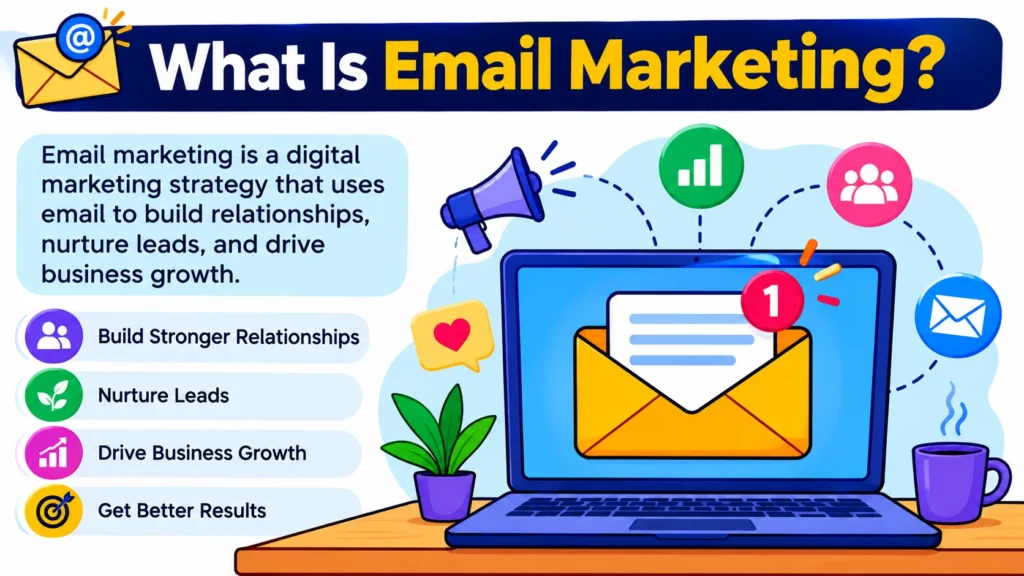
Table of Contents
What Is Email Marketing?
Email marketing is the practice of using email to communicate with a group of people for a variety of purposes, including sharing information, developing customer relationships, promoting products or services, announcing important updates, or encouraging a specific action.
Depending on the organization and its objectives, an email marketing program might include:
- Welcome emails for new subscribers
- Newsletters containing useful or educational information
- Product and service announcements
- Automated educational sequences
- Special offers and promotional campaigns
- Event invitations and reminders
- Customer follow-ups
- Re-engagement campaigns for inactive subscribers
The most effective programs generally prioritize relevance over volume.
That distinction matters. A subscriber who receives one genuinely useful message is likely to view the next email differently from someone who receives a steady stream of unrelated promotions. Frequency has its place, but frequency without relevance can quickly become noise.
The goal, therefore, is not merely to occupy the inbox. It is to earn a place in it.
Why Email Marketing Matters
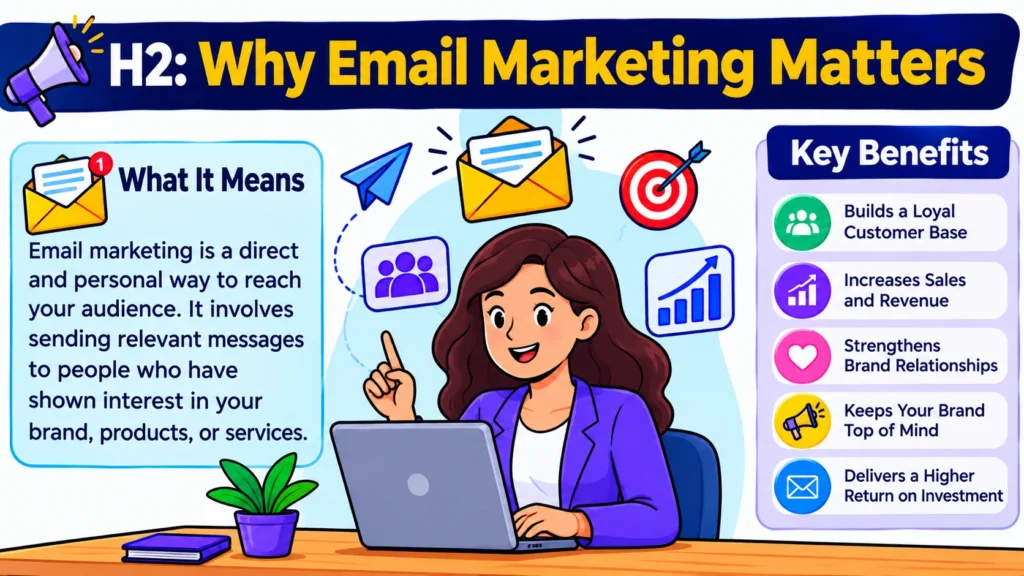
Email gives organizations a direct communication channel with people who have already demonstrated some level of interest. That makes it useful for several purposes, from nurturing relationships to distributing information and measuring audience responses.
Building Customer Relationships
Consistent, useful communication can help an organization remain relevant between purchases, visits, events, or other interactions.
Consider a software company. Rather than sending only sales messages, it might provide product education, workflow suggestions, feature explanations, and practical tips. A publisher, meanwhile, could deliver a weekly selection of carefully chosen articles.
The underlying principle is simple: give subscribers a reason to want the next email.
Over time, that consistency can help turn a one-time interaction into an ongoing relationship.
Delivering Relevant Information
Not every subscriber has the same interests, and treating an entire mailing list as though it were one homogeneous audience can limit the effectiveness of a campaign.
Email allows marketers to organize subscribers according to meaningful characteristics, preferences, or behaviors. Someone interested in one category can receive information related to that category without necessarily receiving every other message an organization sends.
Better targeting can make communication feel less intrusive and more useful.
Supporting the Customer Journey
People interact with organizations at different stages and for different reasons. Email can support those stages with communication that reflects where someone is in the relationship.
A new subscriber might receive an introduction to the organization and its resources. A prospective customer could receive educational content that helps them evaluate an option. An existing customer, by contrast, may benefit more from product updates, support information, or suggestions for getting greater value from something they have already purchased.
The message changes because the relationship has changed.
Creating a Measurable Communication Channel
Another advantage of email is its ability to generate campaign-level performance data.
Depending on the platform and configuration, marketers may be able to examine delivery, opens where measurable, clicks, conversions, unsubscribes, and other actions associated with a campaign.
These measurements do not tell the whole story, but they provide clues. A campaign with strong engagement may reveal what resonates with an audience, while weak performance can highlight areas that deserve closer examination.
The important point is to use metrics as evidence for better decisions—not as numbers to chase for their own sake.
What Is Targeted Email Marketing?
Targeted email marketing involves sending messages to specific groups of subscribers based on relevant information rather than treating the entire mailing list as a single audience.
For example, an online retailer might organize subscribers according to whether they have:
- Made a previous purchase
- Shown interest in a particular product category
- Signed up for a specific type of content
- Recently joined the mailing list
- Engaged with previous emails
Targeting can make an email more relevant because the content is selected with a particular audience in mind.
However, good targeting should improve communication—not encourage marketers to make unnecessary assumptions about individuals. The information used for segmentation should have a legitimate purpose and should be handled responsibly.
How to Segment an Email Audience
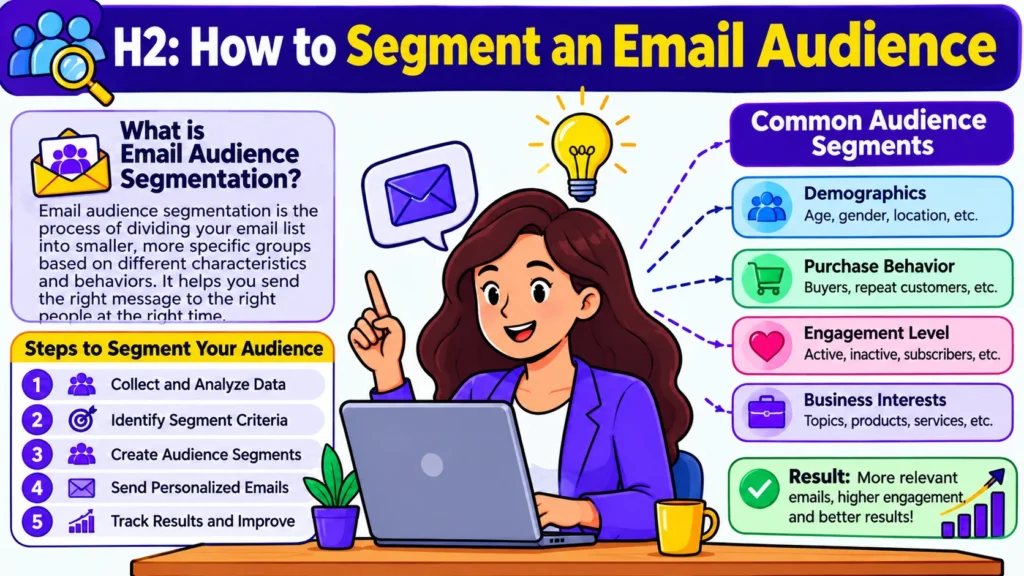
Audience segmentation is one of the foundations of effective targeted email marketing. Done well, it allows an organization to replace generic communication with messages that are better aligned with subscriber interests and circumstances.
Demographic Segmentation
Depending on the organization, audience, and information voluntarily provided by subscribers, demographic characteristics such as location, language, or age range may sometimes be useful for segmentation.
The key is restraint.
Organizations should collect information because it serves a legitimate communication purpose, not simply because the information happens to be available. Data that is unnecessary for the intended campaign may create more complexity than value.
Behavioral Segmentation
Behavior can provide useful signals about a subscriber’s interests.
Examples include:
- Previous purchases
- Content downloads
- Website interactions
- Event registrations
- Email engagement
- Product interests
For example, someone who repeatedly interacts with content about a particular subject may be more receptive to future communication about that topic.
Behavioral data, however, should be collected and used responsibly, with appropriate attention to privacy obligations and applicable requirements.
Interest-Based Segmentation
Sometimes the simplest way to understand what subscribers want is to ask them.
A business covering several subjects could allow people to select their preferred topics during signup. A subscriber interested in product education, for instance, could receive educational material without being overwhelmed by unrelated announcements.
Preference-based segmentation can be particularly valuable because the subscriber has actively expressed an interest rather than leaving the marketer to infer everything from behavior.
Customer Lifecycle Segmentation
Subscribers can also be grouped according to their relationship with an organization.
A basic lifecycle might include:
- New subscribers
- Prospective customers
- First-time customers
- Returning customers
- Long-term customers
- Inactive subscribers
Each stage presents different communication opportunities.
A new subscriber needs context. A prospective customer may need reassurance or education. A long-term customer may respond better to useful updates, loyalty-oriented communication, or advanced resources. Inactive subscribers require an entirely different question: is there still a reason for them to remain engaged?
How to Build an Email Marketing Strategy
A successful email marketing program rarely emerges from sending messages first and figuring out the strategy afterward. It starts with a clear objective, an understanding of the audience, and a realistic plan for delivering value consistently.
1. Define the Objective
Begin with a straightforward question:
What is this campaign supposed to accomplish?
Possible objectives include:
- Educating subscribers
- Increasing event registrations
- Promoting a new product
- Encouraging repeat purchases
- Sharing company news
- Driving traffic to useful content
- Maintaining customer relationships
A specific objective gives the campaign direction. It also makes measurement easier because you can determine whether the email achieved the outcome it was designed to support.
Without a clear objective, an email can easily become a collection of unrelated information, promotions, and links.
2. Build a Permission-Based List
A healthy email strategy begins with people who have voluntarily agreed to receive communications.
Avoid relying on purchased lists or adding contacts who did not appropriately request your messages. A mailing list can contain thousands of addresses and still be remarkably ineffective if many of those people never wanted the communication in the first place.
Quality matters more than raw size.
Signup forms should also communicate the basic purpose of the subscription clearly enough that people understand what they are agreeing to receive.
3. Set Expectations
Subscribers should have a reasonable idea of what will happen after they sign up.
For example, a registration form might explain that subscribers will receive a weekly newsletter covering a particular subject. That small amount of transparency can establish expectations before the first email ever arrives.
It also helps create a more coherent relationship between the promise made during signup and the communication that follows.
If someone signs up for a weekly educational newsletter and begins receiving several promotional emails every week instead, the problem is not merely frequency. The organization has failed to match the expectation it established.
4. Create Useful Content
Every email should have a reason for existing.
Useful content might include:
- Practical advice
- Educational resources
- Product information
- Relevant announcements
- Curated articles
- Invitations
- Customer resources
Promotional content can certainly belong in an email strategy. The problem arises when promotion becomes the only reason subscribers hear from an organization.
People may tolerate an occasional sales message. They are less likely to remain interested in a channel that repeatedly asks for something without consistently offering anything useful in return.
5. Write a Clear Subject Line
The subject line is often the first piece of information a recipient sees, so it should accurately communicate what the email contains.
Avoid exaggerated or misleading wording designed solely to provoke curiosity. A clever subject line that creates the wrong expectation may earn attention once, but it can damage trust over time.
Less useful:
“Important! You Won’t Believe This!”
More useful:
“5 Ways to Organize Your Weekly Email Workflow”
The second version is less theatrical, but that is precisely its strength. The recipient can immediately understand the subject and make an informed decision about whether the message is relevant.
6. Make the Email Easy to Scan
Email is frequently consumed in short bursts, often on mobile devices. Structure therefore matters almost as much as wording.
Useful practices include:
- Short paragraphs
- Descriptive headings
- Bullet points when appropriate
- Clear calls to action
- Readable typography
- Adequate spacing
Avoid cramming several unrelated ideas into a single message.
An email should have a recognizable hierarchy: the reader should be able to glance at it and understand what matters, why it matters, and what to do next.
7. Include an Appropriate Call to Action
A call to action tells the reader what step to take after reading the message.
Examples include:
- Read the full guide
- Register for the event
- View the product
- Download the resource
- Update your preferences
The call to action should follow naturally from the email’s purpose.
If the email exists to promote an event, registration may be the logical next step. If it exists to educate, directing readers toward a detailed resource might make more sense.
One clear action is often better than a confusing collection of competing requests.
Email Marketing vs. Social Media
Email and social media are not interchangeable channels. They can overlap in purpose, but each offers a different communication environment.
| Email Marketing | Social Media |
|---|---|
| Direct communication with subscribers | Public or platform-based communication |
| Requires an email address and appropriate permission | Usually depends on platform accounts and followers |
| Useful for newsletters and structured campaigns | Useful for conversations, discovery, and public content |
| Supports detailed audience segmentation | Targeting depends partly on the platform |
| Provides campaign-level email metrics | Metrics vary across platforms |
Neither channel is automatically superior.
Email may be particularly useful when an organization wants a structured, direct communication channel. Social media can be valuable for discovery, public conversation, community interaction, and reaching people who have not yet subscribed.
For many organizations, the most practical strategy is not choosing one over the other, but understanding what each channel does best.
Important Email Marketing Metrics
Measurement helps marketers understand whether a campaign is moving toward its intended objective.
But metrics should be interpreted rather than worshipped. A number is useful only when you understand what it represents and what decision it can inform.
Delivery Rate
Delivery rate indicates how many messages were successfully delivered rather than rejected or returned.
List quality can influence delivery performance. Outdated, invalid, or problematic addresses may contribute to delivery issues, which is one reason maintaining a healthy subscriber database matters.
Open Rate
Open rate has traditionally been used to estimate how many recipients opened an email.
However, modern privacy features and technical changes can make open data less precise than it once was. As a result, open rate should not be treated as the definitive measure of whether a campaign succeeded.
It can still provide context, but it is better considered alongside stronger indicators of engagement.
Click-Through Rate
Click-through rate measures recipient clicks according to the reporting methodology used by the email platform.
It can help indicate whether the content, links, and call to action generated enough interest for recipients to take another step.
A message may attract attention without producing meaningful action. Click data can help reveal that difference.
Conversion Rate
A conversion is whatever meaningful action the campaign is designed to generate.
Depending on the campaign, that could mean:
- Completing a purchase
- Registering for an event
- Downloading a resource
- Filling out a form
Define the desired conversion before launching the campaign. Otherwise, it becomes difficult to determine whether the campaign actually accomplished what it was supposed to do.
Unsubscribe Rate
Unsubscribes are not necessarily evidence of failure.
People’s interests change. Circumstances change. Sometimes a subscriber simply no longer needs the information.
That said, a sudden increase in unsubscribes deserves attention. It may indicate that the content is no longer relevant, the sending frequency has become excessive, the targeting is poor, or the expectations established during signup are not being met.
Common Email Marketing Mistakes
Even a carefully designed campaign can struggle when basic issues are overlooked.
Sending Too Frequently
There is no universal number of emails that every audience should receive.
The appropriate frequency depends on the type of content, the expectations established during signup, and the audience itself. A daily publication and a monthly industry newsletter operate under very different conditions.
Rather than assuming that more communication is automatically better, monitor engagement, feedback, unsubscribes, and other meaningful signals.
Sending Irrelevant Content
A subscriber interested in one subject may have little interest in everything else an organization produces.
This is where segmentation and preference management become valuable. The more clearly an organization understands what different groups want, the easier it becomes to avoid sending information that feels disconnected from the subscriber’s original reason for joining.
Ignoring Mobile Users
An email that looks excellent on a large desktop display can become frustratingly difficult to read on a phone.
Text may become cramped. Buttons may be difficult to tap. Images can distort the layout. Long paragraphs may feel even longer on a small screen.
Test campaigns across appropriate devices and screen sizes before sending them.
Making Every Message Promotional
When every email is a sales pitch, subscribers may eventually stop paying attention.
A stronger strategy balances promotional communication with education, useful resources, practical information, announcements, or other material that provides genuine value.
The objective is not to eliminate promotion. It is to prevent promotion from becoming the entire relationship.
Making Unsubscribing Difficult
Subscribers should have a clear and practical way to stop receiving marketing emails.
Trying to make unsubscribing confusing, hidden, or unnecessarily difficult may create short-term retention at the expense of long-term trust. Responsible communication recognizes that people should be able to change their preferences.
Neglecting Inactive Subscribers
An old mailing list can contain people who have stopped engaging, changed interests, or no longer want the communication.
Instead of keeping every address indefinitely without question, organizations can periodically review inactive contacts and consider an appropriate re-engagement process.
Sometimes the best outcome is winning a subscriber back.
Sometimes it is recognizing that the relationship has ended.
Email Marketing and Privacy
Privacy should not be treated as an afterthought added after an email program has already been built. It belongs in the strategy from the beginning.
Organizations may have legal and regulatory obligations involving consent, marketing communications, personal information, data retention, and unsubscribe requests. The specific requirements can vary according to factors such as the organization, audience, location, and countries involved.
Good practices include:
- Collecting subscriber information transparently
- Explaining what people are signing up to receive
- Using appropriate consent mechanisms
- Providing a clear unsubscribe option
- Protecting subscriber information
- Respecting communication preferences
- Reviewing applicable privacy and marketing requirements
Because laws and regulatory guidance can change, organizations dealing with specific compliance questions should consult relevant official sources or qualified legal professionals.
The broader principle remains straightforward: people should understand how their information is being used, and organizations should treat subscriber data with appropriate care.
How to Improve Email Campaigns Over Time
Email marketing is rarely something an organization gets perfectly right on its first attempt.
Good programs evolve.
Rather than making dramatic changes based on a single campaign, marketers can use measured experimentation and accumulated data to gradually improve their approach.
Test One Meaningful Change
You might compare two versions of:
- Subject lines
- Calls to action
- Email layouts
- Content formats
- Sending times
Changing everything simultaneously can make the results difficult to interpret. If the campaign performs differently, you may know that something changed—but not necessarily what caused the difference.
A focused test creates a clearer learning opportunity.
Study Audience Behavior
Look beyond any single metric.
Suppose an email receives substantial attention but produces very few clicks. That could suggest that the subject line successfully attracted interest while the content or call to action failed to motivate the next step.
Numbers become much more useful when they are interpreted together.
The question is not simply, “Did the campaign perform well?”
It is, “What does the behavior tell us about what should happen next?”
Review Your Signup Sources
Not all subscribers necessarily arrive through the same path.
People who join through an educational article may behave differently from people who subscribe after purchasing a product. Visitors coming from an event, social platform, search result, or dedicated signup page may also have different expectations.
Compare relevant signup sources and examine engagement over time. This can reveal which channels are attracting genuinely interested subscribers rather than simply generating addresses.
Keep Improving Relevance
As an organization learns more about its audience, its segmentation and content strategy should evolve.
Interests change. Products change. Audiences grow. Expectations shift.
The objective is not to send an ever-increasing number of emails. It is to send more useful messages to the appropriate audience at the appropriate point in the relationship.
That is where email marketing becomes less about broadcasting and more about communication.
Frequently Asked Questions About Email Marketing
1. What is email marketing used for?
Email marketing is used to communicate with subscribers through newsletters, educational content, product announcements, promotions, event invitations, customer resources, and other forms of direct communication.
2. Is email marketing suitable for small businesses?
Yes. Small businesses can use email marketing to communicate with customers and interested prospects without maintaining a large marketing department.
The strategy simply needs to match the organization’s resources, audience, objectives, and ability to produce useful content consistently. A small but engaged list can be considerably more valuable than a large list filled with uninterested recipients.
3. How often should I send marketing emails?
There is no universal schedule.
The appropriate frequency depends on what subscribers expect, the type of content being delivered, and the organization’s ability to maintain a consistent standard of quality.
A useful rule is to establish expectations clearly and pay attention to audience response rather than assuming that more emails automatically produce better results.
4. What is email segmentation?
Email segmentation is the practice of dividing a subscriber list into groups according to relevant characteristics such as interests, preferences, behavior, demographics, or customer relationships.
The purpose is to make communication more relevant.
Instead of sending the same message to everyone, organizations can tailor content to groups with genuinely different needs.
5. Should I buy an email list?
Generally, building a permission-based list is a better approach than purchasing contacts who may never have agreed to receive your communications.
Purchased lists can introduce a range of concerns, including privacy, compliance, deliverability, sender reputation, and poor engagement.
A smaller audience that actively wants your communication is usually a stronger foundation than a much larger audience that does not.
Conclusion
Effective email marketing is built on a handful of principles that sound simple but require discipline to apply: permission, relevance, useful content, clear communication, thoughtful targeting, and continuous improvement.
The objective is not to send the greatest possible number of messages. It is to understand subscribers well enough to send messages that deserve their attention.
A strong strategy begins with a permission-based audience and a clearly defined objective. From there, sensible segmentation, valuable content, accurate subject lines, appropriate calls to action, and meaningful measurement provide the framework for improvement.
Over time, campaign data can reveal patterns. Some messages will outperform others. Certain audiences will respond differently. Some signup sources will prove more valuable than others. Those observations can then shape the next campaign, creating a cycle of testing, learning, and refinement.
Most importantly, email marketing should be treated as a relationship rather than merely another promotional channel.
Subscribers are not just addresses in a database. They are people who have chosen to give an organization access to their inbox.
Respect that choice.
Deliver something useful.
Set honest expectations.
And make every message earn its place.
Find marketing tools that fit your needs at AmiinMarketer.com.