
Email marketing remains a practical way for businesses to build relationships, share knowledge, introduce products, and encourage customers to return. But there is a catch: simply sending emails on a regular schedule does not guarantee that people will open them, read them, or take action.
The real difference lies in the content.
Subscribers want messages that respect their time, answer their questions, solve problems, or introduce something genuinely useful. When every email feels like another sales pitch, even an interested reader may eventually lose enthusiasm. Give people a reason to stay, however, and your inbox presence can become a valuable part of their experience with your business.
A thoughtful email marketing content strategy helps you determine what to send, when to send it, whom to send it to, and why each message deserves a place in someone’s inbox. Instead of scrambling for ideas whenever a campaign is due, you develop a clear plan that balances education, updates, practical advice, and relevant promotions.
Whether you operate a small business, publish a blog, sell digital products, manage an online store, or provide professional services, your email content should serve two purposes: help your audience and support your business goals.
In this guide, you’ll learn which types of emails to send subscribers, how to organize your content, how to create a manageable publishing schedule, and how to measure results so your strategy improves over time.
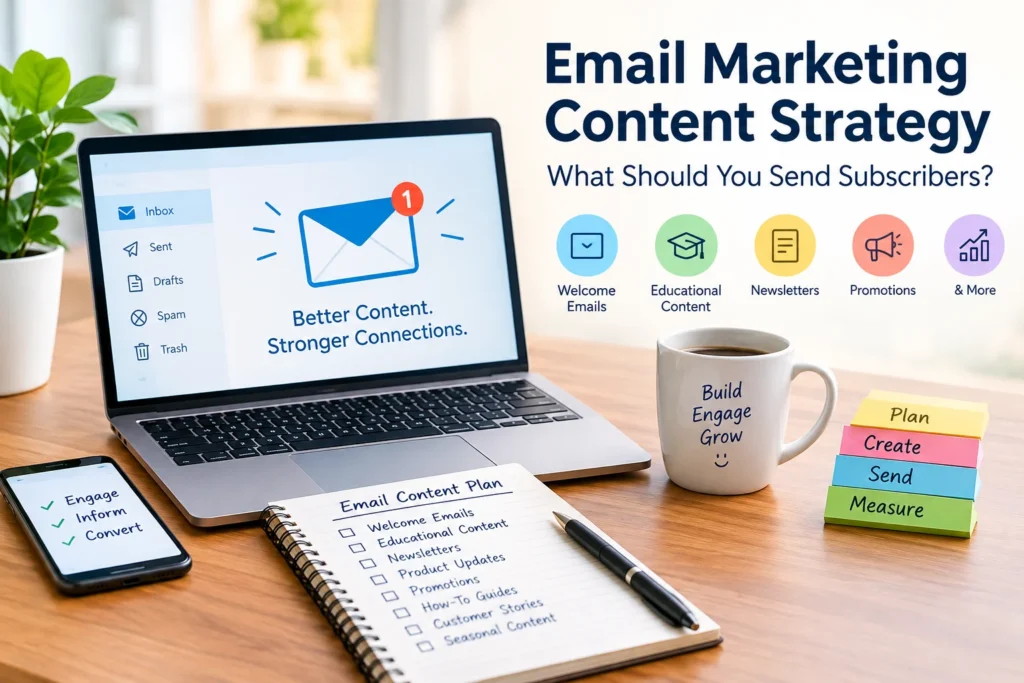
Table of Contents
What Is an Email Marketing Content Strategy?
An email marketing content strategy is a structured approach to planning, creating, and delivering emails that meet subscribers’ needs while supporting your business objectives.
It goes beyond deciding what to write in your next newsletter. It considers your audience, the topics they care about, the formats you use, the frequency of communication, and the action you hope readers will take after receiving a message.
Consider two businesses.
A personal finance blog might send budgeting advice, explanations of financial concepts, links to new articles, and practical money-management resources. An online clothing store, on the other hand, might share styling tips, seasonal collections, product announcements, and discounts on selected items.
Their industries differ. Their email content should differ, too.
Yet both businesses need a clear plan that connects the right message with the right audience.
A useful email marketing content strategy answers five essential questions:
- Who are you emailing? Understand your subscribers’ interests, needs, preferences, and familiarity with your business.
- What should you send? Decide whether educational emails, newsletters, tutorials, product updates, or promotional offers best serve your audience.
- Why are you sending it? Give every campaign a defined purpose instead of sending messages merely to maintain activity.
- When should you send it? Establish a realistic schedule that fits your audience’s expectations and your available resources.
- How will you measure success? Track relevant performance indicators and use the findings to improve future campaigns.
When these elements work together, email marketing becomes more than a collection of isolated messages. It becomes a consistent communication system that can grow alongside your business.
Why Your Email Marketing Content Strategy Matters
When someone subscribes to your mailing list, they are giving you an opportunity to communicate with them. That opportunity comes with an expectation: your messages should offer something worth receiving.
Meet that expectation consistently, and you give subscribers a reason to remain connected. Ignore it, and even a well-designed email can become little more than another notification to dismiss.
Here are four important reasons to plan your content carefully.
1. It Helps You Deliver Consistent Value
Without a content plan, email marketing can quickly become reactive. You send a message when a new product launches, another when sales slow down, and perhaps nothing for several weeks when ideas run dry.
That approach makes communication unpredictable.
A content strategy gives you a reserve of useful topics, from tutorials and frequently asked questions to industry explanations, checklists, and recommendations. You can plan ahead instead of inventing an idea at the last minute.
Consistency does not necessarily mean emailing every day. It means delivering worthwhile content at a frequency you can maintain and your subscribers can reasonably expect.
2. It Makes Your Emails More Relevant
Different subscribers have different reasons for joining your list.
A first-time reader may need an introduction to your business and its most useful resources. Someone who has already purchased a product might prefer instructions, troubleshooting advice, or information about related services.
Sending everyone the same message may be convenient, but convenience alone does not make an email relevant.
By organizing subscribers according to their interests, stated preferences, or relationship with your business, you can create messages that better match what different groups need.
3. It Builds Stronger Customer Relationships
Imagine receiving an email from a company only when it wants you to buy something. After a while, the pattern becomes obvious.
Now imagine that the same company occasionally sends practical advice, answers common questions, shares helpful resources, and introduces offers that genuinely fit your interests. The relationship feels different.
Useful content creates opportunities to demonstrate knowledge, reliability, and an understanding of your audience. Over time, those experiences can strengthen trust and make future promotional messages feel more relevant.
4. It Makes Content Planning More Efficient
Writing good emails takes time. You need to develop ideas, prepare drafts, check facts, create visuals when necessary, test links, and schedule campaigns.
Without a plan, these tasks can become rushed and disorganized.
An editorial calendar gives you a clearer view of upcoming campaigns. It also helps you spot repeated topics, avoid sending too many promotions in succession, and coordinate email content with blog posts, product launches, or seasonal activities.
The result is a more manageable workflow and fewer last-minute decisions.
9 Types of Email Content to Send Subscribers
One of the most useful parts of building an email marketing content strategy is choosing a balanced mix of content. You do not need to use every format, nor should you force a particular type of email into your schedule when it offers little value.
Start with the formats that match your audience, business model, and available resources.
1. Welcome Emails
A welcome email introduces your business to new subscribers and explains what they can expect from future messages.
First impressions matter. Someone who has just joined your mailing list is often interested in learning more about your content, products, or services. A clear, friendly welcome helps turn that initial interest into a useful starting point.
A welcome email might include:
- A short introduction to your business or publication.
- An explanation of the topics you cover.
- Links to your most helpful resources.
- A realistic description of how frequently you plan to send emails.
- One clear next step, such as reading a popular article or exploring a useful guide.
Example: A digital marketing blog could welcome new readers by introducing its main topics and linking to a beginner-friendly guide to email campaigns.
Keep the message focused. A welcome email should make the next step obvious, not overwhelm new subscribers with a dozen links, several product pitches, and a long explanation of your business history.
2. Educational Emails
Educational emails help subscribers understand a subject, develop a skill, or solve a problem they encounter in everyday work or life.
They are especially useful for educational websites, professional service providers, software companies, consultants, and businesses selling products that require explanation.
You might share:
- Step-by-step tutorials.
- Practical checklists and worksheets.
- Beginner-friendly explanations of complicated topics.
- Common mistakes and ways to avoid them.
- Short lessons related to your industry.
- Answers to questions customers frequently ask.
Example: A small business marketing newsletter could explain how to write a more informative subject line, organize an email list, or plan a month of marketing content.
The most useful educational emails teach something rather than merely announcing that useful information exists. Give readers a meaningful takeaway inside the message itself. If the subject deserves a longer explanation, include a link to a detailed article for those who want to explore further.
3. Email Newsletters
A newsletter brings together useful information and delivers it to subscribers on a predictable schedule.
For a blog, that might mean highlighting newly published articles, sharing a few selected resources, and adding a short editorial note. For a service business, it could involve practical recommendations, answers to common questions, and updates relevant to existing customers.
The format can be simple.
A weekly newsletter might feature three recent articles, each accompanied by a sentence explaining why it matters. A monthly newsletter could summarize important developments and offer a handful of practical suggestions.
What matters most is consistency of purpose.
Subscribers should recognize the value of your newsletter and understand how to navigate it. Use a clear structure, descriptive headings, and carefully selected links instead of squeezing every possible update into one crowded email.
A newsletter does not need to be long to be worthwhile. Sometimes, a few carefully chosen ideas are more useful than a lengthy collection of unrelated information.
4. Product and Service Updates
Subscribers may appreciate knowing when you introduce a new product, improve an existing service, publish a resource, or make a change that affects them.
These emails work best when they explain the significance of an update rather than simply announcing that something has changed.
For instance, a software company might introduce a new feature and demonstrate how customers can use it to complete a task more easily. A digital publisher could announce a new downloadable guide that addresses a common problem among readers.
Before sending an update, ask yourself: Why would the recipient care about this information?
If the answer is clear, explain the benefit directly. If the update concerns only a minor internal development with no meaningful effect on customers, it may not deserve a separate campaign.
Prioritize relevance over volume.
5. Promotional Emails and Special Offers
Promotional emails introduce products, services, discounts, sales, launches, or other legitimate commercial opportunities.
They have an important place in many email programs. Businesses need to explain what they offer, and interested subscribers may welcome information about products that solve their problems.
The difficulty arises when promotion becomes the entire strategy.
A useful promotional email should explain:
- What is being offered.
- Who is likely to benefit.
- What the subscriber should know before making a decision.
- Any relevant conditions, restrictions, or limitations.
- What the reader can do next.
Be straightforward about pricing, eligibility, deadlines, and terms. If an offer ends on a particular date, state the actual deadline. Do not manufacture urgency or suggest that a product is almost sold out without a factual basis.
The objective is not simply to make people click. It is to help suitable customers understand an offer and decide whether it meets their needs.
When promotional content appears alongside educational resources and helpful updates, your emails can support sales without making every interaction feel like a transaction.
6. How-To Guides and Checklists
Some subscribers do not need another long explanation. They need a process they can follow.
That is where how-to emails and checklists become particularly useful.
A how-to email breaks a task into manageable steps. A checklist provides a quick way to review work, remember important details, or identify something that still needs attention.
For example, a website owner could send a checklist for preparing a new blog article:
- Choose a clear, relevant topic.
- Research the questions readers want answered.
- Organize the main headings.
- Check facts and external links.
- Review spelling, grammar, and readability.
- Add a relevant call to action.
- Check the finished page before publishing.
A resource like this gives subscribers something they can apply immediately.
These emails are especially effective when your audience values practical guidance and wants to make progress without working through an unnecessarily complicated explanation.
Keep the steps specific. A checklist that says “improve your marketing” is difficult to act on; one that identifies concrete tasks is much more useful.
7. Curated Resources and Recommendations
You do not have to create every useful resource yourself.
Curated emails allow you to select and share relevant articles, tools, tutorials, books, reports, or other materials that help subscribers explore a subject more deeply.
The important part is the selection process.
Instead of sending ten unrelated links because you need to fill a newsletter, choose a smaller collection that addresses a particular need. Explain what each resource offers and why a subscriber might want to explore it.
For example, a newsletter for beginner bloggers might recommend a guide to website security, an article about content planning, and a resource explaining basic search engine optimization.
Each recommendation should have a clear purpose.
If a recommendation includes an affiliate relationship, disclose that relationship clearly and follow the applicable legal requirements and platform policies. Readers should be able to understand when a recommendation may generate compensation for your business.
Trust is worth more than an unnecessarily long list of links.
8. Customer Stories and Case Studies
Customer stories can demonstrate how a product or service works in a real situation. They may describe a challenge, explain the approach taken, and discuss the outcome.
For example, a case study might show how a small business organized its customer communications by adopting a consistent newsletter schedule and separating educational emails from promotional announcements.
A well-presented story gives readers context. It helps them understand how an idea might work beyond a theoretical explanation.
Accuracy matters, however. Obtain appropriate permission before publishing identifiable customer information, and do not invent testimonials, performance figures, or success stories.
If you do not yet have real customer examples, you can still teach effectively. Use a clearly identified hypothetical scenario, a step-by-step demonstration, or an example based on a transparent set of assumptions.
Never present an invented situation as a real customer’s experience.
9. Seasonal and Timely Content
Seasonal emails connect your content with relevant events, recurring business periods, or changing audience needs.
A retailer might share holiday shopping guidance. A business blog could publish a year-end planning checklist, while a service provider might send preparation advice before a particularly busy season.
Timely content can also address changes within your industry, provided the information is accurate and genuinely relevant to your subscribers.
The key is to avoid forcing a connection.
Not every holiday needs a dedicated campaign, and not every industry development deserves an email. A message should still provide a clear benefit to the person receiving it.
Plan seasonal content in advance whenever possible. Original writing, graphic design, product preparation, and campaign coordination often require more time than expected.
A little preparation makes it easier to publish useful content when the moment arrives.
How to Balance Educational and Promotional Emails
One question appears repeatedly when businesses begin planning their email campaigns: how much content should teach, and how much should sell?
There is no universal percentage that suits every industry, audience, or business model. A retail store with frequent product launches will communicate differently from an educational blog that primarily shares articles and resources.
Still, one principle is useful across many situations: make subscriber value the foundation of your communication, and use promotional messages when you have an appropriate offer to introduce.
A simple starting point is an illustrative four-email sequence:
| Content type | Main purpose | |
|---|---|---|
| Email 1 | Educational tip | Help readers solve a specific problem |
| Email 2 | Newsletter | Share useful articles and resources |
| Email 3 | Practical guide | Teach a process or answer a question |
| Email 4 | Relevant promotion | Introduce a suitable product or service |
This sequence is an example, not a strict rule. You may need to adjust it based on subscriber expectations, business activity, and the amount of useful content you can produce.
A new product launch might justify a different sequence. A weekly educational newsletter may require fewer promotional emails. The correct approach depends on what your audience signed up to receive.
Before sending any campaign, consider two questions:
- Does this message provide something relevant to the recipient?
- Does its main purpose justify taking up space in the recipient’s inbox?
If the answer to both is yes, the email is more likely to have a meaningful role in your content plan.
How to Build an Email Marketing Content Strategy Step by Step
A strong strategy does not require expensive software or a large marketing team. You can begin with a spreadsheet, a clear understanding of your audience, and a realistic schedule.
Follow these eight steps to build a practical system.
Step 1: Define Your Audience
Start with the people you want to reach.
What are their interests? Which questions do they ask most often? Are they beginners, experienced professionals, existing customers, or people still deciding whether your business is right for them?
The more clearly you understand their needs, the easier it becomes to select relevant topics.
Look for clues in customer questions, website articles, feedback, product reviews, support conversations, and the preferences subscribers share when joining your list.
For example, an audience learning digital marketing for the first time may appreciate plain-language explanations, straightforward examples, and step-by-step tutorials. Experienced marketers might prefer detailed comparisons, advanced techniques, or analysis of industry developments.
These are starting assumptions, not universal truths. Use actual feedback to refine your understanding.
Your content should respond to what people need, not simply what your business wants to discuss.
Step 2: Set a Clear Goal for Each Email
Every campaign should have a primary objective.
Your overall email program might aim to educate readers, distribute new content, support customer retention, introduce products, or encourage subscribers to explore a service. Individual emails should then support a specific part of that larger goal.
Examples include:
- Encourage new subscribers to explore your most useful resources.
- Help existing customers understand how to use a product.
- Share a newly published article with readers interested in its subject.
- Introduce a relevant offer to subscribers who have chosen to receive promotional content.
Decide on the goal before writing the message.
Doing so gives you a clearer idea of what information to include, which links to provide, and what action to invite readers to take.
It also helps prevent a common problem: emails that try to educate, promote several products, announce unrelated updates, and ask for multiple actions at once.
One primary purpose is usually easier to communicate clearly.
Step 3: Create Content Categories
Content categories, sometimes called content pillars, are the main themes that guide your email program.
They make planning easier because you no longer have to start with a blank page every time you need a new campaign.
For a business blog, four useful categories might be:
- Education: Tutorials, explanations, and beginner guides.
- Practical advice: Checklists, workflows, and actionable tips.
- Updates: New articles, services, and relevant developments.
- Promotions: Products, services, and suitable special offers.
Your categories should reflect the questions and interests of your audience. They should not exist merely to create a tidy-looking calendar.
Once you have established a few core themes, brainstorm several topics under each one. You will have a more dependable source of ideas and a better chance of maintaining variety across your campaigns.
Step 4: Build an Email Content Calendar
An email content calendar records what you intend to send, when you plan to send it, and what each campaign should accomplish.
A spreadsheet is enough for many small businesses. As your email program becomes more complex, you can consider planning features available through your email marketing platform.
At a minimum, record:
- Planned sending date.
- Target audience or segment.
- Email subject or working title.
- Content type.
- Campaign objective.
- Main call to action.
- Drafting, editing, and review status.
Here is an example of a four-week calendar:
| Week | Topic | Format | Goal |
|---|---|---|---|
| Week 1 | Three ways to improve email readability | Educational email | Teach a useful skill |
| Week 2 | New articles and recommended resources | Newsletter | Share helpful content |
| Week 3 | A practical email planning checklist | How-to email | Help readers take action |
| Week 4 | Introduction to a relevant service | Promotional email | Explain a suitable offer |
Treat this as a flexible starting point rather than a mandatory schedule. You do not need to send an email every week if doing so would reduce quality or create unnecessary repetition.
A smaller number of useful emails can be preferable to a crowded calendar filled with messages that have little to say.
Step 5: Write a Clear Subject Line
The subject line gives readers their first indication of what an email contains.
A strong subject line is specific, relevant, and consistent with the message itself. It helps subscribers decide whether the email deserves their attention without relying on exaggerated promises.
Compare these two examples:
- General: “Our Latest Update”
- More specific: “A Simple Checklist for Planning Your Next Email”
The second option tells the reader more about the content and its potential usefulness.
Avoid misleading claims, artificial urgency, and language that suggests a personal emergency when no such situation exists. A subject line should attract attention honestly.
You can also test different subject lines to discover which approaches resonate with your audience. Compare results carefully, though: sending time, audience composition, and other campaign differences can influence performance.
The aim is to learn what works for your readers, not to chase attention at any cost.
Step 6: Write for Easy Reading
Subscribers often read emails between other tasks, and many view them on mobile devices. A message that requires too much effort to understand may lose readers before they reach its most useful point.
Make the structure work in your favor.
Open with a clear introduction. Use short paragraphs, descriptive subheadings when appropriate, and a logical sequence of ideas. Give each email one main focus, then organize supporting details around it.
If you have several related points to cover, use sections or bullet points instead of placing everything inside one enormous paragraph.
Plain language is generally a good starting point. Technical terms may be necessary when writing for a specialist audience, but unnecessary jargon can obscure otherwise valuable advice.
Also consider the length of your message. Some topics deserve a detailed explanation; others can be handled in a few sentences. Write enough to deliver the promised value, then stop.
Step 7: Add a Relevant Call to Action
A call to action, commonly shortened to CTA, tells readers what they can do next.
Depending on the purpose of your email, it might invite subscribers to:
- Read a complete guide.
- Download a checklist.
- Explore a new product collection.
- Review the details of a service.
- Reply with a question.
- View a relevant tutorial.
The CTA should follow naturally from the message.
An educational email could link to a related resource. A product announcement might invite readers to explore the new feature, while a promotional campaign could direct interested subscribers to a product page.
Do not assume that every email needs a sales-oriented CTA. Sometimes, reading an article, learning a skill, or responding with feedback is the most appropriate next step.
Clarity matters more than complexity. Readers should understand what happens when they click.
Step 8: Review and Test Before Sending
Before scheduling a campaign, give it a final review.
Check spelling, grammar, formatting, personalization, and the accuracy of your claims. Test your links, verify that the CTA works, and confirm that the intended audience will receive the message.
Pay attention to mobile readability. Images should display appropriately, text should remain legible, and important information should not depend entirely on a graphic loading correctly. Add suitable alternative text to meaningful images where appropriate.
If your platform supports test emails, use that feature before sending a campaign to your full list.
Finally, review your unsubscribe process and applicable compliance obligations. Requirements vary by jurisdiction and circumstance, so consult the official guidance relevant to your business.
A few careful checks can prevent avoidable mistakes and help protect the trust you have built with subscribers.
How to Personalize Email Content Without Overcomplicating It
Personalization means making your emails more relevant to individual subscribers or groups of people with similar interests.
It does not necessarily require complicated automation, extensive personal data, or a sophisticated marketing system. In many cases, simple and thoughtful choices are enough.
Segment Subscribers by Interest
If subscribers can select their interests when signing up, use those preferences to organize relevant content.
For example, a digital marketing newsletter might let readers choose between email marketing, search engine optimization, and social media marketing.
Someone interested in email campaigns could then receive more tutorials about subject lines, newsletter planning, and subscriber engagement.
This approach reduces the need to send every topic to every reader.
Keep the process manageable. You do not need dozens of segments from the beginning; start with meaningful distinctions that affect the usefulness of your content.
Adapt Content to the Subscriber Journey
Subscribers may need different information depending on their relationship with your business.
- New subscribers may benefit from an introduction, an explanation of what you offer, and links to your best resources.
- Engaged readers may appreciate more detailed tutorials, related topics, or opportunities to explore a subject further.
- Existing customers may need product instructions, service updates, troubleshooting advice, or relevant offers.
These categories are useful starting points, not guarantees about individual preferences. A new subscriber might already know your industry well, while a long-standing customer may still need basic guidance.
Use stated preferences and available engagement information to make sensible decisions rather than assuming that everyone in a category behaves the same way.
Use Personal Data Responsibly
Personalization should improve the subscriber’s experience, not make people uncomfortable.
Collect only the information you genuinely need, explain how it will be used when required, and avoid requesting sensitive details without a clear and appropriate reason.
Follow applicable privacy requirements and respect subscriber preferences.
A relevant recommendation can be helpful. An email that reveals unexpected knowledge about someone’s personal life may have the opposite effect.
Good personalization is thoughtful, proportionate, and transparent.
How Often Should You Email Subscribers?
There is no single sending frequency that works for every mailing list.
A business publishing new articles regularly might send a weekly newsletter. A company with occasional product announcements may communicate less often, while a service that provides time-sensitive updates may have legitimate reasons to send messages more frequently.
The important thing is to choose a schedule that balances subscriber expectations with your ability to produce useful content.
Consider the following questions:
- What frequency did you communicate when subscribers signed up?
- How much genuinely valuable content can you create?
- Does your audience expect frequent updates?
- How have subscribers responded to previous campaigns?
- Are you repeating topics simply because you need something to send?
Set clear expectations at sign-up, and make it easy for subscribers to unsubscribe or adjust their preferences where supported.
After establishing your schedule, monitor engagement trends, unsubscribe rates, and spam complaints. If complaints rise after you increase your sending frequency, investigate what changed instead of automatically continuing with the same approach.
More emails do not necessarily mean better email marketing. Relevance and consistency matter more than filling every available space on the calendar.
Common Email Marketing Content Mistakes to Avoid
Even a well-intentioned campaign can disappoint readers when its content is poorly planned. Recognizing common mistakes makes it easier to build an email program that remains useful over time.
Sending Sales Messages Too Frequently
Repeated promotions can make your communication feel predictable. Subscribers may begin to associate your emails with constant requests to purchase something.
How to improve: Mix commercial messages with educational content, practical resources, and relevant updates. Make promotional emails purposeful rather than automatic.
Writing Without a Clear Purpose
An email that covers too many unrelated topics can leave readers unsure about what matters most.
How to improve: Identify the primary objective before drafting. Remove information that does not support the goal or provide a direct benefit to the reader.
Using Misleading Subject Lines
A dramatic subject line may attract attention, but it can damage trust when the email fails to deliver what it promises.
How to improve: Describe the content accurately. Avoid false urgency, exaggerated claims, and misleading implications.
Ignoring Mobile Readability
Long paragraphs, crowded layouts, tiny links, and poorly sized images can make emails frustrating to read on a phone.
How to improve: Keep the design simple, use readable text, provide sufficient spacing, and test messages on different screen sizes when possible.
Sending Identical Content to Every Subscriber
A message that suits one group may be irrelevant to another. Sending the same material to everyone can waste opportunities to make your content more useful.
How to improve: Use subscriber preferences and sensible audience segments to tailor messages when meaningful differences exist.
Measuring Only Email Opens
Open rates can provide a rough indication of activity, but they are not a complete measure of campaign success. Privacy features and email technology can affect how opens are recorded.
How to improve: Evaluate clicks, conversions, unsubscribes, spam complaints, and other metrics relevant to your campaign objectives. Interpret the results in context instead of relying on one number.
Forgetting Email Compliance
Email marketing requirements depend on the jurisdictions involved and the nature of your communications. Applicable rules may address consent, sender identification, advertising disclosures, and unsubscribe requests.
How to improve: Review the official requirements that apply to your business and audience. For example, the United States Federal Trade Commission provides guidance on the CAN-SPAM Act.
Official resource: CAN-SPAM Act: A Compliance Guide for Business
How to Measure the Success of Your Email Content
An email marketing content strategy should evolve as you learn more about your subscribers.
Some campaigns aim to generate sales. Others are designed to educate readers, distribute new content, encourage product adoption, or collect feedback. Because these objectives differ, the measurements you use should reflect the purpose of each campaign.
Here are several metrics worth monitoring.
| Metric | What it helps you understand |
|---|---|
| Delivery rate | How successfully your platform reports that messages were delivered |
| Click-through rate | How often recipients click links in an email, according to your platform’s definition |
| Conversion rate | How often recipients complete a defined action attributed to a campaign |
| Unsubscribe rate | How frequently recipients leave your mailing list |
| Spam complaint rate | How frequently recipients report your messages as unwanted |
| Revenue attributed to email | The sales your measurement system attributes to email campaigns |
Definitions can differ across email marketing platforms, especially for clicks, conversions, and delivery-related metrics. Consult your provider’s documentation and use consistent definitions when comparing results.
Numbers become more useful when you interpret them alongside the campaign’s purpose.
For example, an educational email might attract plenty of clicks but lead to few downloads of the resource it promotes. That pattern could suggest a mismatch between the email’s promise and the linked page, or it might indicate that the next step is unclear.
Likewise, a rise in unsubscribes after a particular campaign may signal that the content was poorly targeted, the sending frequency was too high, or the message did not match subscriber expectations. Investigate before deciding what to change.
Compare results over time, and test one meaningful change at a time whenever practical. A single campaign rarely provides enough evidence to establish a dependable long-term pattern.
The purpose of measurement is not to collect impressive-looking numbers. It is to understand subscriber behavior and make better decisions.
A Simple 30-Day Email Content Plan for Beginners
If you are starting with a small mailing list or have never organized your campaigns, a 30-day planning period can help you turn ideas into a workable routine.
You do not need to build an elaborate system immediately. Begin with a few useful activities, then expand as you learn what your audience values.
Week 1: Understand Your Audience
Identify the main interests, challenges, and questions of your subscribers.
Choose three or four content categories and define the purpose of your email program. Review existing blog posts, customer questions, and feedback for topics worth exploring.
If your business needs a welcome message, draft one that explains what subscribers can expect and points them toward useful resources.
By the end of the week, you should have a clearer picture of whom you are writing for and what your content needs to accomplish.
Week 2: Create Useful Content
Prepare an educational email that answers a common question or helps readers complete a practical task.
Keep it focused. Explain the main idea clearly, provide an example where useful, and include a relevant link if additional information would help the reader.
You can also review existing website articles, tutorials, and other materials for ideas that can be adapted into email-friendly content. Repurposing useful material can save time, provided you reshape it for the email format instead of simply copying a long article into the message.
Week 3: Organize Your Calendar
Plan the next several emails and choose realistic sending dates.
Record each campaign’s topic, target audience, format, objective, and main call to action. Identify any additional work required, such as creating images or preparing a downloadable resource.
If you already have enough relevant material, prepare a newsletter featuring a small selection of useful articles, recommendations, or tips.
Keep the workload manageable. A calendar should help you produce better content, not become another source of unnecessary pressure.
Week 4: Review and Improve
Send your planned emails according to your chosen schedule, then review the available performance data.
Look for meaningful clicks, conversions, replies, reader feedback, unsubscribe patterns, and spam complaints. Which messages seemed most relevant? Were any topics difficult to understand? Did readers follow the intended next step?
Use these observations to shape your next month’s plan.
This 30-day process cannot guarantee specific marketing results. It does, however, give you a practical starting point for developing a more consistent, organized, and measurable email program.
Frequently Asked Questions
1. What should I send to my email subscribers?
Send content that matches your audience’s interests and the expectations you established when people subscribed. Useful options include welcome messages, educational tips, newsletters, tutorials, product updates, curated resources, customer stories, and relevant promotions. Give every email a clear purpose rather than sending messages simply to fill your calendar.
2. How do I create an email marketing content strategy?
Start by identifying your audience and defining your business goals. Choose several content categories, establish a realistic sending frequency, and create a calendar that records each email’s topic, audience, and objective. Write clear messages, review them before sending, and measure relevant results so you can improve future campaigns.
3. How often should I send marketing emails?
The right frequency depends on your audience, industry, and ability to create useful content. Some businesses send weekly newsletters, while others communicate less often. Explain your expected frequency at sign-up, maintain a manageable schedule, and monitor engagement, unsubscribes, and spam complaints to determine whether your approach remains appropriate.
4. Should every email include a sales offer?
No. Email can educate readers, answer questions, share resources, announce updates, and help customers use a product or service. Promotional messages are important for many businesses, but every email does not need to ask for a purchase. Focus on delivering relevant value and choose a call to action that fits the message.
5. How can I tell whether my email content strategy is working?
Measure each campaign against its primary objective. Clicks and conversions can help you evaluate action-oriented messages, while replies and reader feedback may reveal whether educational content is useful. Monitor unsubscribes and spam complaints, too. Compare results over time and make adjustments based on consistent patterns rather than one isolated campaign.
Conclusion
A successful email marketing content strategy begins with a straightforward principle: give subscribers a meaningful reason to hear from you.
That reason will vary. Some readers want practical tutorials, others appreciate a well-organized newsletter, and some are looking for product updates or relevant offers. Your job is to understand those differences and create a content plan that responds to them.
Start with a few useful content categories. Build a realistic calendar, write clear messages, and make each campaign serve a defined purpose. Personalize content when it improves relevance, respect subscriber preferences, and follow the email marketing requirements that apply to your business.
Most importantly, remember that your mailing list represents people, not merely addresses to which you can send advertisements. Their time and attention have value.
When you consistently deliver helpful information, communicate honestly, and improve your approach based on meaningful feedback, email marketing can become a more dependable way to serve your audience while supporting your business goals.
Find marketing tools that fit your needs at AmiinMarketer.com