
Email remains one of the most direct and dependable ways for a business to communicate with customers and prospects. Yet volume, by itself, is rarely a winning strategy. Sending more messages does not necessarily mean generating better results. Effective Email Marketing Campaigns are built around something more deliberate: the right audience, a well-defined objective, genuinely useful content, sensible timing, and consistent measurement.
In 2026, there is even more to consider. Privacy and consent matter. So does inbox placement. Mobile usability, accessibility, subscriber expectations, and the overall quality of the customer experience can all influence how people respond to an email. When messages arrive too frequently or feel irrelevant, recipients can simply tune them out. When an email is useful, timely, and thoughtfully constructed, however, it can do something more valuable than generate a click—it can strengthen the relationship between a business and its audience.
This guide walks through the process of planning, creating, launching, measuring, and improving Email Marketing Campaigns, with one principle running through every stage: the subscriber’s experience should remain at the center.
Table of Contents
What Are Email Marketing Campaigns?
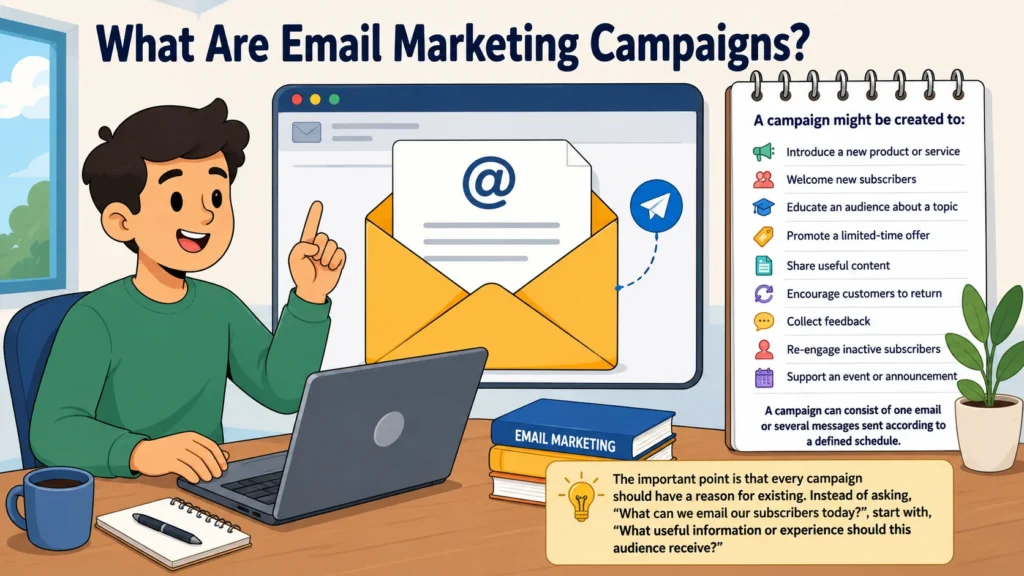
An email marketing campaign is a planned communication, consisting of one or more email messages, created to accomplish a particular business or communication objective.
That objective might be commercial, educational, informational, or relationship-focused. For example, a campaign could be designed to:
- Introduce a new product or service
- Welcome new subscribers
- Educate an audience about a particular topic
- Promote a limited-time offer
- Share useful or relevant content
- Encourage previous customers to return
- Collect feedback
- Re-engage inactive subscribers
- Support an event, launch, or important announcement
Some campaigns are extremely simple: one email, one audience, one action. Others unfold across several messages delivered according to a predetermined schedule.
The distinction is less important than the purpose behind the campaign.
Every campaign should have a reason for existing. Rather than asking, “What can we email our subscribers today?”, a stronger question is, “What useful information, opportunity, or experience should this particular audience receive?”
That small shift in thinking can change the entire campaign.
Why Email Marketing Campaigns Still Matter in 2026
Email continues to be valuable because it provides businesses with a communication channel that can be direct, measurable, and highly adaptable.
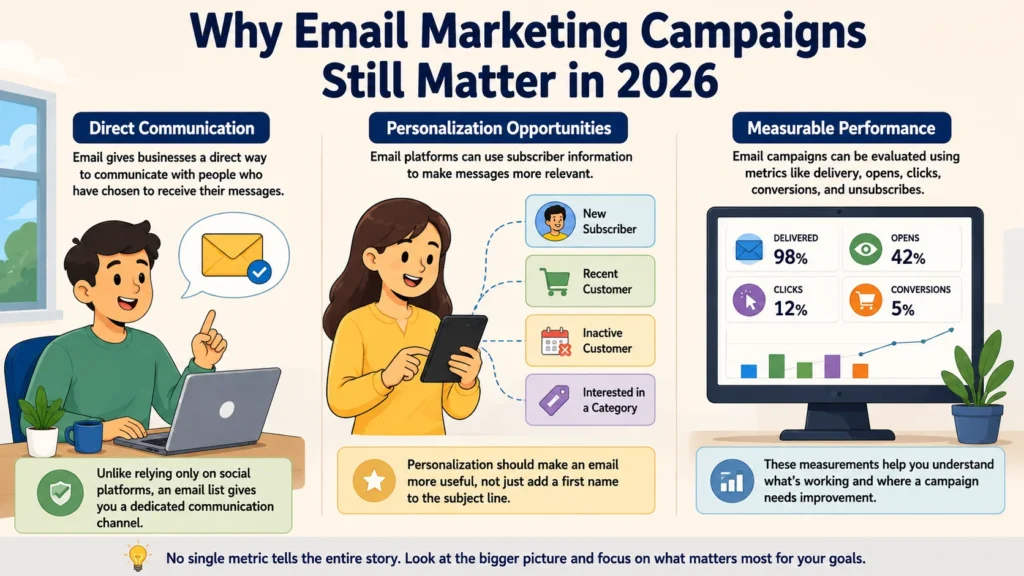
Direct communication
Email gives organizations a way to communicate with people who have chosen to receive their messages. That makes it different from depending entirely on public social platforms, where distribution can be influenced by the platform’s features and systems.
Still, having an email address does not guarantee that every subscriber will see or open every message. Inbox providers use various systems to determine how messages are delivered and displayed. Responsible sending practices therefore remain essential.
Personalization opportunities
Modern email platforms can use information such as subscriber preferences, previous interactions, or customer status to make communication more relevant.
An online store, for instance, may have very different messages for:
- A person who has just subscribed
- A recent customer
- A customer who has not purchased for several months
- Someone who has demonstrated interest in a particular product category
The objective should not be personalization for its own sake.
Simply placing someone’s first name in a subject line is not necessarily meaningful personalization. The more useful approach is to use relevant information to improve the message itself—to make it more timely, more appropriate, or more helpful to the person receiving it.
Measurable performance
Email campaigns also provide a range of performance signals. Marketers can examine delivery rates, clicks, conversions, unsubscribes, and other indicators of engagement.
These measurements can reveal where a campaign is performing well and where it may need attention.
But metrics need context.
A campaign that produces a large number of opens but very few meaningful actions may require a different response from a campaign that generates fewer opens yet attracts highly relevant clicks and conversions. No single number can tell the complete story.
How to Create Effective Email Marketing Campaigns
A successful campaign does not begin when someone starts writing the first paragraph of an email.
The groundwork comes earlier.
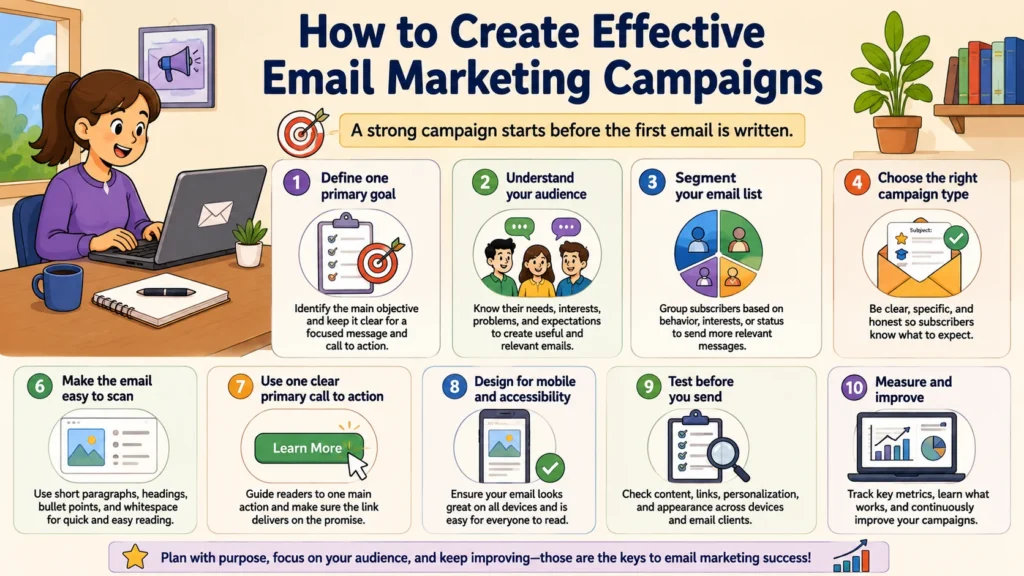
1. Define one primary goal
Before creating the campaign, decide what you actually want it to accomplish.
Your objective might be to:
- Drive registrations for an event
- Introduce a new service
- Educate subscribers about a product
- Generate visits to a newly published article
- Encourage existing customers to return
- Gather customer feedback
A campaign can certainly contribute to several broader business objectives. Even so, choosing one primary goal gives the campaign direction and prevents the message from becoming a collection of unrelated requests.
Consider the difference.
“We want subscribers to read our article, buy our product, follow us on social media, and sign up for our webinar.”
That is a lot to ask from one email.
A more focused objective would be:
“Encourage subscribers to register for our upcoming webinar.”
Now the campaign has a destination. The subject line, body copy, supporting information, and call to action can all work toward that single outcome instead of competing for attention.
2. Understand your audience
Effective Email Marketing Campaigns begin with the people receiving them.
Before drafting the message, consider who those people are and what they actually need. Ask:
- Who will receive this email?
- What problem, question, or interest does this audience have?
- What do they already know?
- What information would genuinely help them?
- What action is realistic for them to take?
- How frequently do they expect to hear from you?
You do not necessarily need an elaborate research operation to answer these questions.
Customer questions can reveal a great deal. So can website behavior, previous campaign performance, surveys, and conversations with support teams. Often, the information needed to create a better campaign is already scattered throughout the business; the challenge is noticing it and putting it to use.
3. Segment your email list
One message sent to an entire database may be convenient, but convenience is not always the same thing as relevance.
Segmentation allows marketers to divide subscribers into groups according to characteristics, preferences, or behavior that actually matter to the campaign.
Useful segments might include:
- New subscribers
- Existing customers
- Prospective customers
- Highly engaged subscribers
- Inactive subscribers
- Customers interested in a particular category
- People who registered for a specific event
The key word is useful.
There is little value in creating dozens of tiny segments simply because the technology allows you to do so. If the groups do not have meaningfully different needs or behaviors, excessive segmentation can create more complexity without producing better communication.
4. Choose the right campaign type
Not every objective calls for the same kind of email. Matching the campaign format to the purpose makes the communication easier to understand—and usually easier to manage.
Welcome campaigns
A welcome campaign introduces new subscribers to an organization. It can explain what they should expect, provide helpful resources, establish communication preferences, and set expectations around email frequency.
A good welcome sequence does more than say hello. It begins the relationship.
Promotional campaigns
Promotional campaigns communicate an offer, product, service, or other commercial message.
The strongest promotional emails are usually straightforward. They explain what is being offered, why it might matter to the recipient, and what action the reader can take. Exaggerated claims may attract attention temporarily, but clarity and credibility are more valuable over time.
Educational campaigns
Educational campaigns are designed primarily to help the reader learn something useful.
For example, a software company might develop a short sequence explaining how customers can get greater value from a particular feature. The product is still present, but education is doing the heavy lifting.
Newsletter campaigns
Newsletters can bring together articles, announcements, educational material, and selected updates on a regular basis.
Consistency matters here. Subscribers should have a reasonable understanding of what they are signing up to receive. When expectations and delivery are aligned, a newsletter has a better chance of becoming something people recognize and value rather than another message competing for attention.
Re-engagement campaigns
Re-engagement campaigns target subscribers who have gradually become less active.
A simple approach is to acknowledge the inactivity, provide a reason to re-engage, and give the subscriber a clear choice about whether they still want to receive future emails.
Sometimes the most responsible outcome is not another click. It is allowing an uninterested subscriber to leave.
5. Write a useful subject line
The subject line has an important job: it helps the recipient decide whether the email deserves attention.
Effective subject lines tend to be:
- Clear
- Specific
- Relevant
- Concise enough to understand quickly
- Consistent with the content of the email
Avoid creating curiosity that the email cannot satisfy.
For example:
“You won’t believe what happened!”
may create a moment of intrigue, but it tells the reader almost nothing.
Compare it with:
“5 ways to improve your monthly email newsletter”
The second subject line immediately establishes an expectation. The reader knows what the email is about and can make a more informed decision about whether it is relevant.
That kind of honesty matters.
6. Make the email easy to scan
Most people do not read marketing emails as though they were settling in with a long-form article. They scan.
Your email should accommodate that behavior.
Use:
- Short paragraphs
- Descriptive headings
- Bullet points where they make sense
- Clear calls to action
- Comfortable spacing between sections
- Readable typography
- Relevant images rather than unnecessary decoration
Important information should not be buried beneath a wall of text. If the reader has to fight through the email to discover why it matters, the campaign has already created unnecessary friction.
7. Use one clear primary call to action
A call to action tells the reader what should happen next.
Depending on the campaign, that might be:
- Read the guide
- Register for the event
- View the product
- Book a consultation
- Complete the survey
- Update your preferences
An email can contain secondary links. There is nothing inherently wrong with that. But the primary action should be unmistakable.
Just as importantly, the call to action should accurately describe what happens after the click. If a button says “Read the guide,” the destination should deliver the guide—not an unrelated sales page or a confusing intermediate screen.
Clarity builds trust.
Email Personalization: More Than Using a First Name
Personalization is often reduced to one familiar trick: adding a subscriber’s first name.
That can make an email feel slightly more personal, but meaningful personalization goes considerably further.
The real purpose is relevance.
Information that a subscriber has reasonably provided—or information generated through legitimate interactions—can help determine what content they receive and when they receive it.
A professional software company, for example, might provide:
- Beginner resources to new users
- Advanced tutorials to experienced users
- Product education connected to a customer’s selected plan
That is more useful than simply writing “Hi Sarah” at the beginning of every email.
Personalization must also be handled responsibly. Businesses should be transparent about how subscriber information is used and should follow the privacy and marketing requirements applicable to their audience and location.
When there is uncertainty, a sensible principle is to collect and use only information that has a clear purpose.
Email Timing and Frequency
There is no universally perfect day or hour for every email campaign.
What works for one audience can perform very differently for another. Timing can depend on:
- The audience
- The industry
- The type of message
- Time zone
- Subscriber preferences
- The existing customer relationship
- The campaign objective
A business-to-business newsletter, for example, may behave differently from a retail promotional campaign. The audiences have different contexts, different expectations, and potentially different reasons for opening an email.
Instead of assuming that one schedule will remain effective indefinitely, monitor your own results and test reasonable alternatives.
Frequency deserves the same attention.
Even valuable content can become irritating when it arrives too often. Repeated messages may lead subscribers to disengage or unsubscribe, particularly when the content does not justify the increased volume.
A practical approach is to establish expectations when people subscribe and, where appropriate, give them options for managing their preferences.
Mobile-Friendly Email Design
Email does not exist on a single screen.
A message that looks excellent on a large desktop display can become frustratingly difficult to use on a phone. Since a significant amount of email reading takes place on mobile devices, responsive and mobile-friendly design should be treated as a basic requirement rather than an optional refinement.
Before launching a campaign, check:
- Is the text comfortably readable?
- Are buttons large enough and easy to tap?
- Do images scale appropriately?
- Does the important information remain understandable if images fail to load?
- Are links easy to use?
- Does the message function across commonly used email clients?
Do not make the meaning of an important email dependent entirely on images.
Text should communicate the essential information. Images can support that message, but they should not be the only thing carrying it.
Accessibility Should Be Part of Email Design
Accessibility belongs in the planning process, not at the very end as a technical afterthought.
Several practices can make an email easier for a broader range of subscribers to understand and use:
- Write descriptive link text
- Provide meaningful alternative text for important images
- Maintain sufficient text readability
- Use a logical content structure
- Avoid placing the only copy of an important message inside an image
- Make calls to action understandable within their context
Accessible communication is not simply a compliance consideration. It can also improve usability for everyone.
When information is structured clearly, links are understandable, and important content does not disappear when images fail to load, the email becomes easier to navigate regardless of how the recipient accesses it.
Testing Email Marketing Campaigns
A campaign should not reach the entire audience before anyone checks whether it actually works.
Testing can uncover surprisingly simple problems—broken links, incorrect dates, missing personalization, formatting issues, or a call to action that leads somewhere it should not.
Before sending, review the following.
Content
Check spelling, grammar, links, product information, dates, prices, and calls to action.
A tiny error can undermine confidence in an otherwise carefully planned campaign.
Personalization
If the email contains dynamic fields, make sure they display correctly. Also confirm that sensible fallback text exists when subscriber information is unavailable.
Links
Test every important link. Do not assume a link works simply because it worked when the email was first created.
Make sure each destination is the one the message promises.
Appearance
Preview the email at different screen sizes and, where possible, in commonly used email clients.
Formatting can change dramatically between environments.
Sender information
Make sure the sender name and email address are recognizable to subscribers.
A familiar sender identity gives recipients immediate context: they can tell who is communicating with them before they even begin reading.
Measure the Right Email Marketing Metrics
Sending the campaign is not the finish line.
Once the message has gone out, examine what happened. More importantly, judge those results against the campaign’s original objective rather than treating one attractive number as proof of success.
Delivery metrics
Delivery-related measurements can help identify technical problems or issues with list quality.
If messages are not reaching recipients reliably, improving the subject line is unlikely to solve the underlying problem.
Open-related metrics
Open measurements can provide directional information about engagement, but they should be interpreted cautiously.
Technical factors and privacy features can affect how accurately opens are measured, so open-related data should not automatically be treated as a perfect representation of subscriber behavior.
Click-through rate
Click activity can provide insight into whether recipients found the email content and its call to action relevant enough to investigate further.
A click represents a stronger action than merely receiving the message, although its importance still depends on the campaign’s objective.
Conversion rate
A conversion represents the action that truly matters to the campaign.
That could mean a registration, purchase, download, completed form, or another defined outcome.
If the purpose of the campaign is to generate registrations, then completed registrations are more closely connected to success than a large number of opens.
Unsubscribe rate
Unsubscribes can reveal useful information about subscriber expectations, message relevance, and sending frequency.
An unsubscribe is not automatically evidence of failure.
Giving people an easy and appropriate way to leave an email list is part of responsible email marketing. In some cases, removing disengaged subscribers can ultimately leave a healthier and more relevant audience.
A Simple Framework for Improving Campaign Performance
Improvement becomes easier when you change one meaningful variable at a time.
Rather than redesigning everything after every campaign, establish a baseline first. Then make a focused change and observe what happens.
For example:
Campaign 1: Establish a baseline.
Campaign 2: Test a clearer subject line.
Campaign 3: Improve the primary call to action.
Campaign 4: Test a more relevant audience segment.
Campaign 5: Compare a different content format.
This gradual approach makes it easier to understand which changes may have influenced performance.
The important part is to test according to a meaningful hypothesis. Randomly changing multiple elements at once may produce a different result, but it makes the reason for that difference much harder to understand.
Good testing creates knowledge, not just new numbers.
Common Email Marketing Mistakes to Avoid
Even a carefully designed campaign can fail when basic principles are ignored.
Buying email lists
Purchased or poorly sourced email lists can create problems with relevance, trust, deliverability, and compliance.
A large list is not necessarily a valuable list.
Build an audience through legitimate and transparent methods instead. Subscribers who have a genuine reason to hear from you are generally more useful than a collection of addresses acquired simply to increase database size.
Sending without clear consent or permission
Email marketing requirements differ depending on jurisdiction and situation.
Businesses should understand the rules applicable to their audience and obtain permission where required.
For legal or regulatory questions, rely on the relevant official authority or a qualified professional rather than treating general marketing guidance as a substitute for legal advice.
Using misleading subject lines
A subject line should accurately represent the email waiting behind it.
Short-term attention is rarely worth the long-term damage that can result when subscribers feel manipulated or misled.
Overloading subscribers
Even excellent content becomes unwelcome when it arrives too frequently.
Pay attention to engagement, monitor subscriber behavior, and provide appropriate preference or unsubscribe options. Respecting someone’s inbox is part of respecting the person.
Making every email a sales pitch
If every message asks the subscriber to buy something, the relationship can quickly become one-sided.
Educational, useful, and informative content can provide value between promotional campaigns. Sometimes the best way to support future sales is simply to become worth listening to.
Ignoring inactive subscribers
An email list is not automatically healthy just because it contains a large number of addresses.
Inactive subscribers can affect the usefulness of your audience data and may indicate that expectations, relevance, or communication frequency need to be reconsidered.
Consider establishing a responsible re-engagement process and reviewing list quality regularly.
Email Marketing Campaigns vs. Social Media Marketing
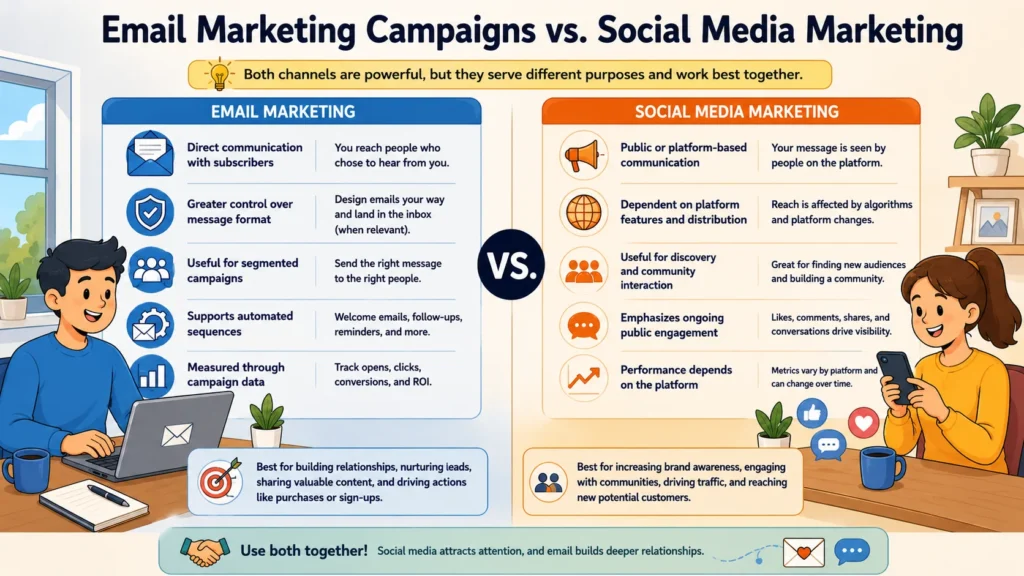
Email and social media can work together, but they operate in different communication environments.
| Email Marketing | Social Media Marketing |
|---|---|
| Direct communication with subscribers | Public or platform-based communication |
| Greater control over message format | Dependent on platform features and distribution |
| Useful for segmented campaigns | Useful for discovery and community interaction |
| Can support automated sequences | Often emphasizes ongoing public engagement |
| Campaign performance can be measured through campaign data | Performance depends on the specific platform |
Neither channel is automatically superior.
They simply do different jobs.
A business might use social media to attract attention and introduce its ideas to a wider audience, then use email to provide deeper information to people who have actively chosen to subscribe.
The two channels can therefore complement one another rather than compete.
How Automation Can Improve Email Campaigns
Automation allows email messages to be triggered by defined events, subscriber actions, or schedules.
Common examples include:
- A welcome email sent after subscription
- A follow-up after someone registers for an event
- Educational messages delivered during onboarding
- A reminder connected to an unfinished process
- A customer follow-up after a purchase
The appeal is obvious. Automation can make communication more timely while reducing repetitive manual work.
But automation should never become “set it and forget it.”
Automated sequences need periodic review. Check that:
- The information is still accurate
- Links continue to work
- The timing remains appropriate
- Messages are not being sent unnecessarily
- The sequence still reflects the current customer experience
A workflow that made perfect sense six months ago may be confusing today if the product, website, customer journey, or business priorities have changed.
The best automation removes repetitive work without removing thoughtfulness from the recipient’s experience.
A Practical Email Campaign Checklist
Before launching your next campaign, run through the following checklist:
- Is the campaign goal clearly defined?
- Is the audience appropriate?
- Does the content provide genuine value?
- Is segmentation useful for this campaign?
- Does the subject line accurately describe the message?
- Is the email easy to scan?
- Is there a clear primary call to action?
- Does the email work well on mobile devices?
- Are important links working?
- Are personalization fields displaying correctly?
- Is the sender recognizable?
- Are unsubscribe and preference options handled appropriately?
- Does the campaign follow applicable email and privacy requirements?
- Have the key performance metrics been identified?
- Is there a plan for reviewing the results?
A checklist may seem basic, but that is precisely why it works. It catches the small oversights that are easy to miss when everyone involved has been looking at the same campaign for too long.
Frequently Asked Questions About Email Marketing Campaigns
1. What makes an email marketing campaign effective?
An effective campaign begins with a clear purpose and a relevant audience. From there, it needs useful content, an understandable call to action, and a measurement plan that connects performance to the original objective.
It should also respect subscriber preferences and comply with applicable marketing and privacy requirements.
2. How often should a business send marketing emails?
There is no universal frequency that works for every business.
The appropriate schedule depends on audience expectations, content quality, campaign type, and engagement. Start with a reasonable frequency, communicate expectations clearly, and adjust the schedule based on meaningful feedback and performance rather than arbitrary rules.
3. Should every email marketing campaign be personalized?
No.
Personalization is valuable when it improves relevance. It does not need to appear in every message merely to create the impression that an email is personalized.
Use subscriber information responsibly, and make sure there is a clear reason for using it.
4. What is the most important email marketing metric?
That depends entirely on the campaign objective.
If the goal is registrations, completed registrations matter more than simply counting opens. If the goal is content engagement, clicks may be more useful. If the objective is revenue, conversions and related business outcomes deserve greater attention.
Choose measurements that connect directly to what the campaign is supposed to accomplish.
5. How can a small business improve its email marketing campaigns?
Start with the fundamentals.
Build a permission-based audience. Learn what subscribers actually need. Send useful content. Make emails easy to read and navigate. Test important elements before changing everything at once. Then review the results regularly.
A simple system that is consistently maintained can be far more effective than an elaborate strategy that becomes too complicated to operate.
Conclusion
Successful Email Marketing Campaigns are not created by sending the greatest possible number of messages.
They are created by understanding the audience, respecting its expectations, and delivering something useful at a time when it makes sense.
Begin with a specific objective. Identify the people most relevant to that objective. Create content that earns their attention rather than demanding it. Make the next action obvious. Then, after the campaign has run its course, examine the results and use what you have learned to make the next campaign better.
That process is simple in principle, although doing it well requires discipline.
In 2026, effective email marketing increasingly comes down to relevance, trust, usability, privacy, and consistency. Businesses that treat subscribers like people—not merely entries in a database—and continually refine the way they communicate are better positioned to build durable relationships through email.
Looking for the right marketing tools? Explore expert reviews, comparisons, and guides at AmiinMarketer.com.