
Email marketing remains one of the most practical ways for businesses, creators, and organizations to communicate with people who have chosen to hear from them. Rather than depending entirely on social media algorithms or continuously paying for advertising, businesses can use email to maintain a direct line of communication with their subscribers.
But what are the benefits of email marketing, exactly?
There is more to it than sending promotional messages. A thoughtfully planned email marketing strategy can help a business educate its audience, distribute useful content, introduce products and services, strengthen customer relationships, encourage repeat engagement, and bring people back to its website.
Of course, email marketing is not a guaranteed shortcut to traffic or sales. Its results can be influenced by audience quality, content relevance, deliverability, consistency, timing, and whether subscribers actually receive information that matches what they expected when they joined the list.
In this guide, we’ll explore the 10 key benefits of email marketing, how different types of businesses can use email, the limitations to keep in mind, and practical ways to get more value from an email strategy.
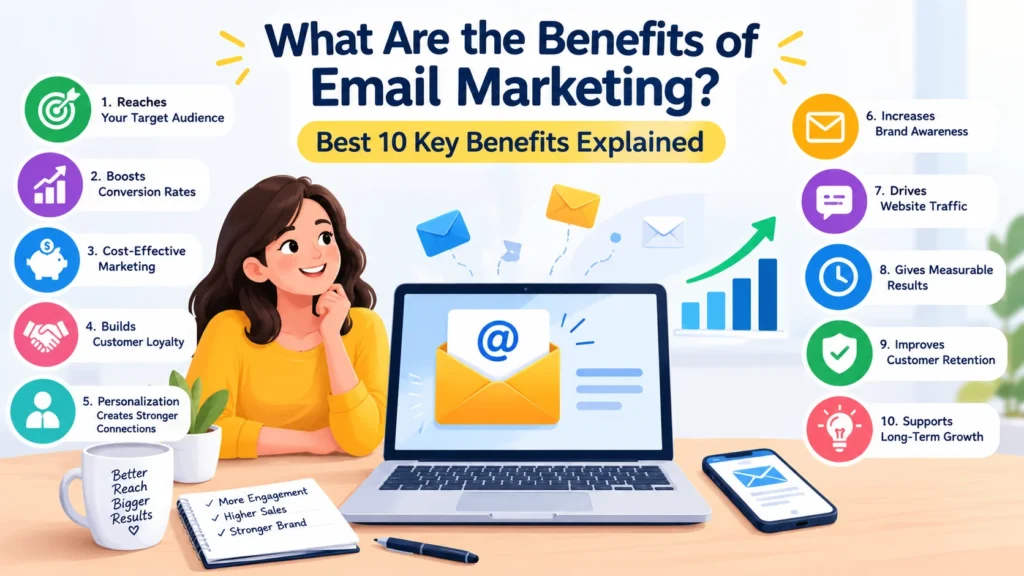
Table of Contents
What Is Email Marketing?
Email marketing is the practice of using email to communicate with people who have voluntarily subscribed to receive messages from a business, organization, creator, or another sender.
The purpose of an email can vary considerably. Some messages are educational; others are designed to announce something, nurture a relationship, or promote a product.
Common types of email marketing messages include:
- Educational content
- Company or product updates
- Newsletters
- Special offers
- Product announcements
- Welcome emails
- Event information
- Personalized recommendations
- Customer follow-ups
For example, a software company might send a welcome email immediately after someone creates an account. A few days later, it could send an educational message explaining how to use an important feature.
Likewise, a content website might publish a new article and notify its subscribers through a newsletter.
The important distinction is this: email marketing is not simply a sales channel. It can also be an information and relationship-building channel that helps a business remain connected with its audience over time.
10 Benefits of Email Marketing
1. Direct Communication With Your Audience
One of the most important benefits of email marketing is the ability to communicate directly with people who have subscribed to your list.
When someone joins an email list, they have chosen to receive messages according to the expectations and terms presented when they subscribed. This creates a communication channel that a business can use repeatedly rather than relying exclusively on third-party platforms.
That differs from social media.
On a social platform, the business creates a post, but the platform ultimately influences how and when that content is distributed. Algorithms, platform policies, user behavior, and competition for attention can all affect visibility.
With email, businesses have more direct access to their subscriber list.
That does not mean every email will reach the inbox or every subscriber will open it. Deliverability, spam filtering, subscriber interest, message quality, and other factors still influence results.
Even so, having a direct communication channel can be valuable for businesses that want to maintain an ongoing relationship with their audience.
2. Helps Build Long-Term Customer Relationships
Good marketing is not always about making an immediate sale.
Sometimes, it is about staying useful.
Email gives businesses an opportunity to communicate with customers between purchases instead of contacting them only when there is something to sell. A consistent stream of relevant information can help keep a brand familiar while providing subscribers with reasons to remain engaged.
For example, a business might send:
- A welcome email
- Helpful educational content
- Product tips
- Relevant company updates
- Occasional promotional offers
This creates a continuing communication cycle without requiring customers to visit the company’s website every day.
However, relevance matters enormously. If every message feels unnecessary, repetitive, or overly promotional, subscribers may simply stop paying attention—or unsubscribe.
The goal should not be to send more emails. It should be to send better emails.
3. Supports Customer Retention
Email marketing can also play a role in keeping existing customers engaged after they have purchased a product or signed up for a service.
The relationship does not necessarily end at checkout.
A business can use email to provide helpful information that makes a product easier to understand, use, or enjoy. That additional communication can be particularly useful for software, online courses, memberships, e-commerce products, and subscription services.
For example:
- A software company can explain newly released features.
- An online store can provide product-care information.
- A course provider can send learning reminders.
- A SaaS company can share tutorials and practical tips.
- A membership website can announce newly available resources.
These messages can help customers get more value from what they already purchased.
Email alone cannot guarantee customer retention. Retention depends on many factors, including product quality, customer experience, pricing, support, and the customer’s actual needs.
Still, useful follow-up communication can be an important part of a broader retention strategy.
4. Can Support Website Traffic
Another useful benefit of email marketing is its ability to bring existing subscribers back to your website.
Imagine that you publish a detailed article about choosing email marketing tools. Instead of waiting for every potential reader to discover the article through Google or social media, you could notify relevant subscribers through your newsletter.
Someone interested in the subject may see the email, click the link, and read the article.
The process can look like this:
Website content → Email subscriber → Newsletter → Website visit
This can be particularly useful for bloggers, publishers, software companies, and businesses that regularly produce educational resources.
But there is an important distinction: the purpose should not be to generate empty clicks.
If subscribers repeatedly receive emails that promise value but lead to weak or irrelevant content, trust can decline. The content behind the click needs to justify the reader’s attention.
5. Allows Audience Segmentation
Not every subscriber has the same needs.
A beginner may want an introductory guide, while an experienced customer might be looking for advanced information. Sending exactly the same message to both people may therefore be less useful than creating relevant groups.
This is where email segmentation becomes valuable.
Many email marketing platforms allow businesses to organize subscribers into groups based on information or behavior that has been legitimately collected and can be used appropriately.
For example, an online store might create segments for:
- New subscribers
- Existing customers
- Customers interested in a particular product category
- People who attended an event
- Subscribers who regularly engage with a specific type of content
Segmentation can make communication more relevant.
A person who has shown interest in beginner-level material could receive introductory resources. Someone who has already interacted with advanced content might receive more detailed information.
Instead of treating the entire audience as one large group, segmentation allows businesses to recognize that different subscribers may be at different stages of their journey.
6. Enables Email Personalization
Personalization is another significant benefit of email marketing.
At its simplest, personalization might involve including a subscriber’s name. But modern email campaigns can go further by tailoring content according to relevant interests, preferences, or previous activity.
For example, a website could recommend articles based on the topics a subscriber previously interacted with.
Used appropriately, personalization can make an email feel more relevant and useful.
There is a line, however, between helpful personalization and communication that feels intrusive. Businesses should use personal information responsibly and handle subscriber data carefully.
They should also follow applicable privacy requirements and email marketing laws.
The objective is simple: make the message more relevant without making the subscriber uncomfortable.
7. Makes Automated Communication Possible
Email marketing automation allows businesses to send certain messages automatically when predefined conditions are met.
This can save considerable time.
For example, a business could create an automated welcome sequence like this:
Day 1: Welcome email
Day 3: Helpful educational resource
Day 5: Product or service information
Day 8: Additional useful content
Once the sequence has been configured, the system can send the appropriate message when a new subscriber enters the workflow.
Automation can also be useful for customer onboarding. A software company, for instance, could gradually introduce new users to important features instead of overwhelming them with everything at once.
But automation is not a “set it and forget it” strategy.
Automated campaigns need regular review. Information can become outdated, links can break, products can change, and messages that once made sense may eventually become irrelevant.
Automation should reduce repetitive work—not remove human judgment from the marketing process.
8. Can Be Used to Promote Products and Services
Email marketing can also support product and service promotion.
Businesses can use email to inform relevant subscribers about:
- New products
- Existing services
- Product updates
- Seasonal promotions
- Events
- Educational offers
- Relevant resources
For example, a software company might announce a new feature and explain the problem it is designed to solve.
That approach is generally more useful than simply saying, “We launched something new.”
The reader needs context.
Why does the product matter? Who is it for? What problem does it address? What should the subscriber know before taking action?
A strong promotional email can answer those questions while keeping the message focused.
Promotional campaigns should also comply with applicable email marketing, advertising, privacy, and unsubscribe requirements.
9. Provides Measurable Campaign Data
One of the practical advantages of email marketing is that many email platforms provide campaign performance data.
Depending on the platform and its tracking capabilities, marketers may be able to monitor metrics such as:
- Delivery rates
- Opens
- Clicks
- Unsubscribes
- Bounces
- Conversions
These measurements can help businesses understand how subscribers respond to different types of communication.
For example, suppose a business notices that educational articles consistently receive more clicks than heavily promotional messages. That information could influence future content planning.
The data can become a feedback loop:
Send → Measure → Learn → Improve → Send again
However, individual metrics should not be treated as the entire story.
Email tracking can be affected by email clients, privacy features, technical limitations, and other factors. A high open rate does not automatically mean a campaign achieved its business objective, just as a low click rate does not necessarily explain why subscribers were uninterested.
Metrics become more useful when they are considered alongside the purpose of the campaign.
10. Can Support a Broader Marketing Strategy
Email marketing does not need to operate in isolation.
In fact, it can complement several other marketing channels, including:
- SEO
- Content marketing
- Social media
- Paid advertising
- Affiliate marketing
- Product marketing
- Customer support
Consider a simple example.
A company publishes an SEO-focused article on its website. It then shares the article through social media and sends the resource to relevant email subscribers.
Each channel performs a different role.
SEO can help people discover the content through search. Social media can increase public visibility and encourage discussion. Email can bring the resource directly to people who have already chosen to hear from the company.
Rather than placing the entire marketing strategy on one platform, businesses can create a more connected system in which different channels support one another.
How Email Marketing Can Benefit Different Types of Businesses
The value of email marketing can look different depending on the organization, its audience, and its goals.
Small Businesses
Small businesses can use email to stay connected with customers, share useful information, announce updates, and promote relevant products or services.
For a local business, an email campaign might announce a new service, upcoming event, seasonal update, or important business information.
The strategy does not have to be complicated.
A small, engaged audience can be more useful than a large list filled with people who rarely pay attention.
E-commerce Businesses
Online stores can use email for a wide range of communication, including product announcements, order-related messages, educational content, and promotional campaigns.
Email can also help maintain communication after the first purchase.
For example, a store might provide useful information about using or caring for a product, followed later by relevant updates or offers.
The key is to make the communication useful rather than turning every message into another sales pitch.
SaaS and Software Companies
Software companies can use email to guide users through onboarding, explain features, announce updates, and share educational resources.
An automated onboarding sequence can gradually introduce important features, helping new users understand the product without requiring the company to manually send every message.
This is particularly useful when a product has several features that customers need time to explore.
Bloggers and Content Creators
Bloggers and creators can use newsletters to distribute newly published content directly to subscribers.
This gives creators another way to reach their audience instead of depending entirely on search engines or social media platforms.
For a publisher that consistently creates useful content, an email list can become an important distribution channel.
Email Marketing vs. Social Media Marketing
Email marketing and social media marketing are not necessarily competing alternatives. They serve different purposes and operate through different systems.
| Email Marketing | Social Media Marketing |
|---|---|
| Direct communication with subscribers | Communication through a social platform |
| Requires an email list | Usually relies on followers or platform audiences |
| Useful for newsletters and automated sequences | Useful for public posts and community interaction |
| Can support personalized communication | Can provide broader public visibility |
| Businesses have more control over their subscriber list | Platform rules and algorithms influence distribution |
Because the two channels have different strengths, a business may choose to use both.
Social media can help attract attention and build public visibility, while email can provide a more direct way to communicate with people who have already opted into the business’s audience.
What Are the Limitations of Email Marketing?
Understanding the limitations of email marketing is just as important as understanding its benefits.
Email can be a valuable channel, but it is not effortless or guaranteed to produce results.
Email Lists Require Time to Build
A new website or business may begin with very few subscribers.
That is normal.
Building a legitimate email list takes time and requires a clear reason for people to subscribe. Businesses need to communicate what subscribers will receive and why joining the list is worthwhile.
Buying or collecting contacts without appropriate permission can create both trust and compliance problems.
Not Every Subscriber Will Engage
A large email list does not automatically equal a highly engaged audience.
Some subscribers may ignore messages. Others may delete them, stop opening them, or eventually unsubscribe.
Audience quality matters.
A smaller group of genuinely interested subscribers can be more meaningful than a much larger list containing inactive or uninterested contacts.
Deliverability Can Be a Challenge
Sending an email does not necessarily mean that it will appear in the recipient’s primary inbox.
Deliverability can be influenced by several factors, including technical configuration, sender reputation, email content, recipient behavior, and spam filtering.
That means businesses need to pay attention not only to what they send but also to how their email program is configured and maintained.
Email Marketing Platforms May Cost Money
Many email marketing platforms offer free plans, but those plans may have limits on subscribers, emails, automation, or available features.
As a list grows or a business needs more advanced functionality, a paid plan may become necessary.
Pricing and features differ between providers, so businesses should check current pricing and plan details before choosing a platform.
Poor Email Practices Can Damage Trust
Email can strengthen a relationship—or weaken it.
Sending irrelevant messages, using misleading subject lines, communicating too frequently, or making the unsubscribe process unnecessarily difficult can create a frustrating subscriber experience.
Good email marketing begins with clear expectations.
People should understand what they are signing up for, and the messages they receive should generally match those expectations.
How to Get More Value From Email Marketing
If you are starting an email marketing strategy, there is no need to build an elaborate system immediately.
Start with the fundamentals.
1. Give People a Clear Reason to Subscribe
Tell potential subscribers what they will receive.
For example:
“Subscribe to receive practical email marketing tips and new guides.”
A clear promise helps people understand what they are signing up for. It can also attract subscribers who are genuinely interested in the subject rather than people who joined without understanding the purpose of the list.
2. Send Relevant Content
Before pressing send, think about the subscriber.
Ask yourself:
- Is this useful?
- Is it relevant to the subscriber?
- Does it provide enough value?
- Is the timing appropriate?
These questions are simple, but they can prevent many low-quality emails from reaching your audience.
3. Keep Your Emails Easy to Read
An email does not need to be complicated to be effective.
Use short paragraphs, clear headings, straightforward language, and a logical structure.
The reader should be able to understand the purpose of the email quickly.
When the message is easy to scan, people can decide almost immediately whether the information is relevant to them.
4. Avoid Excessive Promotion
An email list should not feel like a nonstop advertising channel.
A healthier communication strategy can include a mixture of educational content, useful resources, company updates, and relevant promotions.
The exact balance will depend on the business and its audience.
What matters is that subscribers continue to see a reason to stay subscribed.
5. Make Unsubscribing Straightforward
Subscribers should have a clear and straightforward way to stop receiving marketing emails.
This is important for user trust and can also be required under applicable regulations.
Making the process unnecessarily difficult does not create a stronger relationship. It can do the opposite.
6. Review Your Results
Use the available campaign data to understand what is working and what needs improvement.
Do not focus on one number alone.
Consider engagement, clicks, unsubscribes, conversions, and—most importantly—the actual purpose of the campaign.
Over time, these observations can help you refine your content, audience segments, timing, and overall strategy.
Is Email Marketing Still Useful?
Email marketing remains a widely used communication channel because it can support several different business activities, from distributing content and communicating with customers to promoting products and automating repetitive messages.
But its usefulness depends heavily on execution.
A business with a relevant audience, useful content, clear subscriber expectations, and responsible email practices may find email to be a valuable part of its broader marketing strategy.
At the same time, email should not be treated as a guaranteed source of traffic, sales, or growth.
A large subscriber count is not enough.
What matters is whether the people on the list are genuinely interested and whether the communication gives them a reason to continue paying attention.
Frequently Asked Questions
1. What are the main benefits of email marketing?
The main benefits of email marketing include direct communication with subscribers, relationship building, support for customer retention, website traffic, audience segmentation, personalization, automation, product promotion, measurable campaign data, and integration with broader marketing activities.
2. Is email marketing good for small businesses?
Yes. Email marketing can be useful for small businesses that want to maintain communication with customers and subscribers.
The strategy should match the business’s audience, available resources, and goals. A simple and relevant email strategy can be more practical than a complicated campaign system that the business cannot maintain consistently.
3. Can email marketing increase sales?
Email marketing can support sales by informing relevant subscribers about products, services, resources, and offers.
However, it does not guarantee sales.
Results can depend on audience interest, offer relevance, pricing, timing, product quality, and the overall customer experience.
4. What is the difference between email marketing and email automation?
Email marketing is the broader practice of communicating with an audience through email.
Email automation is a specific part of email marketing in which messages are triggered automatically according to predefined conditions, such as joining a list, completing an action, or reaching a particular stage in a customer journey.
In other words, email automation is a method used within email marketing.
5. How often should a business send marketing emails?
There is no universal email frequency that works for every business.
The appropriate schedule depends on the audience, type of content, business model, and subscriber expectations.
Instead of sending emails simply to maintain a particular frequency, businesses should prioritize useful and relevant communication.
Conclusion
The benefits of email marketing go far beyond sending promotional messages.
Email can provide businesses with a direct way to communicate with subscribers, nurture customer relationships, distribute useful content, support retention, automate repetitive communication, promote relevant products, and learn from campaign data.
But the channel has limitations, too.
Building an audience takes time. Not every subscriber will engage. Deliverability can be affected by technical and behavioral factors. Poorly planned campaigns can also damage the trust that businesses work hard to build.
For that reason, effective email marketing should be built around a few fundamental principles:
Relevance. Usefulness. Permission. Consistency. Respect for subscribers.
When email is treated as a long-term communication channel rather than nothing more than a sales tool, it can become a valuable component of a broader digital marketing strategy.
Discover better marketing tools at AmiinMarketer.com