
AI has reshaped the way businesses find prospects, write outreach, manage follow-ups, and evaluate campaign performance. What once required a patchwork of spreadsheets, templates, manual research, and repetitive administrative work can now be handled through increasingly sophisticated AI email marketing systems.
But there is an important distinction to keep in mind: automation itself does not make cold email effective.
A platform can send thousands of messages in a matter of minutes. That does not mean those messages are well targeted, relevant, compliant, or worth receiving.
The more useful AI-powered cold email platforms in 2026 are therefore moving beyond the simple idea of “send more emails.” Their real value lies in helping businesses build a repeatable outreach process—one in which AI assists with prospect research, personalization, copy generation, lead qualification, follow-up scheduling, and campaign analysis, while people remain responsible for strategy, judgment, and final approval.
This guide explores how AI-powered cold email systems work, which capabilities deserve attention when comparing platforms, how to create a practical automation workflow, and what businesses should consider before putting outreach on autopilot.
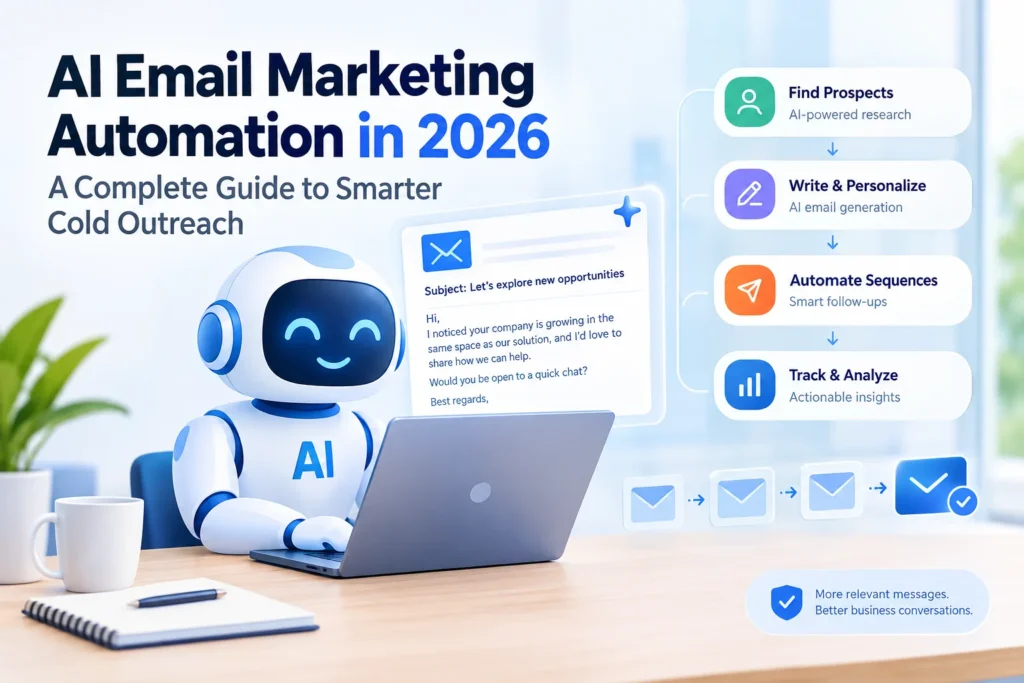
Table of Contents
What Is AI Email Marketing?
AI email marketing is the use of artificial intelligence to support different stages of the email marketing process, including planning, writing, personalization, sending, segmentation, and campaign analysis.
The exact capabilities differ from one platform to another, but AI may assist with:
- Generating or improving email copy
- Producing subject-line variations
- Personalizing messages using approved customer information
- Segmenting contacts into relevant groups
- Suggesting follow-up sequences
- Classifying incoming replies
- Identifying potential leads for human review
- Summarizing campaign performance
- Testing alternative versions of messages
The key word here is assist.
AI works best as an assistant rather than as a substitute for marketing judgment. A sales team, for example, can establish its ideal customer profile, messaging strategy, product positioning, and communication rules. The AI can then transform those guidelines into multiple draft variations, which a team member reviews and adjusts before anything is sent.
That division of responsibility matters. It keeps automation useful without allowing it to become uncontrolled.
Explore our AI Marketing resources. amiinmarketer.com
What Is a Cold Email Automation Platform?
A cold email automation platform typically brings several functions together: email sending, contact management, campaign sequencing, workflow automation, and analytics.
A simplified process might look like this:
Prospect data → qualification → personalization → email → follow-up → reply classification → human response
More advanced platforms may also connect directly with CRM systems and other business applications, allowing information to move between marketing and sales workflows without requiring employees to update every record manually.
Still, not every platform does the same thing.
Some products concentrate on campaign sequencing. Others place greater emphasis on AI writing, prospect research, CRM integration, analytics, or broader workflow automation. That difference is important when comparing tools because the platform with the longest feature list may not necessarily fit the way your team actually works.
Cold Email vs. Email Marketing
Although the terms are often used interchangeably, cold email and traditional email marketing are not identical.
Traditional email marketing generally involves people who have subscribed to a company’s communications or already have some form of customer relationship with the business.
Cold email is different. It typically involves contacting a person or organization that has not previously requested communication from the sender.
That distinction can have legal and operational consequences.
Marketing-email requirements may vary according to the recipient, jurisdiction, type of organization, and relationship between the sender and recipient. In the UK, for example, rules distinguish between individual subscribers and corporate subscribers, while businesses also need to consider applicable data-protection requirements.
Why Businesses Use AI for Cold Email Automation
Cold outreach involves plenty of repetitive work. AI can reduce some of that burden, allowing teams to spend more time on strategy and actual conversations.
1. Faster Drafting
Writing every email from a blank page is slow, particularly when a campaign needs different versions for multiple customer segments.
With AI, marketers can provide approved information about the audience, offer, tone, and campaign objective. The system can then produce an initial draft for a person to review and refine.
The human review remains important. AI-generated copy is a starting point, not an automatic guarantee of accuracy or quality.
2. More Structured Personalization
Personalization is often misunderstood.
It does not simply mean inserting a prospect’s first name into the opening sentence. Meaningful personalization can be based on legitimate business information, such as:
- Industry
- Company size
- Business role
- Product category
- Publicly stated business priorities
- A relevant business event
The goal should be relevance, not the appearance of intimacy.
Accuracy is especially important here. An automated system should never invent information about a prospect simply because doing so makes an email sound more personalized.
A message containing a false assumption can undermine trust faster than a generic message ever could.
3. Automated Follow-Up Workflows
Follow-ups are another area where automation can save substantial time.
A platform can schedule messages according to predefined rules. A straightforward sequence might include:
- Initial introduction
- Follow-up with additional context
- Final message asking whether the subject is relevant
But automation needs an exit strategy.
If someone replies, opts out, or otherwise indicates that they do not want additional messages, the system should stop sending automatically. Continuing to contact someone simply because they remain in a campaign database is a workflow failure, not successful automation.
4. Reply Classification
Some AI systems can categorize incoming replies into groups such as:
- Interested
- Not interested
- Request for more information
- Wrong contact
- Out of office
- Unsubscribe request
- Needs human review
This can make a meaningful difference for sales teams. Rather than manually sorting every response, representatives can focus their attention on conversations that actually require human involvement.
5. Campaign Analysis
AI can also help marketers interpret campaign data, summarize results, and identify patterns that deserve closer examination.
However, one number rarely tells the whole story.
An increase in opens, for instance, does not necessarily mean an increase in qualified conversations or customers. A better assessment considers the broader funnel and connects campaign activity to meaningful business outcomes.
Key Features to Compare in AI Email Marketing Platforms
When evaluating AI email marketing platforms in 2026, do not stop at the presence of an “AI” label.
The more important question is what the system actually lets your team control.
AI Writing and Personalization
Look for platforms that allow you to define parameters such as:
- Brand voice
- Approved claims
- Audience characteristics
- Product information
- Personalization rules
- Words or subjects to avoid
Just as important, the platform should allow people to review and modify AI-generated content before it reaches prospects.
AI that writes quickly is useful. AI that writes quickly while remaining controllable is considerably more useful.
Campaign Sequencing
Campaign controls can have a greater practical impact than flashy copywriting features.
Check whether the platform supports:
- Multiple email steps
- Delays between messages
- Business-hour scheduling
- Reply-based stopping
- Unsubscribe handling
- Manual approval steps
- Campaign pausing
These features determine how much control your team actually has once a campaign is running.
CRM Integration
CRM integration can eliminate duplicate work and help maintain a consistent record of customer interactions.
Before selecting a platform, check whether it connects with the CRM your organization already uses. More importantly, find out exactly what information can move between the systems and in which direction.
An integration that exists on paper but does not support the fields or workflows your team needs may provide little practical value.
Deliverability and Authentication Support
Cold email automation is not simply a matter of sending more messages.
Businesses need to understand domain authentication, sending reputation, bounce management, spam complaints, and recipient engagement.
Google’s current Gmail guidance states that senders sending around 5,000 or more messages to personal Gmail accounts within a 24-hour period are treated as bulk senders and are subject to additional requirements. These include authentication, avoiding unwanted email, and making unsubscribing easy. Google has also stated that enforcement against non-compliant traffic has been increasing.
A platform can provide technical controls and useful safeguards, but it cannot guarantee inbox placement.
Analytics
Useful campaign reporting may include:
- Delivery rate
- Bounce rate
- Reply rate
- Positive-reply rate
- Unsubscribe rate
- Meetings or conversions
- Campaign-level performance
- Performance by audience segment
Be cautious about overvaluing any metric that can be influenced by technical factors.
For many campaigns, replies and meaningful business outcomes provide a more useful signal than opens alone.
Data Controls
If a platform stores prospect information, examine how that data is handled.
Important questions include:
- Where is the data stored?
- How long is it retained?
- Who can access it?
- Can the data be exported?
- How are deletion requests handled?
- Which third-party services receive the information?
These questions become increasingly important when personal information is involved or when a business operates across multiple jurisdictions.
A Practical AI Cold Email Automation Workflow
A responsible cold email system does not need to be complicated. It does, however, need clear rules.
Step 1: Define the Target Audience
Start with a specific customer profile.
Rather than targeting “all small businesses,” establish concrete criteria such as:
- Industry
- Company type
- Geographic market
- Relevant business need
- Appropriate job roles
- Exclusion criteria
More precise targeting can improve relevance without requiring increasingly intrusive personalization.
Step 2: Establish Your Data Rules
Decide what information the AI is permitted to use.
For example, a business might allow the system to reference approved company information and publicly available business information while prohibiting speculation about someone’s personal circumstances.
Clear boundaries reduce the likelihood of inaccurate or inappropriate personalization.
Step 3: Create the Core Message
The initial email should make two things clear: why the recipient is being contacted and what the business is offering.
Avoid unsupported claims such as “this will double your revenue” or “everyone in your industry needs this.”
Simple, defensible messaging is easier to review, easier to maintain, and less likely to create problems when automated across a campaign.
Step 4: Add AI-Assisted Personalization
Give the AI explicit instructions rather than relying on vague commands.
For example:
Mention one relevant business fact from the approved data. Do not invent information. Do not make assumptions about the recipient’s personal situation.
Specific constraints are generally more useful than simply instructing an AI system to “make the email highly personalized.”
Step 5: Create a Small Follow-Up Sequence
More messages do not automatically create better outreach.
A concise sequence may be enough:
Email 1: Introduction and relevance
Email 2: Additional information or useful context
Email 3: Short final follow-up
Again, the workflow should stop when the recipient replies or opts out.
Step 6: Add Human Review
Human approval is particularly valuable for:
- New campaigns
- High-value prospects
- Unusual personalization
- Sensitive industries
- AI-generated claims
- Messages involving legal or regulatory considerations
The principle is simple:
Automation should reduce repetitive work, not remove accountability.
Step 7: Measure Meaningful Outcomes
Evaluate campaigns using several metrics rather than relying on a single headline number.
For example:
Qualified replies ÷ delivered emails × 100
can provide a more useful picture of engagement than simply counting how many messages were sent.
The right metrics ultimately depend on the goals of the business. A campaign designed to generate meetings should not be judged in exactly the same way as one designed to qualify prospects or start longer sales conversations.
How to Choose the Right AI Email Marketing Platform
There is no universal platform that is right for every organization.
Instead, compare potential tools against your actual workflow, team structure, technical environment, and business requirements.
| Requirement | What to look for |
|---|---|
| AI writing | Editable drafts, brand controls, personalization rules |
| Automation | Sequences, delays, conditions, automatic stopping |
| Deliverability | Authentication support, bounce controls, reputation monitoring |
| CRM | Reliable integration with your existing system |
| Analytics | Replies, conversions, bounces, unsubscribes, and campaign trends |
| Compliance | Opt-out handling, data controls, and auditability |
| Team workflow | User permissions, approvals, and collaboration |
| Cost | Transparent pricing and realistic usage limits |
| Integrations | Connections to the tools your team already uses |
| Human oversight | Approval and editing before important messages are sent |
Price deserves context, too.
The cheapest platform may become the more expensive option over time if it forces your team to perform substantial manual work or lacks capabilities that your workflow depends on.
At the same time, a platform with an enormous feature list is not automatically the right fit. More features can mean more complexity, and complexity has a cost of its own.
AI Email Marketing: Benefits and Limitations
AI automation offers real advantages. It also creates new risks.
Understanding both sides is essential before scaling an outreach program.
Potential Benefits
Efficiency: Repetitive drafting, classification, and workflow tasks can be automated.
Consistency: Teams can apply standardized messaging rules across campaigns.
Scalability: A structured workflow can support larger campaigns without requiring every step to be performed manually.
Analysis: AI can summarize campaign data and identify areas that deserve further review.
Personalization assistance: AI can adapt approved messaging for different audience segments.
Important Limitations
AI can be wrong. It may misunderstand source information or generate claims that are not supported by the available data.
Personalization can become artificial. A message may feel less relevant—not more—when personalization is built around weak, irrelevant, or awkward details.
Automation can amplify mistakes. A flawed manually sent message might affect one recipient. Put that same mistake inside an automated sequence, and it can be repeated across an entire campaign.
Deliverability is not guaranteed. Authentication and responsible sending practices can help, but no platform can promise that every message will arrive in the primary inbox.
Compliance remains your responsibility. Connecting a campaign to a third-party automation platform does not automatically make the campaign lawful. The ICO, for example, states that organizations remain responsible for complying with applicable electronic marketing requirements when they use a bulk-email platform.
Compliance and Responsible Cold Email
Cold email rules vary considerably by country, recipient type, and business context.
Before launching a campaign, identify the jurisdictions involved and review the rules that apply to those recipients.
UK Considerations
The UK’s PECR framework distinguishes between different categories of recipients.
For example, corporate subscribers can generally receive B2B electronic marketing without PECR consent, but senders must not disguise their identity and must provide a valid opt-out address. Sole traders and certain partnerships are treated differently.
The ICO also emphasizes that using personal data for direct marketing can introduce additional data-protection obligations.
Bought and Publicly Available Lists
A publicly available email address should not automatically be treated as permission to send marketing messages.
The ICO notes that publicly available contact details do not, by themselves, demonstrate consent for unsolicited electronic marketing to individuals. It also advises organizations to consider the validity and scope of consent when using purchased lists.
The source of an email address therefore matters. So does the legal basis for using it.
Unsubscribe Requests
Every automated campaign needs a dependable process for handling opt-outs.
Once someone has indicated that they do not want further communication, the system should not continue sending simply because that person remains in a CRM record or campaign list.
A reliable suppression or do-not-contact process is one of the basic safeguards of responsible automation.
Common AI Cold Email Mistakes to Avoid
Sending at Maximum Volume
More email is not necessarily better email.
Large sending volumes can increase operational and reputation risks, particularly when messages are poorly targeted or unwanted.
Using AI Without Fact-Checking
Every factual claim generated by AI should be checked before it becomes part of an automated campaign.
A confident sentence can still be completely wrong.
Over-Personalization
Personalization should improve relevance, not demonstrate how much information the system can find.
Mentioning irrelevant details can make a message feel more automated rather than less.
Use personalization when it genuinely helps explain why the message is relevant.
Ignoring Negative Replies
Negative responses are operational signals.
When appropriate, contacts should be removed or suppressed from future outreach rather than repeatedly exposed to the same campaign.
Measuring Only Opens
Open-related metrics can be influenced by technical factors and should not be treated as the sole measure of campaign performance.
Look at replies, qualified conversations, conversions, unsubscribes, and other outcomes that matter to the business.
Treating Compliance as a Platform Feature
A platform can provide tools for managing opt-outs, records, and workflows. It cannot determine every legal obligation that applies to your organization.
Compliance is not something you purchase with a software subscription.
What Should an AI Cold Email System Automate?
A useful principle is:
Automate repetition, not responsibility.
Tasks that are generally well suited to automation include:
- Draft generation
- Basic segmentation
- Workflow scheduling
- Follow-up timing
- Reply classification
- Reporting
- Routine CRM updates
Other tasks often deserve human oversight:
- Defining the target audience
- Approving claims
- Reviewing unusual personalization
- Handling sensitive conversations
- Interpreting legal requirements
- Responding to important prospects
The objective is not to remove people from the process.
It is to remove unnecessary repetition so people can spend their time where judgment, context, and communication actually matter.
Frequently Asked Questions
1. What is AI email marketing?
AI email marketing uses artificial intelligence to assist with tasks such as email drafting, personalization, segmentation, campaign automation, reply classification, and performance analysis. The exact capabilities vary from one platform to another.
2. Can AI completely automate cold email campaigns?
AI can automate many operational tasks, but completely hands-off automation is not always appropriate. Human review can help identify inaccurate claims, poor personalization, compliance concerns, and unusual customer responses before they create larger problems.
3. Does AI guarantee better email deliverability?
No. AI does not guarantee inbox placement.
Deliverability depends on factors such as authentication, sending reputation, recipient engagement, message quality, bounce rates, complaints, and the requirements of individual email providers. Google’s current sender guidance includes additional requirements for bulk senders.
4. Can I use publicly available email addresses for cold outreach?
Not automatically.
Whether an address can lawfully be used for marketing depends on factors including the recipient, jurisdiction, applicable privacy and marketing laws, and how the information was obtained. The ICO, for example, states that publicly available contact information does not by itself establish consent for unsolicited marketing to individuals.
5. What should I look for in an AI cold email platform?
Look at the complete workflow rather than focusing on the AI feature alone.
Consider campaign automation, personalization controls, CRM integration, deliverability support, analytics, opt-out handling, data controls, pricing, integrations, and the ability to keep humans involved in important decisions.
Conclusion
AI email marketing can make cold outreach more organized, scalable, and efficient—but only when it is embedded within a thoughtful process.
The goal should not be to generate the largest possible number of emails. It should be to create a system that combines accurate audience targeting, relevant messaging, sensible automation, reliable data practices, meaningful measurement, and human oversight.
When comparing AI cold email automation platforms in 2026, look beyond the marketing language surrounding their AI capabilities. Examine the workflow itself. Consider integrations, analytics, data controls, sending features, campaign safeguards, and support for responsible email practices.
Most importantly, remember what automation can—and cannot—do.
A well-designed system should make it easier to communicate with appropriate recipients using relevant information. Just as importantly, it should make it equally easy to stop when someone does not want further contact.
That is the difference between automation for its own sake and automation designed to support a responsible, sustainable outreach process.
Learn more about AI Marketing amiinmareting.com