
An effective email marketing funnel does more than deliver promotional messages to an inbox. It creates a purposeful journey, helping potential customers discover your business, understand the value of your offerings, evaluate their options, and eventually make informed purchasing decisions. When designed thoughtfully, this journey can continue long after the first sale, encouraging customer satisfaction, repeat purchases, and lasting relationships.
For small business owners, bloggers, online retailers, service providers, and digital marketers, an email marketing funnel offers a practical way to turn scattered email campaigns into a coordinated marketing strategy. Instead of sending identical messages to every subscriber, you deliver information that reflects people’s interests, questions, and readiness to take action.
But successful email marketing requires more than automation. The real challenge is understanding what your audience needs at each stage and providing the right information without overwhelming readers or pushing them toward a premature decision.
In this guide, you’ll discover what an email marketing funnel is, why it matters, how its stages work, and how to build one step by step. You’ll also learn how to measure performance, avoid common mistakes, and create a funnel that serves both your subscribers and your business.
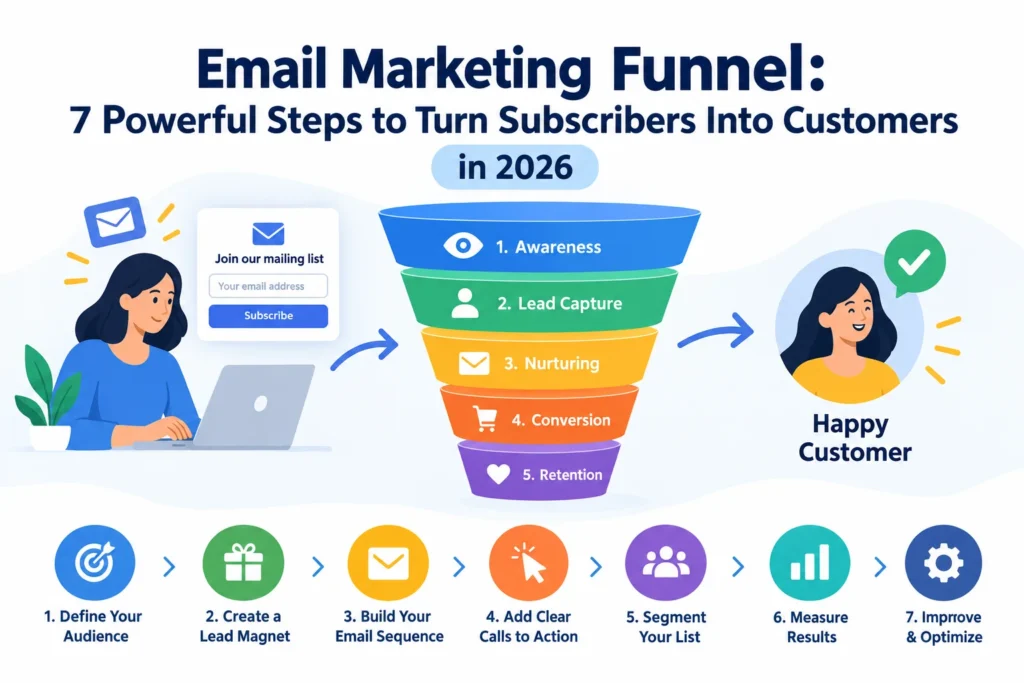
Table of Contents
What Is an Email Marketing Funnel?
An email marketing funnel is a structured sequence of email communications designed to guide potential customers through different stages of their buying journey. These stages typically begin with awareness and interest, progress through education and evaluation, and may ultimately lead to a purchase and an ongoing customer relationship.
Think of it as a guided path rather than a collection of unrelated messages.
A visitor might discover your website through a search engine, subscribe to receive a helpful resource, and begin receiving educational emails. As the relationship develops, you can introduce relevant products or services, answer common questions, and explain how your offering addresses a particular problem. Following a purchase, additional messages can help the customer get started, solve difficulties, or discover useful features.
Every email should have a reason for being sent.
Some messages establish familiarity. Others provide practical knowledge, address objections, or invite subscribers to take a specific action. When the sequence is planned carefully, each communication contributes to a broader objective.
For example, imagine that you run a website teaching entrepreneurs how to improve their email marketing. A visitor arrives after reading an article about writing effective promotional emails and downloads a free campaign-planning checklist.
You could then send a welcome email containing the checklist, followed by a lesson about subject lines, a guide to audience segmentation, and an explanation of email automation. Once the subscriber understands these concepts, you might introduce a relevant marketing tool or service.
The goal isn’t to force every subscriber to purchase immediately. It is to provide useful information, build confidence, and make the next step clear when the reader is ready.
Email Marketing Funnel vs. Sales Funnel
Although the terms are closely related, an email marketing funnel and a sales funnel describe different aspects of the customer journey.
A sales funnel represents the broader process through which someone discovers a business, considers its offerings, and becomes a customer. Depending on the company, this process may involve advertising, website visits, sales conversations, product demonstrations, and checkout.
An email marketing funnel focuses on the role email plays within that larger process.
For instance, a business might attract visitors through search engines, encourage them to subscribe through a website form, nurture their interest with automated emails, and eventually complete sales through an online store.
Email supports the journey, but it isn’t necessarily the only channel involved.
Understanding this distinction helps you build a more realistic strategy. Your emails should work alongside your website, content, advertising, and sales process rather than operate as an isolated marketing activity.
Why Is an Email Marketing Funnel Important?
Without a clear structure, email marketing can become reactive. A business sends a newsletter one week, announces a discount the next, and promotes a new product shortly afterward, without considering whether those messages form a coherent experience.
An email marketing funnel brings direction to that process.
It gives every communication a purpose, creates continuity between messages, and helps subscribers move from curiosity toward informed action. Here are five important benefits.
1. Builds Stronger Relationships With Subscribers
Trust rarely develops through a single message. People often need time to understand a business, evaluate its credibility, and decide whether its products or services deserve their attention.
A well-designed email funnel creates opportunities to build that confidence gradually.
You might share useful tutorials, explain common industry challenges, answer frequently asked questions, or provide honest information about your products. Over time, these communications can demonstrate that your business understands its audience and is willing to offer value beyond a sales pitch.
Small interactions matter. A helpful email delivered at the right moment may be more meaningful than several aggressive promotions sent too soon.
The objective is to establish a relationship based on usefulness and credibility, not simply to accumulate subscribers.
2. Delivers More Relevant Content
Your subscribers are unlikely to share identical goals, experience levels, or purchasing intentions.
A beginner downloading an introductory guide may need simple explanations and practical examples. An experienced marketer, by contrast, might prefer advanced automation strategies, campaign analysis, or detailed comparisons of available tools.
A structured funnel allows you to respond to these differences.
By organizing subscribers according to their interests, signup sources, previous purchases, or other relevant information, you can deliver content that better reflects their needs. This makes your communication more focused and gives readers a stronger reason to engage.
However, segmentation alone does not guarantee better results. The messages must still be useful, accurate, and appropriate for the audience receiving them.
3. Saves Time Through Automation
Email automation allows businesses to send certain messages automatically when subscribers join a list, make a purchase, or complete another predefined action.
For example, a welcome sequence can begin immediately after someone subscribes. A customer who purchases an online course might receive access instructions, while someone requesting a product demonstration could receive relevant follow-up information.
Once configured, these workflows reduce repetitive tasks and help maintain consistent communication, even when a business has limited time or staff.
Still, automation is not a substitute for attention.
Broken links, outdated prices, irrelevant messages, and poorly timed follow-ups can undermine the experience. Review your automated sequences regularly to ensure they remain accurate and useful.
4. Supports Customer Retention and Loyalty
An email marketing funnel should not necessarily end when a customer completes a purchase.
In many businesses, the period immediately after a sale is an opportunity to demonstrate value and strengthen the relationship. Customers may need onboarding instructions, troubleshooting resources, product tutorials, or information about updates.
Consider an online education business. After someone purchases a course, a useful email sequence could explain how to access the lessons, suggest a study schedule, and point learners toward additional resources.
These messages help customers make better use of what they purchased.
When the experience is positive, customers may return for future purchases or recommend the business to others. Such outcomes are not guaranteed, of course, but thoughtful follow-up can create better conditions for lasting relationships.
5. Makes Marketing Performance Easier to Measure
A structured funnel gives you several opportunities to evaluate what is working and where improvements may be needed.
You can measure how many visitors subscribe, how many subscribers click email links, how many people reach a product page, and how many eventually complete a purchase.
Each measurement provides a different perspective.
If many visitors subscribe but few engage with subsequent messages, your welcome email or content strategy may need attention. If readers click through to your sales page but rarely buy, the issue might involve the offer, pricing, product information, or checkout experience.
Rather than guessing, you can use these patterns to guide your decisions.
The 5 Main Stages of an Email Marketing Funnel
Most email marketing funnels can be organized into five stages: awareness, lead capture, lead nurturing, conversion, and retention.
The exact structure depends on your business model, the complexity of your product, the price of your offering, and how much information customers need before making a decision. Nevertheless, these stages provide a useful starting framework.
Stage 1: Awareness
Awareness begins when potential customers discover your business and start learning about the problem you help solve.
They might find you through a search engine, a social media post, an online advertisement, a recommendation, or an educational article. At this point, they may know little about your brand, and purchasing is unlikely to be their immediate priority.
Your task is to attract the right audience and provide a compelling reason to explore your content.
Example: A small business owner searches online for ways to improve customer communication and discovers your article about email marketing strategies.
Rather than immediately promoting a paid service, you could offer a practical tutorial or checklist that addresses the reader’s problem.
The distinction is important. Helpful information creates an opportunity to establish trust, whereas an aggressive sales message may arrive before the audience understands who you are or why your business matters.
Stage 2: Lead Capture
Lead capture occurs when a visitor voluntarily provides an email address, usually to receive a resource, newsletter, or other information they have requested.
The resource offered in exchange for subscribing is often called a lead magnet.
Common examples include:
- Free checklists and downloadable templates
- Beginner-friendly guides and educational resources
- Email courses and practical tutorials
- Webinars or product demonstrations
- Industry newsletters and relevant updates
The strongest lead magnets solve a specific problem for a clearly defined audience. They don’t have to be lengthy or elaborate; they simply need to deliver a benefit that matters to the person receiving them.
For example, a remote-work blog might offer a job application checklist, while a digital marketing website could provide an email campaign planning template.
Make the signup process transparent. Explain what subscribers will receive, set reasonable expectations for future emails, obtain the consent required for your communications, and provide an accessible way to unsubscribe.
Stage 3: Lead Nurturing
Lead nurturing is the process of helping subscribers understand their options, learn about possible solutions, and make informed decisions.
Interest does not always translate into immediate purchasing intent. Someone may recognize a problem but still need to compare alternatives, understand pricing, or determine whether a particular product is suitable.
This is where useful educational communication becomes especially valuable.
Nurturing emails may include:
- Educational lessons and practical guidance
- Examples showing how a process works
- Answers to common customer questions
- Comparisons of different solutions
- Product demonstrations and tutorials
- Clear explanations of pricing, features, and limitations
Example: After downloading an email marketing checklist, a subscriber receives a welcome message, a guide to writing stronger subject lines, a lesson about audience segmentation, and an introduction to email automation.
Each message builds on the previous one, helping the subscriber develop a clearer understanding of the subject.
Avoid artificial urgency, exaggerated promises, and incomplete product information. The purpose of nurturing is to support informed decisions, not manipulate people into buying something they don’t need.
Stage 4: Conversion
The conversion stage encourages subscribers to take a meaningful action. Depending on your business, that action might be purchasing a product, booking a consultation, requesting a quotation, or starting a free trial.
The appropriate approach depends on the offering and the amount of consideration required before buying.
Someone interested in an inexpensive digital template may be comfortable making a purchase after reading a few helpful emails. A business evaluating expensive software, however, may need detailed comparisons, technical explanations, demonstrations, and answers to specific questions.
A useful conversion email should explain:
- What the product or service does
- Who is most likely to benefit from it
- Which problem it helps address
- What the customer receives
- The price and relevant purchase conditions, where appropriate
- The next action the reader can take
Clarity matters more than complexity. A focused call to action often works better than several competing links that leave the reader uncertain about what to do.
Stage 5: Retention and Loyalty
Once a subscriber becomes a customer, the objective changes. Instead of concentrating primarily on the initial purchase, your communication should help the customer receive value from that decision.
Post-purchase emails might include receipts, setup instructions, tutorials, customer support information, and relevant product updates.
For example, someone purchasing an online course could receive a welcome message, instructions for accessing the lessons, suggestions for organizing their study time, and information about additional learning resources.
These messages demonstrate that the relationship does not end at checkout.
When customers feel supported and can use a product successfully, they may be more inclined to purchase again or recommend the business to others. Continue listening to feedback, though; customer loyalty develops through the quality of the overall experience, not email frequency alone.
How to Build an Email Marketing Funnel Step by Step
Understanding the theory is useful, but a working funnel requires a practical plan. The following steps will help you develop a manageable system without introducing unnecessary complexity at the beginning.
Step 1: Define Your Target Audience
Before writing a single email, determine who you want to reach.
Consider the audience’s goals, common frustrations, experience level, questions, and reasons for considering your product or service. These details influence everything from the lead magnet you create to the language you use in your messages.
Avoid defining your audience so broadly that your content becomes generic.
For example, rather than targeting everyone interested in marketing, you could focus on small business owners who want to build their first email newsletter.
That distinction gives you a clearer direction. You can discuss beginner-friendly tools, subscriber signup forms, introductory campaign ideas, and common mistakes that new email marketers encounter.
A well-defined audience makes it easier to create content that feels relevant rather than interchangeable.
Step 2: Set a Clear Funnel Goal
Decide what you want your email marketing funnel to accomplish.
Possible objectives include:
- Growing a relevant email subscriber list
- Selling a digital product
- Generating qualified leads
- Booking consultations
- Encouraging free-trial registrations
- Helping new customers use a product successfully
Choose one primary objective for each funnel. Although a business may have several broader marketing goals, asking one email sequence to achieve too many things can make its messages unfocused.
Your objective should also be measurable.
For example, you might track the percentage of new subscribers who eventually purchase an introductory product, or measure how many qualified subscribers book a consultation after receiving a particular sequence.
A clear goal gives you a standard against which to evaluate performance.
Step 3: Create a Valuable Lead Magnet
A lead magnet is a resource offered to encourage relevant visitors to subscribe to your email list.
Its value depends less on its length than on its usefulness. A concise checklist that helps someone complete a task may be considerably more helpful than a long guide filled with general advice.
Start with a problem your audience wants to solve, then create a resource that addresses it directly.
Here are a few examples:
| Business type | Lead magnet idea |
|---|---|
| Marketing blog | Email campaign checklist |
| Fitness website | Beginner workout planner |
| Online education business | Free introductory lesson |
| Business consultant | Project planning template |
| E-commerce store | Product selection guide |
The promise should match the resource. If your signup page advertises a comprehensive course, subscribers should not receive only a brief PDF with a few introductory tips.
Deliver what you offer. That first interaction helps establish the expectations for every email that follows.
Step 4: Choose an Email Marketing Platform
An email marketing platform provides the tools needed to collect subscribers, manage contact lists, send campaigns, and automate communications.
The best option depends on your current requirements, technical comfort, audience size, and budget.
When comparing platforms, consider these features:
- Email automation and scheduling
- Signup forms and landing pages
- Audience segmentation
- Campaign reporting and analytics
- Integration with your website or online store
- Subscriber management and unsubscribe functionality
- Pricing, subscriber limits, and sending allowances
Some platforms offer free plans with restrictions, while others charge according to subscriber numbers, sending volume, or available features.
Review the provider’s official website for current prices, plan limitations, and relevant compliance tools before making a decision.
You do not need an expensive platform to build your first funnel. Start with the capabilities required for your initial sequence, learn how your audience responds, and upgrade when your needs justify the additional expense.
Step 5: Write a Welcome Email
Your welcome email is often the first direct communication a new subscriber receives from your business. It sets expectations and creates an early impression of your brand.
A strong welcome email should confirm the subscription, deliver the promised resource, explain what future messages may contain, and provide a simple next step.
Here is an example.
Subject: Your Email Campaign Checklist Is Here
Message:
Hello,
Thank you for subscribing! You can access your email campaign checklist using the link below.
Over the next few emails, I’ll share practical tips for planning campaigns, writing useful messages, and organizing your email list.
To get started, download the checklist and choose one improvement you can make to your next campaign.
Best regards,
The Team
Notice what the message does. It delivers the promised resource, explains what subscribers can expect, and encourages a small, relevant action without immediately demanding a purchase.
That is a useful foundation for a longer relationship.
Step 6: Build a Short Email Sequence
After preparing your welcome email, decide which messages should follow and what each one needs to accomplish.
For a straightforward funnel, four to six emails may provide a reasonable starting point. More complex products or purchasing decisions may require a longer educational process.
The right length depends on your audience, offer, and the amount of information subscribers need before taking action.
Here is an illustrative five-email sequence:
| Suggested timing | Main purpose | |
|---|---|---|
| 1. Welcome | Immediately | Deliver the resource and establish expectations |
| 2. Education | 2 days later | Help solve a common problem |
| 3. Practical guidance | 4 days later | Share a useful method or example |
| 4. Solution overview | 6 days later | Explain a relevant product or service |
| 5. Invitation | 8 days later | Present a clear next step |
These timings are examples, not universal rules. Some audiences prefer frequent communication, while others need more time between messages. Adjust the schedule according to subscriber expectations, engagement patterns, and the nature of your offer.
Most importantly, give every email a distinct purpose. Repeating the same sales pitch in slightly different words adds little value and can quickly weaken interest.
Step 7: Add Relevant Calls to Action
A call to action, commonly abbreviated as CTA, tells readers what they can do next.
Depending on the message, it might invite them to:
- Download a guide
- Read a tutorial
- Compare available plans
- View a product demonstration
- Book a consultation
- Complete a purchase
The CTA should fit the email’s purpose. An educational message may lead to a detailed tutorial, whereas a product-focused email might invite readers to review features, pricing, or available options.
Make the next step obvious. If every paragraph contains a different request, readers may struggle to identify the most important action.
Check your links before sending campaigns, too. Each link should work correctly and lead to the page described in the message. Misleading buttons, confusing navigation, and disguised destinations can damage trust.
Step 8: Segment Your Audience
Audience segmentation means dividing subscribers into groups based on relevant characteristics, interests, or behavior.
Depending on your business and the information you appropriately collect, you might organize subscribers by:
- Topic of interest
- Signup source
- Previous purchases
- Product preferences
- Stage in the buying journey
- Recent email engagement
For example, someone who subscribes for beginner email marketing advice might receive introductory lessons, while an existing customer could receive advanced tutorials and product support.
The purpose is straightforward: make communication more relevant.
However, segmentation should not become an excuse for unnecessary tracking or intrusive personalization. Collect only the information you need, explain your practices clearly, and respect the privacy requirements that apply to your business.
Step 9: Test and Improve the Funnel
Launching your funnel is the beginning of the learning process, not the end of it.
Review performance regularly and look for patterns across the customer journey. If many people subscribe but few engage with the emails, examine the welcome message, content relevance, and expectations established on the signup page.
If subscribers click through to your product page but rarely complete a purchase, investigate the clarity of the offer, the pricing, the product’s suitability, and the checkout experience.
Where practical, change one important element at a time. This makes it easier to understand which changes may have contributed to a different outcome.
And remember: a disappointing result does not automatically mean you need to send more emails. A shorter sequence, clearer message, stronger lead magnet, or simpler signup experience may be the better solution.
Email Marketing Funnel Example for a Small Business
Consider a small business that sells downloadable marketing templates. Its objective is to turn interested website visitors into customers while offering useful guidance before asking for a purchase.
The funnel could work like this:
1. Attract visitors. Publish educational articles about campaign planning, email copywriting, and common marketing challenges.
2. Offer a free resource. Invite readers to download a campaign-planning checklist in exchange for subscribing.
3. Welcome new subscribers. Deliver the checklist immediately and explain what future emails will cover.
4. Provide educational content. Share practical lessons about campaign objectives, audience segmentation, and writing clear calls to action.
5. Introduce a relevant product. Explain how a paid collection of marketing templates can help subscribers organize their work and save time.
6. Invite a purchase. Direct interested readers to a product page containing clear descriptions, accurate pricing, and transparent purchase terms.
7. Support customers. After a purchase, send access instructions and guidance on using the templates effectively.
Each stage serves a different purpose. The free resource attracts relevant readers, the educational sequence develops understanding, and the product offer provides a logical next step for subscribers who need that solution.
Not everyone will purchase. That is normal.
A funnel is not a guarantee of sales; it is a structured way to deliver information, identify opportunities, and measure how people respond. Its effectiveness improves when you use those observations to refine the experience.
How to Measure Email Marketing Funnel Performance
You cannot improve a funnel consistently without understanding its performance. Fortunately, you do not need dozens of complicated metrics to begin.
Start with a handful of measurements that correspond to your objectives, then examine them together rather than interpreting every number in isolation.
1. Signup Conversion Rate
The signup conversion rate measures the proportion of visitors to a signup page who subscribe.
Formula:
Signup conversion rate = (Number of new subscribers ÷ Number of visitors to the signup page) × 100
For example, suppose 500 people visit your signup page and 25 subscribe.
The calculation is:
(25 ÷ 500) × 100 = 5%
Your signup conversion rate is therefore 5%.
Use a consistent definition of visitors and subscriptions when comparing results across different periods or campaigns. Otherwise, the figures may not be directly comparable.
2. Email Click-Through Rate
Click-through rate measures how frequently recipients click links within an email. Email platforms may calculate this metric differently, so check how your provider defines it.
Formula:
Click-through rate = (Unique email clicks ÷ Delivered emails) × 100
Suppose an email reaches 400 recipients and 20 unique recipients click a link.
(20 ÷ 400) × 100 = 5%
The click-through rate is 5% under this definition.
Clicks can indicate interest in the content or destination, but they do not necessarily mean someone is ready to buy. Review the landing page experience and subsequent actions to understand what happens after the click.
3. Conversion Rate
Conversion rate measures how many people complete the action your funnel is designed to encourage.
That action might be a purchase, consultation booking, free-trial registration, or another measurable outcome.
The calculation depends on what you are evaluating. You might measure purchases among all email recipients, subscribers who visited a sales page, or people who clicked a particular link.
Define the denominator clearly before comparing campaigns. A conversion rate based on all subscribers tells a different story from one calculated using only people who reached the checkout page.
Consistent definitions make your analysis more meaningful.
4. Unsubscribe Rate
The unsubscribe rate measures the proportion of recipients who opt out of an email list or campaign.
An increase can signal several possible problems. Subscribers may be receiving messages too frequently, the content may not match their expectations, or the signup process may have created an inaccurate impression of what they would receive.
However, a single change does not necessarily reveal the cause.
Examine unsubscribe trends alongside email frequency, message content, signup sources, and audience segments. Use the findings to make thoughtful adjustments rather than assuming every unsubscribe reflects a problem with the entire funnel.
5. Revenue and Customer Value
If your funnel is designed to generate sales, track the purchases attributed to email campaigns and compare the resulting revenue with relevant marketing costs.
This helps you evaluate whether the funnel contributes to your business objectives, not merely whether subscribers interact with individual messages.
Attribution can be complicated. A customer might discover your brand through a search engine, return after seeing a social media post, and finally purchase through an email link. Different reporting systems may assign credit differently.
Acknowledge these limitations when interpreting the numbers.
Most importantly, do not judge your funnel solely by email opens or clicks. Revenue, customer satisfaction, retention, and the quality of the subscriber experience also matter.
Common Email Marketing Funnel Mistakes to Avoid
Even a carefully planned funnel can underperform when its messages fail to meet subscriber expectations. Recognizing common mistakes early can help you build a more useful and sustainable email strategy.
Sending Too Many Emails
Frequent communication can become exhausting, particularly when messages repeat the same offers or arrive without a clear purpose.
Establish a reasonable schedule, explain what subscribers should expect, and adjust your frequency according to audience preferences and engagement. More emails do not automatically produce better results.
Making Every Email a Sales Pitch
Subscribers may lose interest when every message asks them to purchase something.
Promotional emails have a legitimate role, but they should sit alongside educational content, practical advice, product support, and answers to genuine customer questions. Give readers reasons to stay subscribed even when they are not ready to buy.
Using an Unclear Signup Offer
A visitor should understand exactly what they will receive and why it may be useful.
Vague promises and exaggerated headlines can attract subscriptions initially, but they may also create disappointment when the promised resource arrives. Describe the offer accurately, deliver it promptly, and ensure future communications match the expectations established at signup.
Ignoring Mobile Readers
Many people read emails on mobile devices, where complicated layouts, tiny links, and long blocks of text can become difficult to navigate.
Keep the design straightforward. Use readable text, clear headings, and links that are easy to tap. Test important messages on different screen sizes before sending them to your audience.
A useful email should remain useful regardless of the device a subscriber uses.
Neglecting Email Deliverability
Email deliverability concerns whether your messages reach recipients’ inboxes rather than being rejected, blocked, or filtered as spam.
Use legitimate subscription practices, maintain accurate contact lists, remove invalid addresses when appropriate, and follow your email provider’s authentication and sending recommendations.
Avoid purchasing email lists or sending unsolicited campaigns. These practices can damage trust, create compliance risks, and harm your ability to reach subscribers.
Google’s official email sender guidelines
Forgetting Privacy and Consent
Email marketing requirements vary by country and circumstance. Depending on the applicable law, you may need consent or another valid legal basis for processing personal information and sending particular types of marketing messages.
Use clear signup language, provide an accessible unsubscribe option, and follow the requirements relevant to your audience and business.
When the applicable rules are unclear, consult official regulatory guidance or a qualified professional rather than assuming one approach works everywhere.
Forgetting Privacy and Consent
Best Practices for a More Effective Email Marketing Funnel
A successful funnel does not have to be complicated. In many cases, consistent execution of a few fundamental principles is more valuable than adding layers of automation before you understand your audience.
Match content to subscriber intent. Someone requesting a beginner’s guide should receive useful introductory information before being presented with advanced product offers.
Write clear subject lines. Tell readers what a message contains without misleading them, exaggerating its importance, or creating false expectations.
Deliver what you promise. If subscribers sign up for a template, provide it promptly and make it easy to access.
Make emails easy to scan. Use descriptive headings, concise paragraphs, meaningful links, and a primary call to action when appropriate.
Keep your list healthy. Monitor invalid addresses, unsubscribes, complaints, and engagement patterns. Respect opt-outs and avoid sending unwanted marketing messages.
Review automation regularly. Check that your messages, links, prices, product details, and instructions remain accurate as your business changes.
Respect your audience. Avoid fabricated deadlines, false scarcity, hidden conditions, and pressure tactics that interfere with informed decisions.
Measure the entire journey. Look beyond individual emails to determine whether your funnel attracts relevant subscribers, provides a positive experience, and contributes to your business goals.
These practices reinforce one another. Clear expectations attract more suitable subscribers, relevant messages give them reasons to remain engaged, and meaningful measurement helps you identify where the experience can improve.
Frequently Asked Questions
1. What is an email marketing funnel?
An email marketing funnel is a planned series of email communications that guides subscribers through stages such as discovering a business, learning about a solution, evaluating an offer, making a purchase, and receiving ongoing customer support.
Each message serves a particular purpose within the broader customer journey.
2. How many emails should an email marketing funnel have?
There is no fixed number suitable for every business. A simple funnel might begin with four to six emails, while a complex product or high-value service may require a longer educational sequence.
The appropriate length depends on your audience, the complexity of your offer, and the information customers need before making a decision. Prioritize usefulness over volume.
3. Can beginners create an email marketing funnel?
Yes. Beginners can start with a signup form, a useful free resource, a welcome email, a short educational sequence, and a relevant offer.
As the audience grows and the business gains experience, it can introduce segmentation, additional automation, and more detailed performance tracking. Start with a manageable system, then expand when the need becomes clear.
4. What is the difference between an email marketing funnel and an email sequence?
An email sequence is a series of messages delivered according to a schedule or a particular trigger. An email marketing funnel is the broader strategy that connects email communications to stages of the customer journey.
A welcome sequence, for example, can form one part of a larger funnel that begins with a website visit and continues through purchase and customer retention.
5. How long does it take for an email marketing funnel to produce results?
The timeline varies according to audience quality, website traffic, email content, product price, and the complexity of the buying process.
Some subscribers may purchase quickly, while others need more time or may never become customers. Monitor performance over a meaningful period, evaluate the quality of engagement, and make improvements based on evidence rather than expecting immediate results.
Conclusion
An email marketing funnel provides a structured way to turn individual email campaigns into a more coherent customer journey. By understanding your audience, offering a genuinely useful signup resource, sharing relevant educational content, and presenting appropriate offers, you can create a better experience for subscribers while supporting your business objectives.
The process does not need to begin with sophisticated technology or a lengthy sequence of automated messages. Start with a clear goal, a focused audience, and a simple plan. Make each email useful. Track the results. Improve the parts of the journey that create friction or fail to meet expectations.
As your business develops, you can introduce more advanced segmentation, additional automation, and deeper reporting. Let your audience’s needs and your actual results guide those decisions.
Ultimately, the strongest email marketing funnel is not the one that sends the most messages or pushes subscribers toward a purchase as quickly as possible. It is the one that delivers relevant information at the right stage, respects the reader’s choices, and makes the next step clear.
Looking for the right marketing tools? Explore expert reviews, comparisons, and guides at AmiinMarketer.com