
For a small business, attracting new customers is only one piece of the puzzle. The bigger challenge often comes afterward: staying connected with those who have already discovered the business, shown interest, or made a purchase. Email marketing for small business offers a practical way to maintain that connection, deliver useful information, promote relevant products or services, and gradually build stronger customer relationships.
Unlike social media, where visibility can be affected by changing algorithms, platform policies, and shifting audience behavior, an email list gives a business a direct communication channel with people who have voluntarily chosen to receive messages. That distinction matters.
And no, effective email marketing does not require a huge team, complicated funnels, or an endless stream of campaigns. A small business can begin with something remarkably simple: a clear signup form, a useful welcome message, and a realistic publishing schedule.
This guide explains how small businesses can build an email list, create valuable campaigns, segment subscribers, automate repetitive communication, measure performance, and avoid the mistakes that can undermine an otherwise promising strategy.
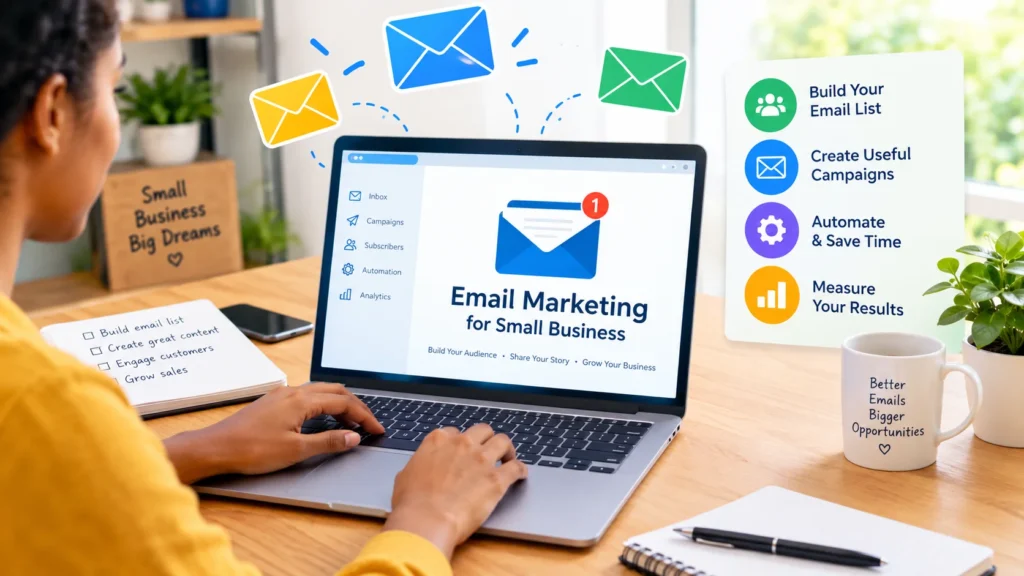
Table of Contents
What Is Email Marketing for Small Business?
Email marketing is the process of communicating with customers or subscribers through email. Depending on the business, those messages might include newsletters, product announcements, educational content, special offers, appointment reminders, company updates, or other information that is relevant to the recipient.
For a small business, one of the biggest advantages is flexibility. You can start small.
There is no requirement to launch dozens of campaigns or hire a dedicated marketing department. A basic system might consist of a signup form, a welcome email, and a newsletter sent on a schedule the business can realistically maintain.
The central principle is relevance.
People are generally more likely to remain subscribed when the emails they receive are useful, expected, and connected to their interests. Sending more messages is not necessarily better. Sending better messages is.
Why Email Marketing Can Be Valuable for Small Businesses
Small businesses frequently operate with limited budgets, staff, and time. Every marketing activity therefore needs to justify the effort required to maintain it.
Email marketing can support several important business objectives.
1. Stay Connected With Customers
Someone might visit your website today, browse several products, and leave without buying anything. That does not necessarily mean the relationship is over.
If that visitor voluntarily joins your email list, you have another opportunity to remain connected and provide useful information over time.
For example, a small online clothing store might send subscribers:
- New product announcements
- Seasonal shopping guides
- Clothing-care tips
- Styling suggestions
- Occasional promotions
The objective is not to fill someone’s inbox simply because you can.
Instead, give subscribers a reason to keep paying attention.
2. Build Customer Relationships
Effective email marketing is about more than making sales.
Useful educational content, thoughtful recommendations, company updates, and answers to common customer questions can make an email feel genuinely helpful rather than purely promotional.
Over time, consistent communication can help customers understand what your business does, what makes its products or services useful, and when your business may be relevant to their needs.
Trust rarely appears after one email. It develops through repeated, worthwhile interactions.
3. Encourage Repeat Business
For many businesses, the first purchase is not the end goal. Customers may return for another product, another booking, another appointment, or another service.
Email can help maintain that relationship.
A restaurant, for example, could send a monthly newsletter featuring new menu items, upcoming events, or useful announcements. A service company might send seasonal maintenance reminders or practical advice related to the service it provides.
The message should reflect the customer’s relationship with the business.
Someone who has never purchased from you may need a different message from someone who has already bought from you several times.
4. Communicate Directly
Email provides a direct communication channel with subscribers instead of requiring a business to depend entirely on public social media posts.
That does not mean every email will be opened, read, or acted upon. Results can be influenced by subject lines, timing, message quality, audience relevance, subscriber expectations, and many other factors.
Still, email gives businesses a useful communication channel that can be developed over time.
How to Build an Email List
A strong email strategy begins with the right audience.
That means building a list of people who have willingly chosen to receive communication from your business. Buying random email lists may seem like a shortcut, but it can create problems with trust, relevance, deliverability, and compliance.
Instead, create legitimate opportunities for interested people to subscribe.
Create a Clear Signup Form
Your signup form should make the value of subscribing obvious.
Tell visitors what they can expect instead of simply asking for their email address.
For example:
Get practical small-business tips, useful resources, and occasional updates delivered to your inbox.
Keep the form simple. Depending on your needs, an email address may be enough. You might also request a first name if personalization is genuinely useful.
The fewer unnecessary fields you include, the easier the signup process can be.
Offer Something Useful
A useful signup incentive can give visitors an immediate reason to join your list.
Possible incentives include:
- A practical checklist
- A short guide
- A downloadable template
- A discount, where appropriate
- Educational tips
- Access to a helpful resource
The important word is useful.
A lead magnet should provide genuine value rather than exist solely as a mechanism for collecting email addresses. If the promised resource is weak or irrelevant, the subscriber may lose trust before your relationship has even started.
Add Signup Opportunities in Relevant Places
Consider adding email signup opportunities to appropriate locations, including:
- Your website
- Blog articles
- Checkout pages
- Resource pages
- Event registration pages
- Social media profiles
However, resist the temptation to place intrusive forms everywhere.
A good signup experience should be visible enough to discover without making the website uncomfortable or difficult to use.
Start With a Simple Email Marketing Strategy
You do not need to construct a complicated marketing funnel on day one.
In fact, starting with a smaller system can make it easier to understand what works.
A practical strategy can be built around four stages.
Step 1: Define Your Goal
Before writing an email, decide what you want the campaign to accomplish.
Your objective might be to:
- Generate sales
- Encourage repeat purchases
- Promote bookings
- Share educational content
- Introduce new products
- Bring visitors back to your website
- Strengthen customer relationships
One campaign can have several positive effects, but choosing one primary objective makes the email easier to write and the results easier to evaluate.
Step 2: Understand Your Audience
Think carefully about the people receiving your messages.
What problems are they trying to solve? What questions do they commonly ask? Which products or services are most relevant to them?
Consider a local fitness equipment store. Its subscribers might include complete beginners, experienced athletes, and business customers. They may all be interested in fitness equipment, but their needs are hardly identical.
That is where segmentation becomes valuable.
Step 3: Create Useful Content
Every email should have a reason to exist.
Instead of asking:
“What can we sell this week?”
ask:
“What would genuinely help this subscriber?”
The answer could be an educational article, product explanation, tutorial, recommendation, announcement, useful resource, or carefully selected offer.
When the content begins with the subscriber’s needs rather than the business’s desire to sell, the communication often becomes more useful and more natural.
Step 4: Measure and Improve
Once campaigns have been sent, review the performance information available to you.
Useful metrics can include:
- Delivery rate
- Open rate
- Click-through rate
- Conversion rate
- Unsubscribe rate
- Revenue or leads attributed to a campaign, when measurable
Do not make sweeping conclusions from a single email.
One campaign can perform unusually well—or unusually poorly—for many reasons. Look for patterns over time, then use those patterns to improve future campaigns.
Email Types Every Small Business Can Consider
Different email formats serve different purposes. The right combination depends on your audience and business model.
Welcome Emails
A welcome email is typically sent after someone subscribes.
It can introduce the business, explain what the subscriber can expect, and guide them toward a useful resource or next step.
A simple structure could look like this:
Welcome → Explain what they will receive → Provide something useful → Suggest a next step
Keep it straightforward.
A welcome email does not need to become a lengthy autobiography about the company. Its job is to establish expectations and begin the relationship well.
Newsletters
A newsletter can contain regular updates, educational information, recommendations, company news, or other relevant material.
For some businesses, a monthly newsletter may be sufficient. Others may have enough useful material to communicate more frequently.
There is no universal schedule.
Consistency is more important than sending an email merely because the calendar says you should.
Promotional Emails
Promotional emails can highlight products, services, discounts, seasonal offers, or other commercial opportunities.
The key is relevance.
If every email feels like another sales pitch, subscribers may gradually stop paying attention. Promotional messages generally work better when they fit the subscriber’s interests and expectations.
Educational Emails
Educational content can position a business as a useful source of information rather than simply another company asking for a purchase.
For example, a home-improvement company might send:
- Maintenance tips
- Project-planning advice
- Common mistakes to avoid
- Product comparisons
- Seasonal preparation ideas
The content should reflect what the audience actually needs.
Useful education creates value before a sale ever happens.
Customer Follow-Up Emails
Follow-up messages can be useful after purchases, bookings, downloads, or other customer interactions.
A business might send:
- Instructions
- Helpful resources
- Feedback requests
- Related recommendations
- Next-step information
Because these messages often follow predictable actions, they can also be good candidates for automation.
That can reduce repetitive manual work.
Email Segmentation: Send More Relevant Messages
Segmentation means dividing subscribers into groups according to useful characteristics or behaviors.
Depending on the business, subscribers could be grouped by:
- Customer status
- Product interest
- Location
- Previous purchases
- Signup source
- Engagement
- Business versus individual customers
Imagine a small software company offering both a basic product and advanced features. Subscribers interested in the basic product may not need the same content as customers exploring advanced functionality.
Rather than sending everyone the exact same message, the company can create communication that better matches each group’s interests.
That said, segmentation can become unnecessarily complicated.
A very small business may be better served by starting with one or two meaningful segments rather than creating dozens of tiny groups that are difficult to manage.
Email Automation Can Help You Scale
As a business grows, automation can make email marketing significantly easier to manage.
An automated sequence can send predetermined messages when a subscriber takes a particular action or reaches a certain stage in the customer journey.
For example, a basic welcome sequence might look like this:
- Email 1: Welcome and introduction
- Email 2: Helpful resource or educational content
- Email 3: Explanation of products or services
- Email 4: Frequently asked questions
- Email 5: Relevant offer or next step
The exact sequence should depend on the business, audience, and purpose.
Automation is useful, but it should never mean “set it and forget it.”
Review automated emails periodically. Check the links. Confirm that offers are still available. Make sure product information, branding, and other details remain accurate.
An automated mistake can repeat itself many times.
How Often Should a Small Business Send Emails?
There is no universal frequency that works for every business.
A local service company may communicate very differently from an online retailer, software company, consultant, or restaurant.
A practical starting point might include:
- Welcome emails when someone subscribes
- Occasional educational content
- Relevant promotional emails
- Important customer updates when necessary
If you genuinely have something useful to share every week, weekly communication may make sense.
If your audience expects fewer updates, a monthly newsletter may be more appropriate.
The important question is not:
“How often can we send?”
Ask instead:
“How often can we provide something worth opening?”
That small change in perspective can improve the quality of an entire email strategy.
How to Write Better Marketing Emails
A professional marketing email does not have to be visually complicated.
In many cases, clarity beats decoration.
Write Clear Subject Lines
Your subject line should accurately represent what the email contains.
Avoid misleading clickbait. A straightforward subject line establishes a better expectation and can help maintain trust with subscribers.
The promise in the subject line should match the experience inside the email.
Keep One Main Idea
An email containing ten unrelated messages can quickly become difficult to follow.
Instead, choose one primary objective and organize the message around it.
If you need to communicate several things, consider whether they can be prioritized or separated into future emails.
Focus creates clarity.
Make the Email Easy to Scan
Use:
- Short paragraphs
- Descriptive headings
- Bullets where appropriate
- Clear calls to action
- Plenty of readable spacing
Many people do not read marketing emails word for word. They scan them.
Good formatting makes the most important information easier to find.
Include a Clear Call to Action
Tell the reader what you would like them to do next.
Examples include:
- Read the guide
- View the product
- Book an appointment
- Download the checklist
- Contact the business
- Learn more
A single, clear next step is often easier to understand than several competing instructions.
Common Email Marketing Mistakes to Avoid
Even a simple email strategy can struggle when fundamental mistakes are overlooked.
Buying Email Lists
Purchased lists can contain people who never agreed to receive communication from your business.
That can damage trust and create deliverability and compliance problems.
Build your audience through legitimate opt-in methods instead.
It may take longer, but the quality of the audience matters far more than simply having a large number of addresses.
Sending Too Many Emails
More emails do not automatically produce better results.
If subscribers begin feeling overwhelmed, they may ignore your messages, unsubscribe, or stop engaging altogether.
Every email should earn its place in the inbox.
Making Every Email a Sales Pitch
Customers may want information, education, useful resources, and practical recommendations—not an endless series of promotions.
Balance commercial messages with content that provides genuine value.
Selling is part of marketing. It should not become the entire relationship.
Ignoring Mobile Readers
Many people read email on smartphones.
Your messages should therefore remain easy to read on smaller screens.
Use readable text, clear buttons, simple layouts, and images that support rather than interfere with the message.
Before sending an important campaign, check how it looks on mobile as well as desktop.
Forgetting to Clean Your List
Email lists naturally change over time.
Some subscribers become inactive. Some email addresses stop working. Others may no longer be interested in your content.
Regularly reviewing your list can help maintain its quality. Depending on your email platform and strategy, you might run a re-engagement campaign or remove addresses according to your policies and applicable requirements.
A smaller, engaged audience can be more valuable than a large list filled with inactive contacts.
Email Marketing vs. Social Media
Email and social media can both play important roles, but they operate differently.
| Email Marketing | Social Media |
|---|---|
| Direct communication with subscribers | Public or platform-mediated communication |
| Requires people to subscribe | Can reach followers and new audiences |
| Useful for newsletters and automated sequences | Useful for discovery and community engagement |
| Provides more control over message format | Depends heavily on platform features and algorithms |
| Can support personalized segmentation | Often focuses on public engagement |
This does not need to be an either-or decision.
A small business can use social media to attract attention, introduce its brand, and reach new audiences, while using email to maintain communication with people who have voluntarily subscribed.
The two channels can complement each other.
A Simple 30-Day Email Marketing Plan
If you are starting from scratch, resist the urge to build everything at once.
A smaller plan is easier to launch, measure, and improve.
Week 1: Set Up
During the first week:
- Define your primary goal
- Choose an email marketing platform
- Create a signup form
- Write your basic welcome email
- Establish your privacy and subscription practices
The goal is to create a functional foundation, not a perfect marketing machine.
Week 2: Create Content
Prepare two or three useful emails.
For example:
- A welcome message
- An educational article
- A useful tip or resource
Think about what your subscribers would genuinely appreciate receiving.
Week 3: Start Building Your List
Add signup opportunities to appropriate areas of your website and other relevant channels.
Explain clearly what subscribers will receive.
People should not have to guess what they are signing up for.
Week 4: Review the Results
At the end of the month, examine the campaign data available to you.
Ask:
- Which emails received the most engagement?
- Which links were clicked?
- Did people unsubscribe?
- Which topics generated interest?
- What should be improved in the next campaign?
Then use those observations to refine the following month’s content.
Progress comes from repetition and learning—not from expecting the first campaign to be perfect.
Costs and Limitations to Consider
Email marketing can be affordable, but it is not completely free of cost or effort.
Depending on the platform and size of your subscriber list, expenses may involve:
- Email software
- Subscriber volume
- Advanced automation
- Templates or design tools
- Professional services
There is also ongoing work involved in creating valuable content, maintaining the subscriber list, monitoring performance, and following applicable email marketing and privacy requirements.
Rules can vary depending on the country, audience, business model, and situation. Businesses should therefore check the requirements that apply to them rather than assuming that one set of rules works everywhere.
Email platforms may also provide their own policies and compliance guidance.
How to Know Whether Your Strategy Is Working
There is no single metric that can determine whether an email strategy is successful.
Instead, connect your measurements to the business objective.
If your goal is to generate website traffic, monitor clicks and relevant website activity.
If your goal is sales, examine conversions and revenue that can reasonably be attributed to email.
If your objective is customer education, look at engagement with educational content.
Negative signals matter, too.
Pay attention to unsubscribes, spam complaints, and declining engagement. These indicators can reveal problems that a simple open-rate or click-rate report might not fully explain.
Ultimately, a useful email strategy should support the business without damaging customer trust.
Frequently Asked Questions
1. Is email marketing good for small businesses?
Yes. Email can be a useful communication channel for small businesses because it allows them to stay connected with people who have voluntarily subscribed.
However, its effectiveness depends on several factors, including audience relevance, content quality, consistency, and execution.
2. How often should a small business send marketing emails?
There is no universal schedule.
A business should choose a frequency it can realistically maintain while continuing to provide useful information. Depending on the audience and business model, weekly, biweekly, or monthly communication may all be appropriate.
The quality of the communication matters more than simply increasing the number of emails.
3. How can I get more email subscribers?
Create clear signup opportunities on relevant website pages, offer useful resources where appropriate, and explain exactly what subscribers can expect.
Avoid purchasing lists or adding people without appropriate permission.
A smaller list built through genuine interest is generally more useful than a larger list filled with people who never wanted your emails.
4. What should I include in a small-business email?
It depends on the purpose of the email.
You might include educational information, a useful resource, company news, a product update, a relevant offer, or a clear next step.
Keep the message focused. Trying to include everything in a single email can make it harder for readers to understand what matters.
5. Do small businesses need email automation?
Not necessarily.
A business can start with manually sent newsletters and introduce automation when repetitive communication becomes worthwhile.
Welcome messages, follow-ups, and other predictable interactions are common candidates for automation.
Automation should make the strategy easier to manage—not make the customer experience feel impersonal.
Conclusion
Email marketing for small business does not need to be complicated.
A practical strategy can begin with permission-based list building, useful content, clear communication, and a publishing schedule that the business can actually maintain.
As the business grows, segmentation and automation can make the system more efficient. But efficiency should never come at the expense of relevance or customer trust.
The most important principle is simple:
Give subscribers a good reason to remain subscribed.
When emails consistently provide useful information, relevant recommendations, educational content, or timely updates, email can become a valuable part of a broader small-business marketing strategy.
Start with one clear goal. Build a quality subscriber list. Send useful messages. Measure what happens. Then improve gradually.
That approach is easier to manage—and far more sustainable—than trying to construct a complicated email marketing system from day one.
Looking for the right marketing tools? Explore expert reviews, comparisons, and guides at AmiinMarketer.com