
Choosing a B2B email marketing agency is rarely as simple as picking the company with the most impressive website or the longest list of recognizable clients.
The real question is more practical: what do you actually need the agency to accomplish?
Some providers are built around cold outreach and appointment setting. Others concentrate on lifecycle marketing, lead nurturing, automation, email production, or broader demand-generation programs. Those distinctions matter because a company trying to generate sales conversations from targeted outbound campaigns has fundamentally different requirements from an established B2B brand trying to improve nurturing, newsletters, segmentation, and marketing automation.
This guide examines several established providers and the areas in which their services may be most relevant. Rather than presenting one agency as the universal winner, the goal is to make the differences easier to understand—so marketing and sales teams can choose a partner based on objectives, audience, technology, budget, and internal capabilities.
Important: Agency services, pricing, partnerships, and capabilities can change. Always review each provider’s current website and proposal before making a purchasing decision.
Table of Contents
What Does a B2B Email Marketing Agency Do?
A B2B email marketing agency helps businesses develop, execute, manage, and optimize email programs aimed at professional or organizational audiences.
That can encompass far more than writing a few promotional messages.
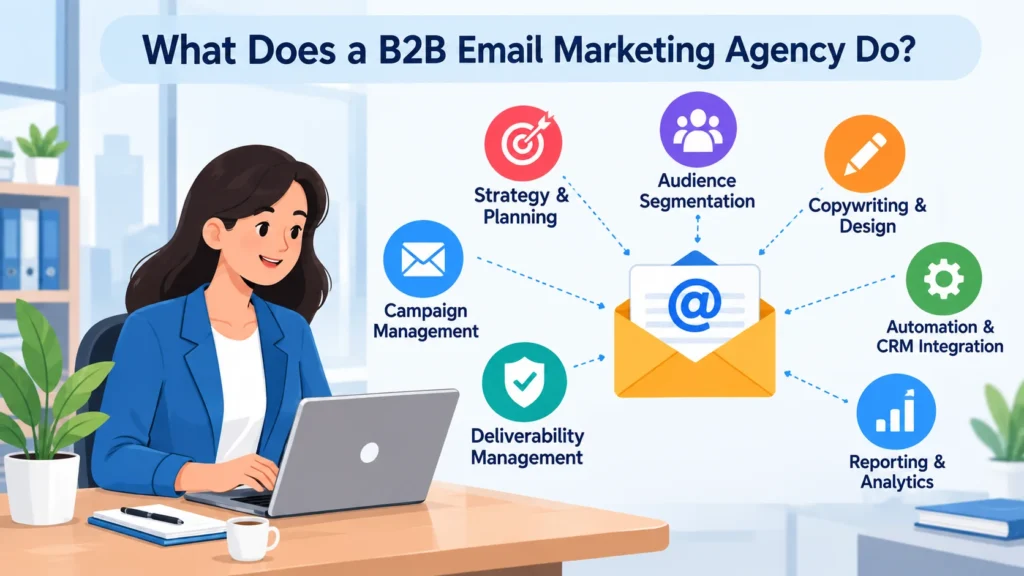
Depending on the provider, services may include:
- Email marketing strategy
- Lead nurturing
- Campaign management
- Audience segmentation
- Copywriting and email design
- Marketing automation
- CRM integration
- Cold email outreach
- Deliverability management
- Account-based marketing (ABM)
- Lead generation
- Reporting and analytics
- A/B testing and optimization
The distinction is important. B2B email marketing is not simply a matter of sending more emails to more people.
B2B purchases can involve multiple decision-makers, long sales cycles, technical products, and several stages of evaluation. Effective email programs therefore need to reflect the recipient’s role, industry, interests, buying stage, and existing relationship with the company.
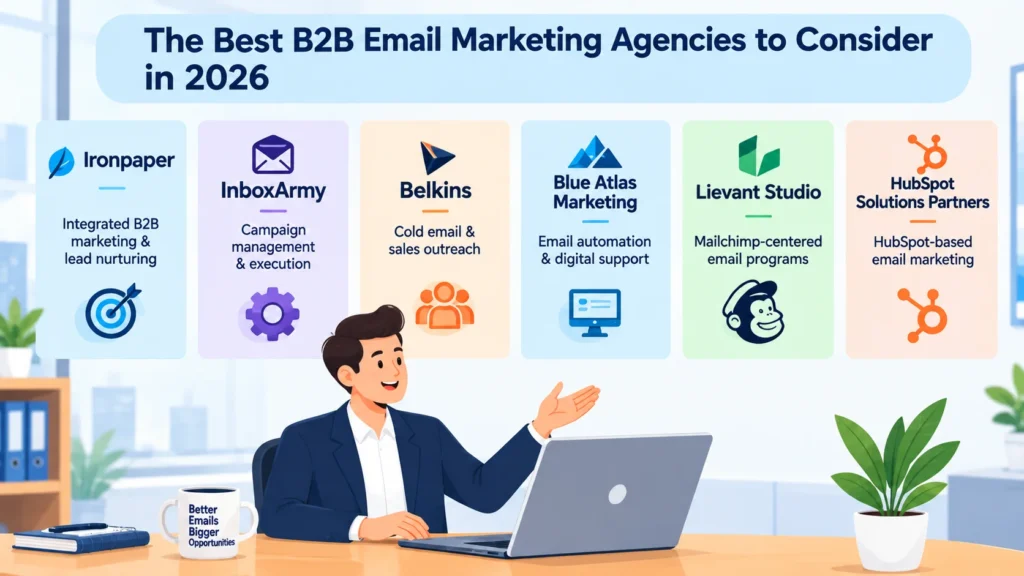
For example, Ironpaper positions its B2B email services around lead generation, demand generation, ABM, sales campaigns, nurturing, and marketing automation—illustrating how email can function as one component of a broader B2B growth system.
The Best B2B Email Marketing Agencies to Consider in 2026
There is no objective ranking that can determine which agency is best for every organization. Needs vary too widely.
The providers below are worth considering because they offer identifiable B2B email capabilities while occupying somewhat different positions within the market.
1. Ironpaper — Best for Integrated B2B Marketing and Lead Nurturing
Ironpaper is a B2B marketing agency that places email within a broader demand-generation and sales-marketing framework.
Its email-related services include lead nurturing, segmentation, automation, analytics, and lifecycle marketing. Rather than treating email as an isolated channel, the agency presents it as part of a larger B2B marketing system.
Best fit: B2B organizations that want email connected to demand generation, lead management, and sales activity.
Potential advantage: The broader B2B marketing perspective may be useful when email needs to work alongside other parts of the customer journey.
Potential limitation: A company that only needs straightforward newsletter production may have little reason to pay for the breadth of a full-service B2B marketing partner.
2. InboxArmy — Best for Hands-On Email Campaign Management
InboxArmy provides B2B email marketing services spanning both strategy and execution.
Its published capabilities include segmentation, copywriting, design, coding, platform setup, deployment, reporting, and ongoing campaign management. In practical terms, that makes it a potential fit for organizations that need an outside team to handle substantial portions of day-to-day email production.
Best fit: Businesses looking for hands-on support with recurring email campaigns.
Potential advantage: Covering multiple stages of production can reduce the operational burden placed on an internal marketing team.
Potential limitation: Before signing, companies should confirm platform expertise, integrations, turnaround expectations, and reporting processes.
3. Belkins — Best for B2B Cold Email and Sales Outreach
Belkins has a stronger emphasis on B2B sales development and outbound email than many traditional email marketing agencies.
Its services include cold email outreach, lead generation, appointment setting, lead nurturing, deliverability support, and omnichannel outreach involving email, LinkedIn, and calling.
Best fit: B2B companies whose primary objective is targeted prospecting and generating sales conversations.
Potential advantage: Email is integrated with sales-development activities rather than treated as an independent marketing channel.
Potential limitation: Businesses primarily seeking newsletter strategy, lifecycle marketing, or customer-retention campaigns may be better served by a different type of specialist.
4. Blue Atlas Marketing — Best for B2B Email Automation and Broader Digital Support
Blue Atlas Marketing appears in Mailchimp’s Expert Directory as a Mailchimp Certified Partner and describes its specialization around B2B lead generation, email marketing automation, and website optimization.
Its listed capabilities extend beyond email, including marketing automation, content, PPC, SEO, and web development.
Best fit: B2B businesses that want email automation alongside broader digital marketing support.
Potential advantage: The wider service offering can be useful when email needs to operate in concert with a website and other acquisition channels.
Potential limitation: Organizations seeking a highly specialized sales-development partner may prefer an agency with a more pronounced cold-email focus.
5. Lievant Studio — Best for Mailchimp-Centered Email Programs
Lievant Studio appears in Mailchimp’s Expert Directory as a Pro Partner. Its listed capabilities include account setup and optimization, audience organization, segmentation, responsive email design, automation, customer journeys, reporting, and integrations.
The profile also indicates that the agency serves B2B organizations alongside clients in other industries.
Best fit: Businesses already using Mailchimp that need professional implementation, automation, segmentation, and campaign support.
Potential advantage: Platform-specific expertise can make implementation considerably easier when Mailchimp is already central to the marketing stack.
Potential limitation: Organizations looking for a broader enterprise revenue-marketing strategy may require capabilities beyond a Mailchimp-centered engagement.
6. HubSpot Solutions Partners — Best for HubSpot-Based B2B Email Marketing
There is another route for organizations already invested in HubSpot: instead of selecting a single agency from a general list, businesses can evaluate providers through the official HubSpot Solutions Directory.
The directory allows companies to search for partners according to services such as email marketing, while also evaluating partner tiers, reviews, industries, and other criteria. HubSpot identifies Elite, Diamond, Platinum, and Gold partner tiers. Still, a higher tier should not be interpreted as a guarantee that a particular provider will be the right fit.
Best fit: B2B organizations already using HubSpot for CRM, marketing automation, or sales operations.
Potential advantage: A suitably experienced HubSpot partner may be able to connect email campaigns with CRM data, workflows, lead management, and reporting.
Potential limitation: A directory can produce many options. Due diligence remains essential.
Browse HubSpot’s email marketing partner directory
B2B Email Marketing Agency Comparison
| Provider | Strongest fit | Notable capabilities | Consider if… |
|---|---|---|---|
| Ironpaper | B2B demand generation | Email, nurturing, ABM, automation, lead generation | Email is part of a larger B2B growth program |
| InboxArmy | Campaign execution | Strategy, segmentation, copy, design, coding, deployment, reporting | You need hands-on email production and management |
| Belkins | Cold outreach | Cold email, lead generation, appointment setting, deliverability | Your priority is outbound prospecting |
| Blue Atlas Marketing | B2B automation | Email, automation, lead generation, website and digital marketing | You want email combined with broader digital services |
| Lievant Studio | Mailchimp programs | Segmentation, automation, design, reporting, integrations | Mailchimp is central to your email stack |
| HubSpot Solutions Partners | HubSpot-based programs | Email, automation, CRM, implementation and related services | You want email closely integrated with HubSpot |
Think of this table as a starting point, not a definitive league table. Agency scope, pricing, staffing, and individual project requirements can vary substantially.
How to Choose the Right B2B Email Marketing Agency
The best agency is ultimately determined by the problem sitting in front of your business.
Not by the label “email marketing.”
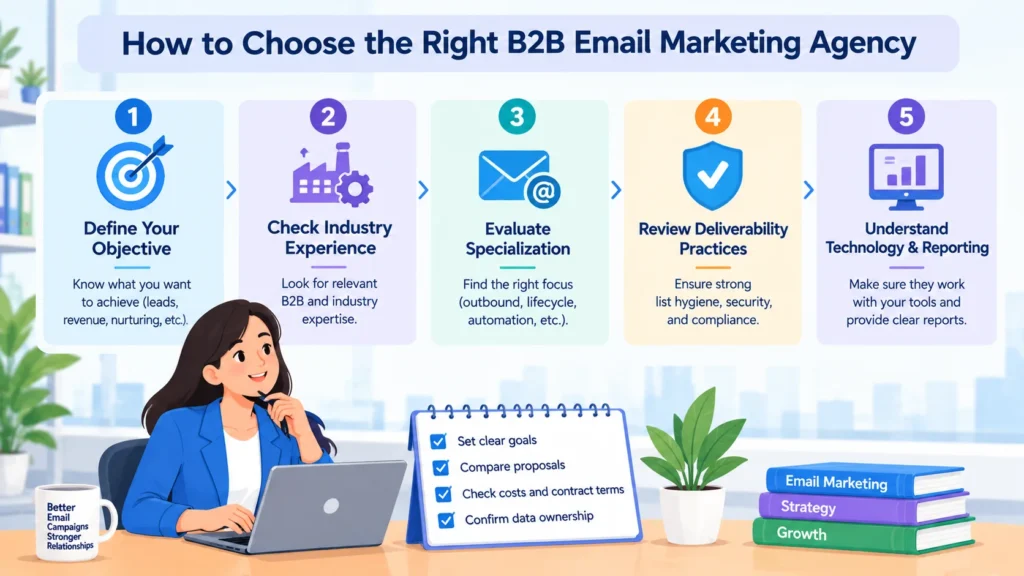
1. Define the Primary Objective
Start with the business outcome rather than the marketing tactic.
Perhaps you need to generate qualified leads. Maybe the priority is booking sales meetings. Or perhaps the bigger challenge is nurturing existing leads, reactivating inactive contacts, improving automation, launching ABM, strengthening deliverability, building a newsletter, integrating email with the CRM, or simply taking a substantial workload away from an overstretched internal team.
Your objective might be to:
- Generate qualified leads
- Book sales meetings
- Nurture existing leads
- Reactivate inactive contacts
- Improve marketing automation
- Launch an account-based marketing program
- Improve email deliverability
- Build a newsletter
- Integrate email with your CRM
- Reduce pressure on an internal marketing team
The distinction can change which agency makes sense.
An outbound prospecting specialist may be excellent at generating appointments but unnecessary for a company whose real need is lifecycle automation.
2. Check B2B Experience in Your Industry
Industry knowledge becomes especially valuable when the product is technical, expensive, regulated, or sold through a complicated buying process.
Ask prospective agencies:
- Which industries do you regularly serve?
- Have you worked with organizations similar to ours?
- How do you learn our products and audience?
- Who will actually write the emails?
- How do you handle technical or specialized subject matter?
- Can you provide relevant examples of previous work?
And don’t stop at recognizable logos.
A famous client list is not automatically evidence that an agency understands your particular market, sales cycle, audience, or product.
3. Evaluate the Agency’s Actual Email Specialization
“Email marketing” is an enormous category.
Two agencies can use exactly the same label while delivering radically different services.
Lifecycle marketing may involve onboarding, nurturing, retention, reactivation, and ongoing customer communications.
Outbound email tends to focus on prospecting, cold outreach, lead qualification, and appointment setting.
Marketing automation can involve workflows, behavioral triggers, segmentation, and CRM integration.
Campaign production may center on copywriting, design, HTML development, deployment, and reporting.
Strategic B2B marketing can combine email with ABM, content, demand generation, and sales alignment.
Before comparing proposals, determine which of these models most closely resembles what your organization actually needs.
4. Ask About Deliverability
A beautifully written email means very little if it consistently disappears before reaching the intended recipient.
Deliverability deserves serious attention.
Ask agencies about:
- Sender reputation
- Domain configuration
- Authentication
- List hygiene
- Bounce management
- Suppression management
- Consent and compliance
- Engagement monitoring
- Deliverability testing
For outbound programs, it is also worth asking how the agency approaches prospecting infrastructure and separates it from other business email activity when appropriate.
Be skeptical of promises involving guaranteed inbox placement or guaranteed response rates. Deliverability is influenced by technical configuration, recipient behavior, sending practices, mailbox providers, and other variables an agency cannot completely control.
5. Understand the Technology Stack
Before hiring anyone, map the systems your organization already uses.
That could include:
- CRM
- Marketing automation platform
- Email service provider
- Analytics tools
- Website or CMS
- Data enrichment systems
- Sales engagement tools
The agency should be able to explain how its work will fit into that environment.
The goal is integration—not creating another disconnected marketing process that your team has to maintain.
What Does B2B Email Marketing Agency Pricing Look Like?
There is no dependable one-size-fits-all price for B2B email marketing services.
Costs can change considerably depending on the scope of the engagement.
Factors may include:
- Number of campaigns
- Number of contacts
- Email volume
- Strategy requirements
- Copywriting
- Design and development
- Marketing automation complexity
- CRM integration
- Reporting requirements
- Deliverability work
- Cold outreach infrastructure
- Lead research
- Appointment-setting services
- Ongoing account management
A small engagement might involve a single campaign, setup project, or limited optimization exercise. A larger B2B organization, by contrast, may need an ongoing retainer covering strategy, content, automation, analytics, reporting, and continuous optimization.
That is why comparing agencies solely by monthly price can be misleading.
A cheaper proposal may exclude important work. If your internal team then has to absorb those responsibilities, the apparent savings can disappear quickly.
Compare scope, not just price.
Questions to Ask About an Agency’s Proposal
Before signing a contract, ask:
- What exactly is included each month?
- How many campaigns or workflows are covered?
- Who owns the email copy and creative?
- Which software costs are included or excluded?
- What reporting will we receive?
- How frequently will campaigns be reviewed?
- Who owns the accounts, data, templates, and creative assets?
- What happens if we end the engagement?
- How are compliance and unsubscribe requirements handled?
- Which metrics determine whether the program needs to change?
Clear answers now can prevent expensive misunderstandings later.
Important B2B Email Marketing Metrics
A strong agency should not simply report email activity. It should connect that activity to the business objective.
Delivery and Deliverability Metrics
These metrics can help reveal technical problems or issues with list quality.
Examples include:
- Delivery rate
- Bounce rate
- Spam complaints
- Unsubscribe rate
- Engagement trends
Engagement Metrics
Depending on the campaign, useful measures can include:
- Click rate
- Reply rate
- Conversion rate
- Landing-page activity
- Form submissions
Open rates can still provide directional information, but they should not be treated as the ultimate measure of campaign performance. Email privacy features and technical factors can influence how opens are recorded.
The more important question is what happened next.
Business Metrics
For B2B organizations, the metrics that matter most may appear much further down the funnel:
- Marketing-qualified leads
- Sales-qualified leads
- Meetings
- Opportunities
- Pipeline contribution
- Revenue influenced by marketing
The right measurement framework depends on the campaign, sales process, audience, and business objective.
Common Mistakes to Avoid
Choosing an Agency Based Only on Claimed Results
Case studies can be valuable. They can also be dangerously easy to misinterpret.
Ask about the campaign period, audience, starting conditions, channels used, and precisely what the reported metric represents.
A result achieved by one organization cannot automatically be transferred to another.
Treating Cold Email and Lifecycle Email as the Same Thing
They aren’t.
Cold outreach generally involves contacting prospects who have not previously established the same kind of marketing relationship with the company. Lifecycle marketing, by contrast, typically involves communications with people who have already interacted with or opted into a business’s communications.
The messaging is different. The technology may be different. Compliance considerations can differ, too.
Most importantly, the success metrics may have little in common.
Focusing Only on Open Rates
A campaign can generate impressive engagement and still fail to produce meaningful business results.
The opposite can happen, too. A highly targeted B2B campaign might generate relatively few responses while creating several valuable opportunities.
Measure what matters to the business.
Ignoring Compliance
Email regulations vary according to jurisdiction and campaign type. Requirements can involve consent, sender identification, unsubscribe mechanisms, data handling, and other obligations.
Before launching a program, both the organization and the agency should determine which laws and industry requirements apply. For example, businesses communicating with audiences in the United States may need to consider the CAN-SPAM Act, while campaigns involving people in other jurisdictions may be governed by different rules.
This article is not legal advice. When requirements are unclear, consult an appropriately qualified legal or compliance professional.
Failing to Establish Ownership
Contracts should clearly establish who owns:
- Contact data
- Email accounts
- Domains
- Templates
- Creative assets
- Automation workflows
- Campaign data
- Analytics accounts
This matters more than it may initially seem.
If you eventually bring the program in-house or move to another agency, unclear ownership can turn a routine transition into a significant operational problem.
A Simple Process for Selecting an Agency
Starting from scratch? Keep the process straightforward.
Step 1: Write a One-Page Brief
Document your audience, products, sales cycle, existing technology, goals, and major challenges.
Step 2: Build a Shortlist
Identify three to five agencies whose specialization genuinely matches your requirements.
Step 3: Request Comparable Proposals
Give each agency essentially the same core information and ask for comparable deliverables.
That makes differences easier to see.
Step 4: Assess Strategy, Not Just Price
Examine how each provider intends to segment audiences, develop messaging, manage technology, measure results, and optimize the program over time.
A proposal that looks cheap on paper may be far less attractive once you examine what it actually includes.
Step 5: Establish Expectations Before Launch
Define responsibilities, timelines, reporting requirements, approval procedures, and success metrics before the first campaign goes live.
Clarity at the beginning tends to save considerable friction later.
Frequently Asked Questions
What is a B2B email marketing agency?
A B2B email marketing agency is a specialized marketing provider that helps businesses plan, execute, and manage email programs for professional or organizational audiences.
Depending on the agency, services can include strategy, copywriting, segmentation, automation, campaign management, lead nurturing, deliverability, analytics, and outbound prospecting.
How much does a B2B email marketing agency cost?
There is no universal industry-wide price.
Costs can vary according to campaign volume, audience size, strategy, creative requirements, technology, automation, integrations, and whether the engagement includes lead generation or sales-development services.
The most useful approach is to request detailed proposals and compare the actual scope of work.
Is a B2B email marketing agency worth hiring?
It can be.
An agency may make sense when an internal team lacks the time, expertise, technical skills, or specialized resources required to operate the program effectively.
But not every business needs one. Organizations with experienced internal email teams may only need outside assistance for specialized projects or particularly complex initiatives.
What is the difference between B2B email marketing and cold email?
B2B email marketing is a broad category that can include communication with subscribers, leads, customers, and prospects throughout the customer lifecycle.
Cold email generally refers to outbound prospecting in which the recipient has not previously established the same type of marketing relationship with the sender.
Because the context differs, strategy, technology, compliance considerations, and success metrics can differ as well.
How do I choose the best B2B email marketing agency?
Begin with the business objective.
Once you know what you want the program to accomplish, identify agencies whose specialization matches that objective. Then evaluate their B2B and industry experience, technology expertise, deliverability practices, reporting, pricing, contract terms, ownership policies, and communication processes.
In most cases, comparing several detailed proposals is more useful than relying on a generic “top agency” ranking.
Conclusion
The best B2B email marketing agency is not necessarily the biggest provider, the cheapest option, or the company with the flashiest case study.
It is the one whose capabilities line up with the problem your business actually needs to solve.
If your priority is integrated B2B demand generation and lead nurturing, a provider such as Ironpaper may be worth evaluating. For hands-on campaign execution, InboxArmy may be more relevant. Organizations focused primarily on outbound prospecting may find Belkins a closer match. Mailchimp users can investigate specialists through Mailchimp’s Expert Directory, while HubSpot customers can use the HubSpot Solutions Directory to identify potentially relevant partners.
The smartest selection process starts before the shortlist.
Define the objective. Identify the required specialization. Compare proposals on equal terms. Examine deliverability, compliance, technology, reporting, and ownership. And don’t let a low monthly price obscure a weak scope of work.
Because ultimately, effective B2B email marketing isn’t about sending more messages.
It’s about sending the right message, to the right audience, at the right point in the customer and sales journey—and being able to connect that activity to a meaningful business outcome.
To explore more about email marketing tools and find expert comparisons, reviews, and helpful guides, visit AmiinMarketer.com